data analyst

Data Analyst Certification Program: Your Practical Path from SQL to Gen AI to a First Job

Data Analyst certification program
Table of Contents
    Add a header to begin generating the table of contents

    A data analyst certification program is often the fastest structured route into a data career. It gives you a clear syllabus, real tools and proof of skill that employers can check.

    This guide explains what a good program teaches, how the learning path works, which tools matter, and what to expect on salary and placement. It is written for freshers, working professionals changing careers and aspiring data analysts.

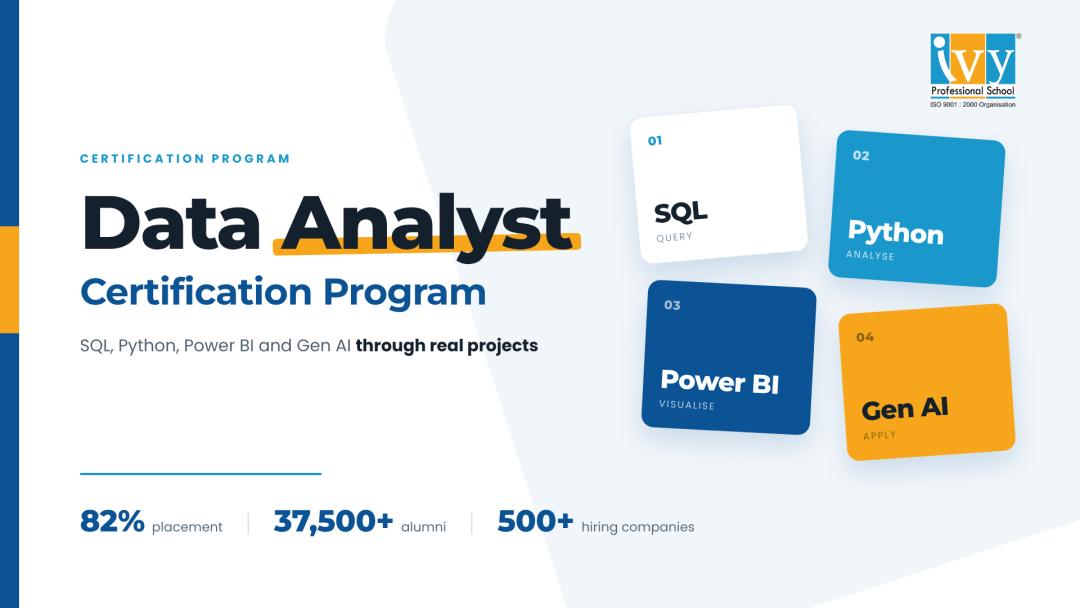
    Quick answer: The best data analyst certification program teaches SQL, Python, Power BI and Gen AI through real projects. It then helps you with your resume, mock interviews and hiring company introductions.

    What Is a Data Analyst Certification Program?

    A data analyst certification program is a structured course that trains you in the skills a data analyst uses at work. It ends with an assessment, projects and a certificate.

    The certificate alone does not get you hired. The skills, the projects and the placement support behind it do.

    Certificate Versus Certification

    A certificate shows you attended a course. A certification shows you passed an assessment that tests real skill.

    Employers value the second. Pick a data analyst certification program that tests you on queries, dashboards and case problems, not on memorised definitions.

    Why a Data Analyst Certification Program Matters Now

    Every team now works with data. Sales, finance, HR, marketing and operations all need a data analyst who can answer business questions with numbers.

    A certification program gives you a faster and more focused path than studying alone. You follow a tested sequence, get feedback and build a portfolio.

    What Employers Look For in a Data Analyst

    Most job descriptions ask for the same core skills:

    • SQL for pulling data from databases
    • Python for cleaning data and automation
    • Power BI for dashboards and reports
    • Statistics and sound business thinking
    • Clear communication with non-technical teams
    • Practical use of Gen AI tools

    A good program covers all six and proves them through projects.

    Who Should Join a Data Analyst Certification Program

    Three groups benefit most. Each starts from a different place.

    Freshers and Recent Graduates

    If you have just finished a degree in commerce, science, engineering or arts, this program gives you a job-ready skill set. You do not need a coding background.

    Working Professionals Moving Into Data Roles

    Many learners come from sales, operations, finance or teaching. Your domain knowledge is a real advantage. A finance executive who learns SQL and Power BI can move into a finance analytics role faster than most freshers.

    Aspiring Data Analysts

    If you already know some Excel or have tried free tutorials, a certification program fills the gaps. You get a fixed sequence, trainer feedback and projects you can show in interviews.

    What a Good Data Analyst Certification Program Should Include

    Use this table to compare programs before you pay any fee.

    ComponentWhat it should coverWhy it matters
    Excel and statisticsFormulas, pivot tables, probabilityBuilds analytical thinking
    SQLJoins, subqueries, window functionsTested in most interviews
    Pythonpandas, NumPy, MatplotlibHandles large, messy data
    Power BIPower Query, DAX, dashboardsTurns analysis into reports
    Gen AIPrompting, LLM tools, tokenizationSpeeds up routine work
    Capstone projectsEnd-to-end business problemsGives proof of skill
    Placement supportResume, mock interviews, hiring partnersTurns skill into offers

    The Learning Path: Beginner to Job-Ready

    Sequence matters more than the number of topics. This path suits most learners.

    Stage 1: Foundations

    Begin with Excel, basic statistics and how business data is structured. Learn to summarise numbers with averages, medians and distributions.

    Do not skip this stage. Weak statistics is the main reason a new data analyst presents a confident chart with the wrong answer.

    Stage 2: SQL

    Most business data sits in databases, so SQL comes next. Learn to filter, group, join and rank data until you can answer a business question unaided.

    Stage 3: Python

    Python lets you handle data that is too large or too messy for Excel. Learn it after SQL, once you already think in tables and filters.

    Stage 4: Power BI

    Now learn to present your findings. Power BI turns your analysis into dashboards that managers read in minutes.

    Stage 5: Gen AI, Capstone Projects and Interview Preparation

    The final stage adds Gen AI skills, a capstone project and placement preparation. By now you can build something real and explain it clearly.

    Hands-On Tool Breakdown

    Tools change, but the thinking behind them lasts. Here is what you should be able to do with each one.

    SQL for the Data Analyst

    SQL is how you ask a database questions. Almost every data analyst interview has a SQL round.

    Focus on these areas:

    • SELECT, WHERE, GROUP BY and HAVING
    • INNER, LEFT and RIGHT joins
    • Subqueries and common table expressions
    • Window functions such as RANK and running totals

    Practise on realistic tables such as orders, customers and products. Interviewers prefer clean queries over memorised syntax.

    Python for the Data Analyst

    Python is the main programming language for analysis and automation. You use it to clean data, explore patterns and repeat work without manual effort.

    Core libraries to learn:

    • pandas for tables, merging and cleaning
    • NumPy for numerical work
    • Matplotlib and Seaborn for charts
    • scikit-learn for simple prediction models

    A typical task is taking a large sales file, fixing dates, removing duplicates and finding the products that drive profit.

    Power BI for Reporting

    Power BI is widely used in Indian companies for dashboards that refresh automatically. A strong report answers one business question at a glance.

    Key skills include:

    • Power Query for cleaning and shaping data
    • Data models with relationships between tables
    • DAX measures for sales, growth and averages
    • Slicers, filters and drill-through pages

    If your manager needs a long explanation of your dashboard, redesign it.

    Gen AI for Everyday Analysis

    Gen AI tools can draft SQL and Python, summarise reports and sort customer feedback into themes. They save time, but they also make mistakes.

    Check every output against the data. A data analyst who verifies Gen AI output is faster. One who trusts it blindly is a risk.

    Tokenization in Plain Words

    Tokenization splits text into small units called tokens. A token can be a word, part of a word or a single character.

    This matters to a data analyst for three reasons:

    • Gen AI tools set limits and costs in tokens
    • Text analysis, such as sentiment and word counts, starts with tokenization
    • Mixed-language text, like Hinglish reviews, tokenizes differently from clean English

    Knowing this helps you design better Gen AI workflows and avoid surprise costs.

     

    How Long Does It Take?

    Most learners need several months of regular study to become job-ready. The exact time depends on your starting point and the hours you can give each week.

    • Freshers with no coding background need the longest ramp-up
    • Professionals with Excel or reporting experience move faster
    • Daily practice matters more than long weekend sessions

    Plan the learning path in stages and finish one project before starting another. Rushing through topics leaves gaps that interviews expose.

    Be careful with promises of results in a few weeks. Real skill takes repeated practice on real data.

    Skills Beyond Tools

    Tools get you shortlisted. Judgement gets you hired. Employers look for a few habits that no software teaches.

    Business Understanding

    Know how the company makes money. A number matters only when you can link it to revenue, cost or customer experience.

    Communication

    Explain findings in plain words. Use one chart per point and one sentence per finding.

    Curiosity and Care

    Ask why a number looks odd before you report it. A careful check catches errors that embarrass analysts later.

    Real-World Capstone Projects

    A capstone project separates a certificate from a skill. Recruiters want to see how you handle a full problem, from raw data to a recommendation.

    ProjectBusiness questionToolsWhat you deliver
    Sales and profit dashboardWhich regions and products earn most?SQL, Power BIInteractive dashboard
    Customer churn analysisWhy are customers leaving?PythonFindings and a simple model
    HR attrition studyWho is likely to resign?Python, Power BIReport with recommendations
    Feedback analyserWhat do customers complain about?Python, Gen AI, tokenizationSummary of themes

    How to Present Your Capstone Project

    Put each project in a portfolio with a short write-up. State the problem, the data, your method and the result in plain language.

    Add a link to your dashboard or code. A hiring manager should grasp your work in two minutes.

    Salary Expectations for a Data Analyst in India

    Pay depends on your city, skills, domain and the company. No data analyst certification program can promise a fixed salary, and you should be wary of any that does.

    These factors usually raise the offer:

    • Strong SQL and a clear portfolio
    • Domain knowledge from a previous job
    • Power BI and Python used together
    • Confident communication in interviews
    ProfileWhat raises paySalary range per year (INR)
    Fresher data analystSQL, Power BI, strong projects₹3.5 to 6 lakh
    Career switcherDomain knowledge plus data skillsNo sourced range
    Experienced data analystPython, Gen AI, business impact₹8 to 15 lakh

    Ivy Professional School reports a 67% average salary hike for learners who move into new roles after training. Your own result depends on your starting point and effort.

    Placement Support: What to Look For

    Placement support should be specific, not a vague promise. Ask every institute exactly what it does for you.

    Core Placement Mechanisms

    A useful data analyst certification program with placement includes:

    • Resume and LinkedIn profile review
    • Portfolio building from your capstone projects
    • SQL and Python practice tests
    • Mock interviews with trainers and practitioners
    • Introductions to hiring companies
    • Career guidance after the course ends

    Questions to Ask Before You Enrol

    • How does the institute calculate its placement percentage?
    • How many hiring companies recruit from its learners?
    • Does it support working professionals as well as freshers?
    • Will you get help until you receive an offer?

    Honest answers tell you more than any brochure.

    Career Paths After Certification

    Your first role is a starting point, not a ceiling. Most learners begin in one of a few common roles.

    Common Entry Roles

    • Business analyst, who links business questions to numbers
    • MIS or reporting analyst, who owns recurring reports
    • Marketing analyst, who studies campaigns and customer behaviour
    • Operations analyst, who tracks cost, delivery and efficiency
    • Finance analyst, who builds models and variance reports

    Where You Can Go Next

    After two or three years, many analysts move into senior analyst, analytics manager or data science roles. Choose a domain early. An analyst who understands retail, banking or healthcare is harder to replace.

    A Worked Example: Answering a Business Question

    Imagine a retail manager asks why sales fell last month. A good analyst clarifies the question before opening a chart.

    Follow this sequence:

    1. Define the question: which stores, products and dates
    2. Collect the numbers from the right tables
    3. Clean them and check for gaps or duplicates
    4. Compare against last month and last year
    5. Find the cause, such as a stock shortage or an ended discount
    6. Present one clear recommendation

    The result is a one-page summary. The manager wants to know what happened and what to do next.

    Resume and Interview Preparation

    Your resume should show what you built, not only what you studied. Lead with projects, name the tools and state the result in one line.

    Resume Tips

    • Keep it to one page if you are a fresher
    • List projects above certificates
    • Describe each project with the problem, method and outcome
    • Use plain language, not buzzwords

    Interview Preparation

    Expect technical, case-based and behavioural rounds. Technical rounds test your queries and logic. Case rounds give you a business problem and ask how you would approach it.

    Practise explaining a project aloud. If you cannot describe your dashboard in two minutes, the interviewer will notice.

    Why Ivy Professional School

    Ivy Professional School has trained learners in data skills since 2008. These are the approved figures for our programmes.

    MeasureFigure
    Experience18+ years (since 2008)
    Alumni37,500+
    Trainers400+
    Hiring companies500+
    Placement82%
    Average salary hike67%
    Google rating4.8/5 from 2,250+ reviews
    RecognitionRecognized by MeitY

    Classes run in Kolkata, Bangalore, Delhi, Pune and Mumbai, with an online option for learners elsewhere. The program focuses on SQL, Python, Power BI and Gen AI, with projects at every stage.

    Common Mistakes Learners Make

    Many learners lose months to avoidable errors. Watch for these:

    • Collecting certificates without building anything
    • Jumping to machine learning before basic analysis is solid
    • Copying project code without understanding it
    • Ignoring communication skills
    • Learning every tool a little instead of a few tools well

    Depth beats breadth. Employers hire people who can finish a task.

    How to Study While Working a Job

    Working professionals have less time but more context. A steady routine beats occasional long sessions.

    • Fix a daily slot, even if it is only an hour
    • Practise on your own team’s data where rules allow, after removing sensitive details
    • Revise weekly and note what you learned
    • Ask trainers questions early

    Treat your job as a source of project ideas. A report you build for your team can become a portfolio piece.

    How to Choose the Right Data Analyst Certification Program

    Use this short checklist before you pay:

    • Does the syllabus cover SQL, Python, Power BI and Gen AI?
    • Are the trainers working practitioners?
    • Do you build capstone projects, not just watch videos?
    • Is placement support described in detail?
    • Can you speak to past learners from your background?

    If most answers are yes, you are looking at a serious program.

    Setting Realistic Expectations

    Learning data skills takes steady effort over several months. Some people receive an offer quickly, and others need more projects and more interview practice.

    That is normal. Keep building, keep applying and ask for feedback after every interview. Each round teaches you something the next round will reward.

    Track progress in a simple sheet. Note each application, the interview stage reached and the topics you found hard. After ten interviews, the pattern shows you exactly what to revise.

    Frequently Asked Questions

    Do I need coding experience to join?

    No. A good program starts from the basics. Many successful analysts began with only Excel.

    Which should I learn first, Python or SQL?

    Learn SQL first. It is easier to start with and appears in almost every interview.

    Does a data analyst certification program guarantee a job?

    No program can guarantee a job. A good one improves your skills, portfolio and access to hiring companies, and your effort decides the rest.

    Final Word

    Data analytics rewards steady practice. Choose a data analyst certification program that teaches SQL, Python, Power BI and Gen AI through real projects, and supports you all the way to the interview.

    Start with one small project this week, share it with a mentor and improve it based on feedback. Small, consistent steps compound faster than learners expect.

    If you are ready to start, speak to an Ivy counsellor and as

    Is a Data Science Course Worth It in 2026? ROI, Salary & Career Growth

    Is a Data Science Course Worth It in 2026
    Table of Contents
      Add a header to begin generating the table of contents

      A few years ago, enrolling in a data science program almost guaranteed a job. But in today’s evolving landscape, the question has changed.

      In 2026, the real question is not whether data science is in demand—it is whether a data science course in 2026 will actually deliver meaningful ROI for your career.

      Let’s break this down across three key dimensions: ROI, salary, and long-term career growth.

      1. The Reality Shift in 2026

      Before evaluating whether a data science course in 2026 is worth it, you need to understand one major shift.

      Data science hasn’t declined—it has matured.

      Companies today are not hiring people who just know tools. They are hiring professionals who can use data and AI to drive decisions.

      What has changed:

      • Entry-level roles are more competitive
      • Mid-level and specialized roles are growing rapidly
      • AI tools are automating repetitive tasks, not replacing data professionals

      This means that simply completing a data science course in 2026 is not enough—you need to bring real-world value.

      2. Salary: What You Can Actually Earn

      Let’s address the most practical concern—earning potential.

      Average Salary in India (2025–2026)

      • Freshers: ₹5–10 LPA
      • 2–3 years: ₹10–20 LPA
      • 5+ years: ₹15–35 LPA (or more in top firms)

      The average salary is around ₹10 LPA.

      Growth Curve

      • Salaries grow faster than many traditional roles
      • Typically 20–30% higher than data analytics roles
      • Senior professionals can cross ₹40 LPA

      However, completing a data science course in 2026 does not guarantee these numbers.

      Your salary depends on:

      • Real project experience
      • Business understanding
      • Ability to use AI tools effectively
      • Problem-solving skills

      A certificate alone does not create value—execution does.

      3. ROI: Is the Investment Worth It?

      Let’s evaluate the ROI of a data science course in 2026 in practical terms.

      Cost of a Data Science Course

      • ₹50,000 to ₹3,00,000 depending on depth and institute

      Expected Outcome

      • Entry-level job: ₹5–10 LPA
      • Career switch: 30–100% salary increase (common case)

      ROI Timeline

      • Break-even: 6–12 months (if placed well)
      • Long-term returns: exponential growth

      Why ROI Still Works

      A well-designed data science course in 2026 offers:

      • A high-income career path
      • Skills applicable across industries
      • Opportunities in AI, ML, analytics, and leadership roles

      The key is not the course—it’s how you leverage it.

      4. Career Growth: Where Does It Lead?

      One of the strongest arguments for a data science course in 2026 is long-term career flexibility.

      Typical Career Path

      Alternative Paths

      Why Growth Is Strong

      • Every industry uses data (finance, healthcare, retail, manufacturing)
      • AI adoption is accelerating
      • Decision-making is becoming data-driven

      A data science course in 2026 is not just about a job—it is a foundation for the AI economy.

      5. The Harsh Truth Most Courses Won’t Tell You

      Let’s be direct.

      A data science course in 2026 is NOT worth it if:

      • You only learn tools like Python, SQL, or Power BI
      • You don’t build real-world projects
      • You expect placement without effort
      • You avoid statistics and problem-solving

      But it is worth it if:

      • You focus on solving business problems
      • You build a strong portfolio
      • You understand how companies use data
      • You combine data + AI + communication skills

      This is the difference between:

      ₹4 LPA candidate vs ₹15 LPA candidate

      6. The Role of AI: Threat or Opportunity?

      A common concern is whether AI will replace data scientists.

      The reality is different.

      AI is:

      • Replacing low-level repetitive tasks
      • Increasing demand for high-level thinkers

      Companies now expect professionals to:

      • Validate AI outputs
      • Design data-driven systems
      • Interpret insights
      • Make business decisions

      A data science course in 2026 should prepare you for this shift.

      The future role is not just a “data scientist”—it is an AI-enabled decision-maker.

      7. Who Should Take a Data Science Course?

      A data science course in 2026 is ideal for:

      Freshers

      • Looking for a high-growth career
      • Comfortable with logical thinking

      Working Professionals

      • Want to switch into analytics or AI
      • From backgrounds like finance, marketing, operations, IT

      Managers & Leaders

      • Want to become data-driven
      • Need to understand AI’s impact on business

      8. Final Verdict: Is It Worth It?

      Short answer: Yes—but only if done right.

      A data science course in 2026 is worth it if:

      • It focuses on real-world application
      • It builds decision-making ability
      • It prepares you for AI-integrated roles

      Because:

      • Salaries remain strong
      • Demand continues to grow
      • Career paths are flexible
      • Long-term ROI is high

      But one thing is clear:

      The shortcut era is over.
      The “learn → build → apply → communicate” era has begun.

      Final Takeaway

      If you treat a data science course in 2026 as:

      ❌ Just a certificate → Not worth it
      ✅ A career transformation tool → One of the best investments you can make

      Success in 2026 is not about knowing more tools.

      It’s about creating real impact with data.

      Prateek Agrawal

      Prateek Agrawal is the founder and director of Ivy Professional School. He is ranked among the top 20 analytics and data science academicians in India. With over 16 years of experience in consulting and analytics, Prateek has advised more than 50 leading companies worldwide and taught over 7,000 students from top universities like IIT Kharagpur, IIM Kolkata, IIT Delhi, and others.

      5 Easy And Effective Roadmap For Data Analyst

      It is not surprising that Data Science is growing rapidly and is expected to reach a market worth USD 350 billion by the end of 2022. The hierarchy has been divided into many categories, such as Data Scientists, Data Analysts, Data engineers, etc., and they are monopolizing the IT sector as a result of the increasing demand and speed. This article will act as a roadmap for Data Analysts. 

      As per the recent survey, it was found that the market was unsuccessful in fulfilling the demand for Data Analysts for the past couple of years and is the reason people are shifting their careers into the Data Science niche because of the major attraction that this niche offers which is growth and salary opportunities.

      An Easy Roadmap For Data Analyst

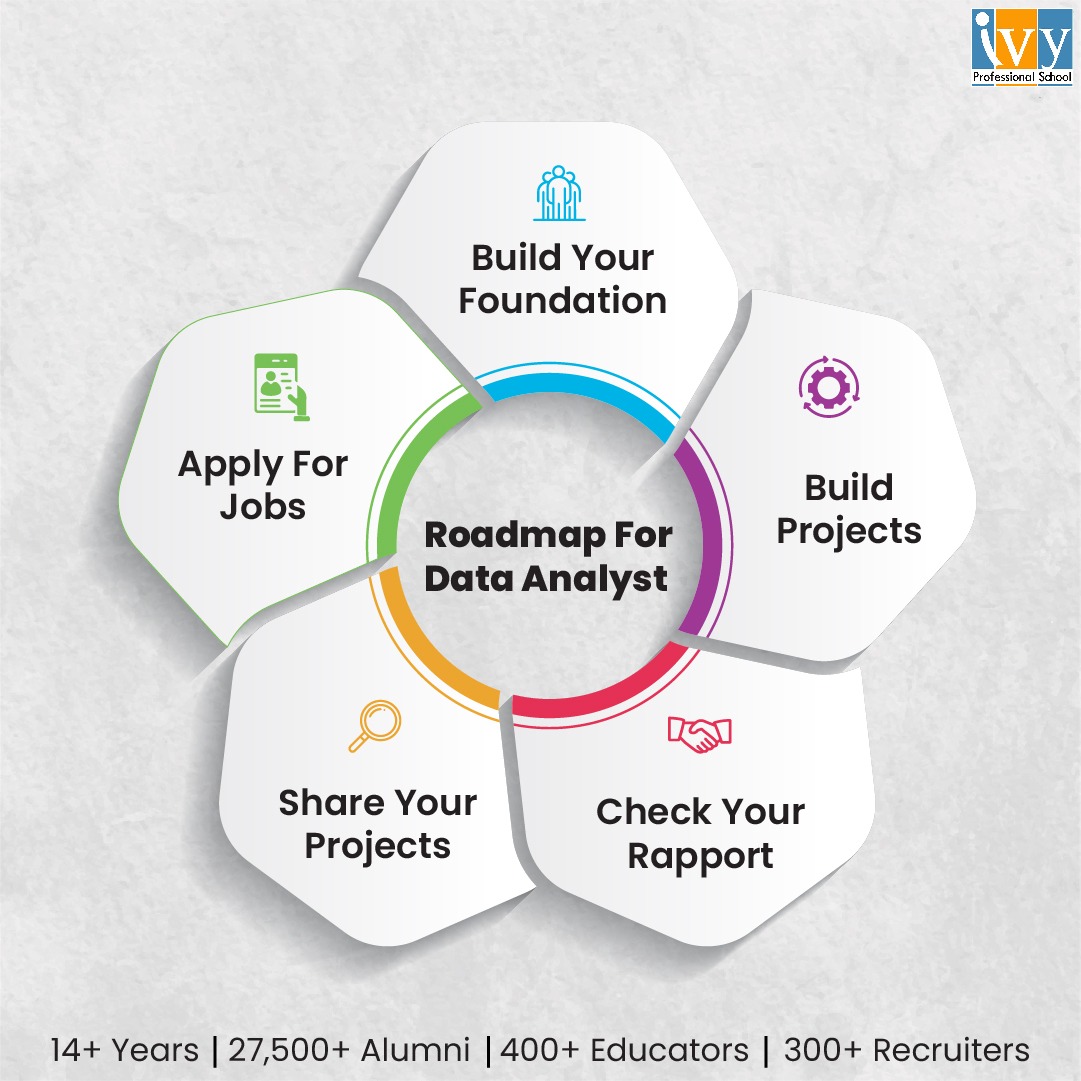
      These easy steps will help you in building your career in Data Science. Data Science is no rocket, you just need to follow a few steps and be dedicated to achieving what you wish. Then becoming a Data Analyst is just a matter of a few months. So without any further delay let us begin with the roadmap for Data Analyst.

      roadmap-for-data-analyst
      Roadmap For Data Analyst

      1. Build Your Foundation

      It is very crucial to have your basics ready. The Data Science industry is all about understanding and if you have that, you are almost there. To create a solid foundation, the first step you will have to take is to enroll in a good data analytics course. Learning the basics will help you a lot in your career. Along with this if you get the chance to practice on some real-life industry-level projects then that will help you more. In this respect, we would take some time to tell you about Ivy Professional School. This is a data analytics institute that offers industry-relevant courses along with real-life projects and placement assistance. Ivy understands the importance and scope of Data Science in the present market scenario and creates its courses accordingly. Their courses are led by industry experts and help a lot in enriching your resume with real-life projects.            

      2. Build Projects

      This is one of the most crucial steps in this roadmap for Data Analyst. As stated above, working on real-life projects will increase the weightage of your resume and will also help you in building confidence. There are a few ways to work on real-life projects:

      • Decide a use case
      • Get your hands on the dataset from Kaggle or any other relevant website. 
      • Apply all your practical learning from the course. 

      Here are some of the examples that you can consider in creating your project. 

      • Data cleaning and data wrangling messy data using Python. 
      • Write a SQL query for extracting the data. 
      • Create a dashboard in Tableau with 2-3 views. 

      3. Check Your Rapport

      Connect and network with like-minded people on Twitter, LinkedIn, or any other social media site you want. For instance, building relationships in this way should be your strategy if you want to improve as an analyst. 

      • Make a list of the companies you want to work for and keep up with them.
      • Make connections with people whose titles match what you’re seeking. Data Analysts, Business Intelligence Analysts, etc.            are a few examples.
      • Make contact with key leaders like VP-Analytics, Director-Analysis, and Senior Data Analyst.
      • Connect with hiring managers and HR staff.

      4. Share Your Projects

      Let the Data Science industry know you. Showcase your projects on various social media handles. There are a few points to keep in mind while you share your projects. 

      • Include a picture of the dashboard or code.. 
      • Write a few sentences about it to provide background and discuss the motivation behind the endeavor.
      • Share the URL to your GitHub repository or other project storage location.

      5. Apply For Jobs

      When you have the above-mentioned steps, you can start to apply for jobs. The best thing about the Data Science field is that you can apply for jobs based on specific tools. So suppose you opt for Data Science With Vizualization certification course at Ivy, you can apply for the tools like Excel, or Power BI once they are completed individually. So this is the benefit that this industry offers. 

      There are various portals from where you can apply such as LinkedIn, Naukri, Indeed, and many more. But the best among them is LinkedIn. It offers wide exposure to all the spheres of recruitment. Here are some ways by which you can look for jobs in the Data Science domain:

      • Look for startups and MNCs, and inquire as to whether they have any positions that might be suitable.
      • Try websites like Hirect, Cutshort, etc., where business owners may recruit directly.
      • Keep an eye on these leaders’ posts that you have linked with. They frequently immediately share chances through posts.

      With this, your roadmap for Data Analyst ends. Follow these steps with determination and smart work to achieve optimum results.

      Wrapping Up

      Today, billions of businesses produce data every day and use it to inform important business choices. It aids in determining their long-term objectives and establishing new benchmarks. In today’s world, data is the new fuel, and every industry needs Data Analysts to make it useful. The market share of Data Analysts is expected to increase by USD 650+ billion at a CAGR of around 13%, making it one of the most sought-after professions in the world. The more data, the greater the need. So if you are planning to make your career in data analytics then it is indeed the best choice. Hope this roadmap for Data Analyst helped you. You can also get free 1:1 career counseling to clear all your doubts regarding this industry. For.. more details visit Ivy’s official website.

      8 In-Demand Data Engineering Skills

      data engineering skills
      What are the most important data engineering skills?

      Guess how much data engineers earn? An average salary of ₹7,44,500 per year in India. And senior data engineers earn between ₹11 lakhs to ₹24 lakhs per year.

      And if you search for data engineering jobs on Indeed or LinkedIn, you will find over 20,000 vacancies in India alone. But why am I telling you all this? 

      Because I want to show how in-demand data engineers are in the market. With more and more companies relying on data to make smart decisions, data engineering has become a necessity.

      Now, if you want to start a career in data engineering, you have to learn some technical and soft skills. In this post, I will tell you what those essential data engineering skills are and how you can start your career in this field. 

      Table of Contents
        Add a header to begin generating the table of contents

        What Does a Data Engineer Do?

        You can think of data engineers as the architects of the data world. They build and maintain systems and architecture to collect, store, and manage data.

        For example, they work with ETL (extract, transform, load) processes to combine data from multiple sources into a central repository. Similarly, they build data pipelines, work with databases, and manage data warehouses.

        They basically prepare the raw data for analysis so that data analysts and data scientists can do their jobs. This way, they work together to help the company find valuable insights and make decisions that lead to business growth. 


        Data Engineering Skills You Must Learn

        To perform all those tasks, data engineers need to gain expertise in various processes, tools, and technologies. They also need soft skills to work together as a team and communicate effectively. Here are all the skills you would need to become a pro data engineer:


        1. Programming

        Aspiring data engineers often ask me, “Is coding important?” And I always tell them that coding is one of the most important skills for data engineers. It is what will help you optimize and automate data workflows as well as improve data quality and reliability. Here are some programming languages often used in data engineering:

        Python: It’s good for handling big data, automating tasks, and working with different data formats. It has a range of libraries that make data processing easier and faster.

        SQL: It helps manage and query large databases. It’s also needed for data handling tasks like extracting, organizing, and updating data stored in databases.

        Java: This language helps you build scalable, high-performance data pipelines. It helps you develop large, reliable systems that handle big data processing efficiently.

        Scala: It helps you work with distributed data systems like Apache Spark. It’s specifically designed to handle large datasets while maintaining performance.

        R: It helps in data analysis and statistical tasks. You will need it to perform complex data manipulation and generate insights from data sets.

        You can go through this data engineering syllabus to learn more about technical skills that are valued in the present market.


        2. Data Warehousing

        One of the most important roles of data engineers is to store and organize raw data in data warehouses. Data warehouses are simply central repositories that allow access to real-time data for analysis and decision-making. 

        Without this skill, you won’t be able to manage the high volume and complex data most companies handle today. So, you need to know about data warehousing solutions like Panopoly or Amazon Redshift. This way, you can make data storage, retrieval, and processing more efficient.


        3. Operating Systems

        Knowing programming languages isn’t enough. You also need an understanding of operating systems to design, develop, and troubleshoot systems. As a data engineer, you will work with operating systems like Linux, UNIX, macOS, and Windows because data infrastructure often runs on these platforms. For example, Linux is widely used in data engineering because of its stability, flexibility, and performance. 


        4. Database Management

        This data engineering skill helps you design, maintain, and optimize databases. SQL is the most widely used language for managing relational databases, allowing you to query, update, and manipulate data efficiently. You also need to learn NoSQL databases like Cassandra or Bigtable, which are better suited for handling unstructured data.

        You can learn basic SQL queries, cleaning and modifying data, aggregating and analyzing data, working with multiple data tables, troubleshooting and error handling, advanced filters in SQL, data definition language, data manipulation language, using subqueries, creating user-defined functions, etc. 


        5. Big Data Engineering

        This is an important data engineering skill because you will often have to work with big datasets that traditional databases can’t handle. It will make you an expert at managing and processing data on a large scale.

        For this, you can learn Hadoop, which includes topics like MapReduce, YARN, HDFS, data spilling, data replication, Daemons, etc. You have to learn Apache Hive to query large datasets using HiveQL. You also need to know Apache Spark, how to optimize it, and how to process data in real time. A good understanding of real-time data processing with Kafka and its integration with Spark is also important.


        6. Azure Cloud Engineering

        Microsoft Azure is a cloud platform that provides scalable, secure, and cost-effective data storage and processing solutions. So, this skill helps you build and maintain data pipelines, store data, and run large-scale analytics in the cloud. 

        Here, you will learn about Azure services like virtual machines, storage, and database services. Next, you can understand advanced data engineering with Azure and real-time data streaming and processing. Learning hybrid cloud scenarios, governance, and compliance is also necessary.


        7. Critical Thinking

        This data engineering skill helps you better analyze and evaluate a situation. You need this to identify problems related to data collection, storage, or analysis and then develop effective solutions. You have to come up with innovative solutions to improve the performance of the systems and the quality of the data. This is where critical thinking helps you. 


        8. Communication

        As a data engineer, you will collaborate with other team members and business leaders with and without any technical expertise. So, better communication skills help you explain data processes and systems and share updates without any misunderstandings. For example, you may have to work with data scientists or analysts and share findings and suggestions. And you know, this skill not only helps you in data engineering but also in your entire life. 


        How to Become a Data Engineer

        Now, let’s understand how to become a data engineer:

        1. Complete Your Education

        Even though formal education may not be that important these days, most employers need data engineers to hold at least a bachelor’s degree. You should hold a degree in something like computer science, computer engineering,  information technology, software engineering, applied math, statistics, physics, or a related area. 


        2. Learn Industry-Relevant Skills

        You just saw the important data engineering skills in the above section. You need to master them. And one of the best ways to do it is to take a comprehensive course.

        For example, Ivy Professional School’s IIT-certified Data Engineering Certification course helps you learn all the in-demand skills like SQL for data engineering, Python essentials for data, Big data processing, and Azure cloud engineering. 

        This 45-week live online course will make you an expert at building a complete ETL data pipeline on the cloud with tools like Azure, Hive, MongoDB, Spark, Hadoop, etc. The really interesting thing about this program is that you will learn from IIT Guwahati professors and expert professionals at Amazon, Google, Microsoft, etc.


        3. Gain Experience and Build Your Portfolio

        Just gaining theoretical knowledge isn’t enough. You also need to know how to implement your knowledge and solve real business problems. And you can do this by working on data engineering projects and doing internships. 

        Again, Ivy Professional School’s Data Engineering Certification course helps you work on 30+ real-life projects. This way, you not only gain practical experience but also build an effective portfolio that showcases your skills. Besides, you will earn a valuable certificate from E&ICT Academy, IIT Guwahati, after completing the course. This way, you can become a credible data engineer. 

        Related: 6 Best Data Engineering Courses


        Summing Up

        The demand for data engineer roles has increased astronomically. Organizations are actively searching for data engineers to enhance their data processes and ultimately make smart business decisions. The above data engineering skills are in demand, and those who can master these skills will have a good chance of earning high salaries. The question is, will you be one of those?

        Prateek Agrawal

        Prateek Agrawal is the founder and director of Ivy Professional School. He is ranked among the top 20 analytics and data science academicians in India. With over 16 years of experience in consulting and analytics, Prateek has advised more than 50 leading companies worldwide and taught over 7,000 students from top universities like IIT Kharagpur, IIM Kolkata, IIT Delhi, and others.

        Is it still worth studying R in 2021?

        What is R?

        R is a programming language that comes long back from 1995. Created by Ross Ihaka and Robert Gentleman at the Auckland University, New Zealand, R is an open-source language that extends its uses for statisticians and data scientists. They are the ones who create and develop applications based on statistics and

        How To Crack Data Analytics Competition by Komal Wahi?

        Introduction

        I am Komal Wahi, currently pursuing my master’s in economics from St. Xavier’s University, Kolkata. I was very much interested in exploring the world of analytics, and the best decision I made was to join IVY Professional School, Kolkata. I enrolled myself for a

        Analyticshala | Choose the Right Statistical & ML Model in Predictive Analytics | Regi Mathew

        Dr. Regi Mathew, a fellowship, PhD holder from IIM Ahmedabad, has extensive experience of 20+ years in the data analytics domain. In addition to that, his data science and analytics journey also includes con

        Amazon Interview Experience with Satyajit Pramanik


        Satyajit Pramanik

        We are proud to share that Satyajit, has bagged a Data Analyst job with

        Data Science Interview Experience with HSBC


        Tanwi placed in HSBC

        We are proud to share that Tanwi has bagged a Data Analyst job with HSBC, one of the largest global banks, HSBC. Below she shares her In

        On Demand Webinar: Application of Data Analytics by Airtel to Retain their Customer Base


        Application of Data Analytics


        The Application of Data Analytics in todays world is manifol

        Paste your AdWords Remarketing code here
        0
        0
        0
        0
        0
        0
        0