
Prateek Agrawal Nov 07, 2026 No Comments
Choosing a data analytics course with placement is one of the most practical career decisions you can make today. Every company, from a neighbourhood retailer to a large bank, now depends on people who can turn raw numbers into clear decisions.
This guide explains what a good data analytics course should teach, how the learning path works, which tools matter, and what to expect on salary and placement. It is written for freshers, working professionals changing careers, and aspiring data analysts.
Quick answer: A strong data analytics course with placement teaches SQL, Python, Power BI and Gen AI through real projects. It then supports you with resume work, mock interviews and introductions to hiring companies.
Data skills are now a basic expectation in sales, finance, HR, marketing and operations. Employers want a data analyst who can query a database, clean messy files and explain the result to a manager.
A course alone does not get you hired. A data analytics course with placement links your learning to hiring, so the skills you build match what companies actually test.
Most job descriptions for a data analyst ask for the same core skills:
If your data analytics course covers these and proves them through projects, you are building the right profile.

This path suits three groups. Each starts from a different point.
If you have just finished a degree in commerce, science, engineering or arts, a data analytics course gives you a job-ready skill set. You do not need a coding background. A good programme starts from the basics and builds up.
Many learners come from sales, operations, finance, HR or teaching. Your domain knowledge is an advantage. A marketing executive who learns SQL and Power BI can often move into a marketing analytics role faster than a fresh graduate.
If you already know some Excel or have tried a few online tutorials, structured training fills the gaps. You get a defined sequence, feedback from trainers and projects you can show in interviews.
Not every data analytics course is built the same way. Use this table to check what you are being offered.
| Component | What it should cover | Why it matters |
| Excel and statistics | Formulas, pivot tables, probability | Builds analytical thinking |
| SQL | Joins, subqueries, window functions | Tested in most analyst interviews |
| Python | pandas, NumPy, Matplotlib | Handles large, messy data |
| Power BI | Power Query, DAX, dashboards | Turns analysis into reports |
| Gen AI | Prompting, LLM tools, tokenization | Speeds up routine analysis |
| Capstone projects | End-to-end business problems | Gives you proof of skill |
| Placement support | Resume, mock interviews, hiring partners | Converts skills into offers |
A clear sequence matters more than the number of topics. This learning path works for most beginners.
Start with Excel, basic statistics and the way business data is structured. Learn how to spot errors in a dataset and how to summarise numbers using averages, medians and distributions.
Do not skip this stage. Weak statistics is the most common reason a new data analyst presents a confident chart with a wrong answer.
Move to SQL next, because most business data sits in databases. Learn to filter, group, join and rank data until you can answer a business question without help.
Python comes third, once you think in tables and filters. It lets you handle data that is too large or too messy for Excel.
Now learn to present. Power BI turns your SQL and Python output into dashboards that managers can read in minutes.
The last stage adds Gen AI skills, capstone projects and placement preparation. By now you have enough skill to build something real and explain it clearly.
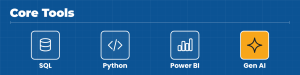
Tools change, but the thinking behind them stays useful. Here is what you should be able to do with each one.
Python is the main programming language for a modern data analyst. You use it to clean data, run analysis and automate repeat work.
Core libraries to learn:
A typical task is taking a large sales file, removing duplicates, fixing dates and finding which products drive the most profit. If you can do that end to end, you are ready for most entry-level Python questions.
SQL is how you ask a database questions. Almost every data analytics interview includes a SQL round, so this skill carries real weight.
Focus on these areas:
Practise on real tables like orders, customers and products. Interviewers prefer a candidate who writes clean queries over one who memorises syntax.
Power BI is the most common reporting tool in Indian companies. A data analyst uses it to build dashboards that update automatically.
Key skills include:
A good dashboard answers one business question quickly. If your manager needs a long explanation, redesign it.

Gen AI tools now help with writing first-draft SQL and Python, summarising reports and classifying customer feedback. They save time, but they make mistakes.
Learn to check every output against the data. A data analyst who uses Gen AI carefully is faster. One who trusts it blindly is a risk.
Tokenization means splitting text into small units called tokens. A token can be a word, part of a word or a single character.
Language models read and produce tokens, not full sentences. This matters to you for three reasons:
Understanding this helps you build better Gen AI workflows and avoid surprise costs.
Imagine a retail manager asks why sales fell last month. A good analyst does not open a chart first. They start by clarifying the question.
Follow this sequence:
The result is a one-page summary, not a long report. The manager wants to know what happened and what to do next.
Tools get you shortlisted. Judgement gets you hired. Employers look for a few habits that no software teaches.
Know how the company makes money. A number only matters when you can link it to revenue, cost or customer experience.
Explain findings in plain words. Use one chart per point and one sentence per finding.
Ask why a number looks odd before you report it. A careful check catches errors that embarrass analysts later.
Capstone projects separate a certificate from a skill. Recruiters want to see how you handle a full problem, from raw data to a recommendation.
| Project | Business question | Tools | What you deliver |
| Sales and profit dashboard | Which regions and products earn the most? | SQL, Power BI | Interactive dashboard |
| Customer churn analysis | Why are customers leaving? | Python | Findings and a prediction model |
| HR attrition study | Which employees are likely to resign? | Python, Power BI | Report with recommendations |
| Customer feedback analyser | What do customers complain about? | Python, Gen AI, tokenization | Summary of themes |
Put every project in a portfolio with a short write-up. State the problem, the data, your method and the result in plain language.
Add a link to your dashboard or code. A hiring manager should understand your work in two minutes.
Pay depends on your city, your skills, your domain and the company. A data analytics course with placement cannot promise a fixed salary, and you should be careful of any institute that does.
Here is what usually moves the number up:
| Profile | What raises pay | Salary range per year (INR) |
| Fresher data analyst | SQL, Power BI, strong projects | [Insert approved range] |
| Career switcher | Domain knowledge plus data skills | [Insert approved range] |
| Experienced data analyst | Python, Gen AI, business impact | [Insert approved range] |
Ivy Professional School reports a 67% average salary hike for learners who move into new roles after training. Your own result will depend on your starting point and effort.
Your first role is a starting point, not a ceiling. Most learners begin in one of a few common roles and grow from there.
After two or three years, analysts often move into senior analyst, analytics manager or data science roles. The path you pick depends on whether you enjoy people, business strategy or deeper technical work.
Pick a domain early. An analyst who understands retail, banking or healthcare is harder to replace than a generalist.
Placement support should be specific, not a vague promise. Ask any institute exactly what it does for you.
A useful data analytics course with placement includes:
Honest answers to these questions tell you more than any brochure.
Your resume should show what you built, not only what you studied. Lead with projects, name the tools you used and state the result in one line.
Expect three kinds of questions: technical, case-based and behavioural. Technical rounds test your queries and your logic. Case rounds hand you a business problem and ask how you would approach it.
Practise explaining a project aloud. If you cannot describe your own dashboard in two minutes, an interviewer will notice.
Ivy Professional School has trained learners in data skills since 2008. The numbers below are the approved figures for our programmes.
| Measure | Figure |
| Experience | 18+ years (since 2008) |
| Alumni | 37,500+ |
| Trainers | 400+ |
| Hiring companies | 500+ |
| Placement | 82% |
| Average salary hike | 67% |
| Google rating | 4.8/5 from 2,250+ reviews |
| Recognition | Recognized by MeitY |
Classes run across Kolkata, Bangalore, Delhi, Pune and Mumbai, with an online option for learners elsewhere. The data analytics course focuses on SQL, Python, Power BI and Gen AI, with projects at every stage.
Many learners lose months on avoidable errors. Watch for these:
Depth beats breadth. Employers hire people who can finish a task, not people who have seen every tool.
Working professionals have less time but more context. A steady routine works better than occasional long sessions.
Treat your current job as a source of project ideas. A report you build for your own team can become a portfolio piece.
Use this short checklist before you pay any fee:
If the answer to most of these is yes, you are looking at a serious data analytics course with placement.
Learning data skills takes steady effort over several months. Some people get an offer quickly, and others need more projects and more interview practice.
That is normal. Keep building, keep applying and ask for feedback after every interview. Each round teaches you something that the next round will reward.
Track your progress in a simple sheet. Note each application, the interview stage reached and the topics you found hard. After ten interviews, the pattern will show you exactly what to revise.
No. A good programme starts from the basics. Many successful data analysts began with only Excel.
Learn SQL first. It is easier to start with, and it appears in almost every interview.
No course can guarantee a job. A good one improves your skills, your portfolio and your access to hiring companies, and the effort you put in decides the rest.
Data analytics rewards people who practise consistently, week after week, with real datasets. Pick a course that teaches SQL, Python, Power BI and Gen AI through real projects, and supports you all the way to the interview table.
If you are ready to start, speak to an Ivy counsellor and ask for the full syllabus, project list and placement details.
