
Prateek Agrawal Oct 31, 2026 No Comments
If you are searching for a data engineering course in Kolkata, you are choosing one of the most future-proof careers in technology. Every business that collects data, from banks and retailers to hospitals and food delivery startups, needs engineers who can build the pipelines that move, clean and store that data reliably. Without them, data scientists have nothing to model and dashboards have nothing to show.
This guide explains what data engineering is, what a good data engineering course in Kolkata should teach, how to compare institutes, what jobs and salaries to expect, and how to turn your training into a real offer letter. Whether you are a fresher, a working professional or a career switcher, read on before you pay for any program.
Data engineering is the discipline of designing, building and maintaining the systems that collect, transform and deliver data to the people and applications that need it. If a data scientist is the chef, the data engineer builds the kitchen, stocks the pantry and makes sure fresh ingredients arrive every morning.
A typical data engineer writes code to pull data from databases, APIs, apps and files, cleans and reshapes it, loads it into a warehouse or data lake, and schedules everything to run automatically. They also monitor data quality, manage costs and keep pipelines fast as volumes grow.
Demand has surged for three reasons. First, companies now generate far more data than manual processes can handle. Second, cloud platforms have made large-scale data infrastructure affordable, so even mid-sized firms are building it. Third, the rise of generative AI has made clean, well-organised data more valuable than ever, because AI models are only as good as the data feeding them. This is why a structured data engineering course in Kolkata is attracting freshers and experienced IT professionals alike.
Kolkata has quietly become a strong base for technology learning and hiring. Here is why many learners prefer to study locally.
A growing IT and analytics ecosystem. Salt Lake Sector V, New Town and Rajarhat host IT services firms, fintech companies and analytics teams, all of which need people who can handle data pipelines.
Lower cost of living. Compared with Bangalore, Mumbai or Delhi NCR, studying in Kolkata costs less for rent, food and commuting, so your total investment in a data engineering course in Kolkata stays manageable.
Classroom plus online flexibility. Many institutes offer live online classes alongside classroom sessions, so you can learn in the format that suits you.
A strong local talent pool. Colleges across the city produce thousands of graduates in engineering, statistics, mathematics and commerce every year. Studying with peers from similar backgrounds builds a useful network, and a good data engineering course in Kolkata will connect you with mentors and alumni already working in the field.
Remote work opens every door. Today you can train in Kolkata and work for a company in Bangalore, Pune, Singapore or London. The location of your institute matters less than the quality of the training and the strength of its hiring network.
You do not need to be a coding genius to begin. A well-designed data engineering course in Kolkata is suitable for:
If you enjoy solving problems, working with logic and building systems that run on their own, data engineering will probably suit you.

Not all programs are equal. Some stop at theory, and others teach outdated tools. Use the checklist below to judge the curriculum of any data engineering course in Kolkata you are considering.
Python is the main language of data engineering. You should learn core syntax, data structures, functions, file handling, error handling, working with APIs and libraries such as Pandas. Writing clean, reusable code matters more than memorising syntax.
SQL is non-negotiable. Expect to learn joins, subqueries, window functions, indexing, query optimisation and data modelling for relational databases. A strong data engineering course in Kolkata will make you write hundreds of queries, not just watch demonstrations.
You should understand star and snowflake schemas, normalisation, fact and dimension tables, and how modern warehouses such as Snowflake, BigQuery or Redshift organise analytical workloads.
Spark is the industry standard for processing large datasets in parallel. Look for hands-on work with PySpark, DataFrames, transformations, partitioning and performance tuning, along with an understanding of how Hadoop-era concepts led to today’s tools.
Extract, transform, load is the heart of the profession. You should build pipelines that ingest raw data, apply business rules and load results into a warehouse, and learn the difference between batch and streaming approaches.
Pipelines must run on a schedule and recover when something fails. Tools such as Apache Airflow help you manage dependencies, retries and alerts. Any serious data engineering course in Kolkata should include orchestration in its projects.
Most companies run data systems on AWS, Microsoft Azure or Google Cloud. You should be comfortable with storage services, compute services, managed warehouses and basic security and cost controls on at least one major cloud.
Apache Kafka and Spark Structured Streaming let you process events such as payments, clicks and sensor readings as they happen. Even an introduction to streaming sets you apart from candidates who only know batch jobs.
Git, Docker, CI/CD concepts and the Linux command line help you work like a professional engineer. Employers notice when a candidate can version-control code and deploy it properly.
Certificates open the door, but projects win interviews. Insist that your data engineering course in Kolkata includes end-to-end projects, such as building a pipeline that ingests e-commerce data, cleans it, loads it into a cloud warehouse and powers a dashboard.

Completing a data engineering course in Kolkata can lead to several roles:
With experience, many engineers advance to senior data engineer, data architect, engineering manager or head of data positions.
On salaries, entry-level data engineers in India commonly start at roughly ₹4 to ₹8 lakh per year, depending on skills, projects and the employer. Engineers with three to five years of experience often earn considerably more, and senior specialists in product companies and global firms can command much higher packages. Actual figures vary by company, city and individual performance, so treat them as indicative rather than guaranteed. What is certain is that learners who finish a data engineering course in Kolkata with strong projects and clear fundamentals are far better placed in interviews.
With many institutes advertising similar promises, use these criteria to compare your options.
Curriculum relevance. Check that the syllabus includes the tools above and is updated regularly. Ask to see the full module list, not just a brochure headline.
Trainer quality. Look for instructors with real industry experience who can explain why a design choice matters, not only how to click through a tool.
Hands-on learning. The ratio of practice to theory should be high. Ask how many projects you will complete and whether you get lab access outside class hours.
Placement support. Ask for specifics: how many hiring partners, which companies, what roles and salary bands, and what happens if you are not placed. Be careful with vague claims. A reliable data engineering course in Kolkata will be transparent about its track record.
Certification and industry recognition. Certificates from reputed academic or industry bodies add credibility to your resume.
Fee structure and flexibility. Compare total cost, EMI options and any outcome-linked payment models. The cheapest course is rarely the best, and the most expensive is not always better.
Alumni reviews. Speak to former students on LinkedIn. Honest feedback from alumni tells you more than any advertisement.
Class format and support. Look for recorded backups, doubt-clearing sessions, mentor access and interview preparation.
Ivy Professional School is an 18-year-old analytics and AI training institute headquartered in Kolkata, with additional centres in Bangalore and Delhi. Its data engineering program is designed for learners who want job-ready skills rather than theory alone, and it sits alongside the institute’s courses in Data Science, Data Analytics, Generative AI and Artificial Intelligence.
Here is what makes Ivy’s approach worth considering if you are shortlisting a data engineering course in Kolkata:

Check the current syllabus, batch dates and eligibility criteria on ivyproschool.com or speak with a counsellor, because details can change from one batch to the next.
Whatever institute you pick, follow a structured path:
Timelines vary by batch and by how much time you can give each week, so adapt the plan to your pace.
Avoiding these mistakes will help your investment in a data engineering course in Kolkata pay off faster.
Is a data engineering course in Kolkata good for beginners? Yes. Many programs start from Python and SQL basics, so you can begin without prior experience as long as you commit to regular practice.
How long does a data engineering course in Kolkata take? Most comprehensive programs run for several months, usually between four and eight months, depending on depth and format. Confirm the exact duration with the institute.
Which skills will I learn in a data engineering course in Kolkata? Expect Python, SQL, data modelling, Spark, ETL pipelines, Airflow, cloud platforms and project work, though the exact toolset depends on the institute.
Do I need a coding background? No, but a willingness to learn programming is essential. Python is beginner-friendly, and the course should teach it from scratch.
Is data engineering better than data science? Neither is better; they are different. Data scientists focus on models and insights, while data engineers build the infrastructure that makes that work possible. Many professionals start in one and move to the other.
What is the fee for a data engineering course in Kolkata? Fees vary widely by institute, duration and inclusions. Compare the full cost, payment options and placement terms before deciding, and ask for a written fee breakdown.
Will I get a job after completing the course? No course can guarantee a job, since results depend on your effort, projects and interview performance. A good institute gives you training, practice, mentoring and access to hiring partners to improve your chances.
Can working professionals join? Yes. Weekend and evening batches and online options make it practical to learn while employed.
Data is the foundation of modern business, and the people who build the systems behind it will remain in demand for years. The right data engineering course in Kolkata gives you structured learning, practical projects, mentor guidance and a path to employers. Focus on curriculum depth, hands-on work, transparent placement support and your own consistency, and you will be well placed to build a rewarding career.
Ready to take the next step? Explore the Data Engineering program at Ivy Professional School, book a counselling session at ivyproschool.com, and see how a data engineering course in Kolkata can fit your goals. If you also want to add AI skills to your profile, look at Ivy’s Generative AI course, which pairs well with data engineering for future-ready careers.

Prateek Agrawal Jun 18, 2026 No Comments
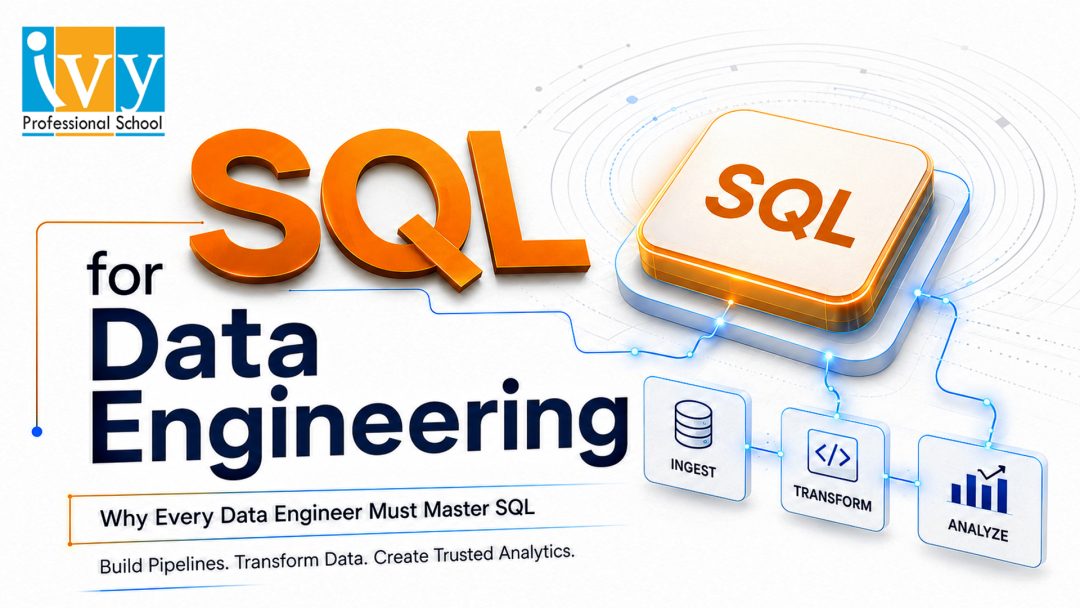
Data engineering has become one of the most important career paths in the modern data economy. Every organization now depends on data from applications, websites, CRMs, ERPs, payment platforms, marketing systems, IoT devices, and customer touchpoints. But raw data is rarely ready for business use. It must be extracted, cleaned, transformed, validated, modeled, and delivered in a reliable form. This is where SQL becomes essential.
SQL for Data Engineering is not just about writing basic queries. It is about building the logic that powers data pipelines, data warehouses, analytics dashboards, reporting systems, and machine learning datasets. While tools such as Python, Spark, Airflow, dbt, Snowflake, BigQuery, Redshift, and Databricks are widely used in the data ecosystem, SQL remains the common language across most platforms.
For any aspiring data engineer, SQL for Data Engineering should be treated as a foundation skill. It helps professionals understand source systems, transform data at scale, test data quality, and create trusted datasets for decision-making. A data engineer who is strong in SQL can debug faster, collaborate better, and build pipelines that are easier to maintain.
This is why professional learning institutes such as Ivy Professional School emphasize practical SQL training as part of data analytics, data science, AI, and data engineering learning paths. For students and working professionals, SQL for Data Engineering creates a clear bridge between classroom learning and production data work. Tools may change, but the ability to reason with structured data remains central.
For beginners, SQL often means selecting rows from a table. For data engineers, SQL has a much larger role.
SQL for Data Engineering means using SQL to move data from raw systems to business-ready datasets. It includes extracting records, joining tables, cleaning fields, standardizing formats, creating derived columns, aggregating data, validating outputs, and preparing tables for downstream users.
A data engineer does not only ask, “Can I get the answer?” The real question is, “Can this logic run every day, at scale, without breaking and without producing incorrect numbers?” This mindset is what makes SQL an engineering skill.
For example, a reporting query may calculate last month’s revenue once. A data engineering query may build a reusable revenue table that updates daily, handles refunds, excludes test transactions, adjusts for time zones, and supports dashboards across the company. That is the practical difference. SQL for Data Engineering is therefore about repeatable, governed, and business-aligned transformation logic.
Some professionals assume SQL may become less important because data engineering now includes Python, Spark, APIs, orchestration tools, and AI-assisted development. In reality, SQL has become more important because modern platforms have adopted SQL deeply.
SQL for Data Engineering works across relational databases, cloud data warehouses, and lakehouse platforms. Analysts use SQL. BI tools generate SQL. Data scientists use SQL to prepare datasets. Transformation frameworks often rely on SQL. Even distributed processing engines support SQL-style logic.
This matters because SQL is readable and declarative. Instead of writing every processing step manually, engineers can describe the result they want, and the database or processing engine decides how to execute it. That makes SQL ideal for transformations, metric definitions, and audit-friendly logic.
In production environments, readability is not cosmetic. Data pipelines are business infrastructure. Multiple people need to understand them, review them, modify them, and trust them.

ETL stands for Extract, Transform, Load. ELT stands for Extract, Load, Transform. Both are central to data engineering, and both depend heavily on SQL.
SQL for Data Engineering is used to clean raw tables, standardize data formats, join multiple sources, create staging layers, build intermediate tables, and publish final analytics-ready datasets. In modern cloud environments, ELT has become especially common because warehouses and lakehouses can handle large-scale transformations after data is loaded.
Consider a simple sales pipeline. Raw orders may arrive from an application database. Payment records may come from a payment gateway. Customer details may come from a CRM. Product details may come from an ERP. SQL can connect these datasets, remove invalid rows, calculate net revenue, map product categories, and produce a clean sales table.
This transformation logic runs repeatedly. It must be stable, accurate, and efficient. That is why SQL for Data Engineering requires more than syntax. It requires pipeline thinking.
At Ivy Professional School, learners are often trained to work with practical datasets because real-world data is rarely clean. It contains missing values, duplicate records, inconsistent formats, and changing business rules.
Every reliable data pipeline begins with source system understanding. Before building a pipeline, a data engineer must know where the data comes from, what each table represents, and how business processes are captured.
SQL for Data Engineering allows engineers to inspect source systems directly. They can check row counts, primary keys, foreign key relationships, date ranges, null values, duplicate records, and unusual category values. This prevents wrong assumptions from entering the pipeline.
For example, in an e-commerce system, one order may have multiple payment attempts, multiple shipments, partial refunds, cancelled items, and discount adjustments. If the engineer assumes one order equals one payment, revenue calculations may become incorrect.
SQL helps the engineer ask better questions. Are cancelled orders included? Are timestamps stored in UTC? Are prices captured at order time or pulled from the latest product catalog? Are refunds recorded as negative transactions or separate events? These details directly affect pipeline design.
Data modeling is one of the most valuable responsibilities in data engineering. A good data model makes analytics faster, cleaner, and more reliable. A poor model creates inconsistent metrics, slow dashboards, and repeated manual work.
SQL for Data Engineering is essential for creating data models. Engineers use SQL to build staging tables, intermediate tables, fact tables, dimension tables, snapshots, aggregate tables, and reporting marts.
For example, a retail business may need fact tables for sales, returns, inventory movement, and payments. It may need dimension tables for customers, products, stores, locations, and dates. A professional education company may need models for leads, courses, batches, enrollments, payments, learner progress, and placements.
Good modeling reduces confusion. Instead of every analyst writing complex joins from raw tables, the data engineering team creates trusted tables that are easier to use. This improves consistency across dashboards and reports.
SQL for Data Engineering turns raw operational records into structured analytical assets. This is where business logic becomes reusable data infrastructure.

Data quality is one of the biggest reasons data engineering exists. A dashboard may look polished, but if the underlying data is wrong, the business decision will also be wrong.
SQL for Data Engineering allows engineers to test whether data is complete, consistent, unique, accurate, and valid. They can identify missing values, duplicate keys, broken relationships, invalid categories, negative amounts, unusual dates, and mismatched totals.
For example, after loading order data into a warehouse, the engineer may compare source and target record counts. They may check whether total revenue matches within a defined tolerance. They may verify that every order has a customer ID and every order item has a valid product ID.
These checks can be automated. If a data quality rule fails, the pipeline can alert the team before incorrect data reaches business users.
This is how SQL protects trust. It helps organizations move from “we have data” to “we trust this data.”
Data pipelines fail for many reasons. A source schema may change. A new data type may appear. A job may run with partial data. A join may multiply records. A dashboard metric may suddenly shift without explanation.
SQL for Data Engineering gives engineers a direct way to investigate these failures. A skilled engineer can trace a number from the final dashboard back to the reporting table, intermediate layer, staging table, raw table, and source system.
For example, if a revenue dashboard suddenly increases by 40 percent, the engineer can use SQL to check whether the increase is real or caused by duplicate payment rows, incorrect joins, late-arriving data, or a change in logic.
Tools can show that a job failed. SQL helps explain why it failed. This debugging ability is one of the strongest practical advantages a data engineer can have.
Correct data is essential, but performance also matters. In cloud environments, inefficient queries can increase compute costs, delay dashboards, and slow down downstream pipelines.
SQL for Data Engineering includes the ability to write efficient logic. Engineers must understand how to apply filters early, reduce unnecessary joins, avoid repeated calculations, use partitions correctly, and materialize important tables when needed.
For example, a query that scans five years of transaction data every morning may be replaced with an incremental process that scans only new or changed records. This can improve runtime and reduce cost.
Performance also depends on understanding how the platform works. Indexing, partitioning, clustering, query plans, and storage formats may differ across systems, but the core principle remains the same: process only what is necessary and structure the data intelligently.
Real-world data does not remain static. New records are added, old records are updated, statuses change, and late-arriving data appears. A strong pipeline must handle these changes correctly.
SQL for Data Engineering is used for incremental loading patterns such as inserts, updates, upserts, merges, and change tracking. Engineers use timestamps, batch IDs, high-water marks, and change data capture fields to identify what must be processed.
For example, if a customer updates their address, should the old value be overwritten or preserved as history? If an order changes from pending to completed, should the warehouse table update immediately? If a refund arrives after three days, should past revenue numbers be adjusted?
These are business logic questions as much as technical questions. SQL helps implement the answer accurately.
Python is important in data engineering. It is used for APIs, automation, scripting, file movement, and workflow control. Spark is used for distributed processing. Airflow and similar tools are used for orchestration. But these tools do not replace SQL.
SQL for Data Engineering complements them. A data engineer may use Python to pull data from an API, Airflow to schedule jobs, Spark to process large files, and SQL to define transformation logic.
In many teams, SQL is preferred for business transformations because it is easier to read and review. Python is often better for procedural tasks, while SQL is clearer for joins, aggregations, and table-based transformations.
The best data engineers do not choose between SQL and Python. They use both intelligently.

Basic SQL is not enough for production data engineering. A data engineer must go deeper.
SQL for Data Engineering requires mastery of joins, aggregations, CTEs, subqueries, window functions, date functions, conditional logic, merge statements, data type conversion, JSON handling, deduplication patterns, and query optimization.
Window functions are especially important. They help with ranking, latest-record selection, running totals, moving averages, cohort analysis, sessionization, and duplicate removal.
Join logic is equally important. Many data errors happen because engineers do not check whether a relationship is one-to-one, one-to-many, or many-to-many. A technically valid join can still produce a wrong business result.
SQL for Data Engineering also requires clean formatting and maintainable structure. Production queries should be readable, testable, and easy for another engineer to review.
Organizations are investing heavily in analytics, automation, and AI. But advanced AI initiatives depend on strong data foundations. If the data is incomplete, inconsistent, or poorly modeled, AI outputs will also be unreliable.
SQL for Data Engineering helps create curated datasets, feature tables, historical snapshots, governed metrics, and business-ready data marts. These assets support dashboards, predictive models, personalization systems, customer segmentation, forecasting, and decision intelligence.
For example, a machine learning model may need customer-level features such as total purchases, average order value, last transaction date, refund rate, engagement frequency, and product category preference. SQL can create these features from raw transactional tables.
This is why SQL is not becoming less relevant in the AI era. It is becoming more strategic. Before organizations can use AI effectively, they must prepare high-quality data.
The best way to learn SQL is through projects. Syntax practice is useful, but it is not enough. Learners must solve realistic problems using messy datasets and business rules.
SQL for Data Engineering should be learned through tasks such as cleaning raw data, creating staging tables, building fact and dimension tables, validating source-to-target loads, handling duplicates, and designing incremental pipelines.
Learners should also practice business metric creation. Revenue, churn, retention, conversion rate, active users, average order value, and customer lifetime value all require careful definitions. SQL is the tool that converts those definitions into repeatable logic.
This is where structured training helps. Ivy Professional School provides career-focused learning in data analytics, data science, AI, and related data skills, with a strong emphasis on practical projects and industry-style problem solving. For learners who want to move into data engineering, mastering SQL is one of the most practical starting points.
Many learners treat SQL as a basic topic and move too quickly to advanced tools. This is a mistake. Weak SQL leads to weak data engineering.
Common mistakes include using SELECT DISTINCT to hide duplicate problems, joining tables without checking the level of detail, ignoring null values, writing unreadable queries, and failing to validate results against source data.
SQL for Data Engineering requires discipline. Queries should be structured, tested, documented, and reviewed. Engineers must think about correctness, performance, maintainability, and business meaning.
Another mistake is practicing only on small sample tables. Real data is larger and messier. It contains missing values, late updates, inconsistent formats, changing definitions, and unexpected exceptions. Practice must reflect this reality.
For career growth, SQL remains one of the highest-value skills in the data field. Data engineering interviews frequently test SQL because it reveals how a candidate thinks about data relationships, logic, edge cases, and business rules.
SQL for Data Engineering is also valuable on the job. A professional who can investigate data issues, optimize queries, explain metrics, build models, and validate pipelines becomes useful across teams.
This skill is relevant for data engineers, analytics engineers, BI developers, data analysts moving into engineering, and data scientists who work with production data. Even managers and consultants benefit from understanding SQL because it helps them evaluate data quality and pipeline feasibility.
Ivy Professional School can support learners in building this career foundation by connecting SQL with analytics, AI, visualization, and real business use cases. The goal is not only to learn commands, but to learn how data moves through an organization. SQL for Data Engineering helps learners develop that end-to-end view.
SQL for Data Engineering is not optional. It is a core professional skill for anyone who wants to build, maintain, and scale reliable data systems.
A strong data engineer uses SQL to understand source systems, design pipelines, transform raw data, create data models, validate quality, debug failures, optimize performance, and support analytics and AI initiatives. SQL remains relevant because it is practical, powerful, readable, and widely supported across modern data platforms.
The data ecosystem will continue to evolve. New tools will emerge. Cloud platforms will change. AI assistants will become more capable. But organizations will still need professionals who can turn raw data into trusted, structured, business-ready information.
That is why every data engineer must master SQL. In practical terms, SQL for Data Engineering remains one of the safest skills to invest in for a long-term data career.
For anyone serious about building a career in this field, SQL for Data Engineering should be one of the first and deepest skills to develop. With the right training, real-world projects, and consistent practice, learners can move from basic querying to production-ready data engineering. Ivy Professional School can be a practical learning partner in that journey by helping learners connect SQL, analytics, data science, AI, and business problem-solving into one career-focused path.