
Prateek Agrawal Nov 28, 2026 No Comments
In 2026, Generative AI has moved from demos to production. Teams are no longer asking whether a large language model (LLM) can write a clean paragraph. They are asking whether it can answer a customer’s policy question correctly, write valid SQL against a company schema, or classify thousands of reviews without drifting off format. A general-purpose foundation model, used as it comes, rarely does all of this well.
That gap is where customization begins, and it is also where many projects stall. Should you write better prompts, connect the model to your documents, or train it further on your own examples? Each path costs a different amount of time, money and skill, and the wrong choice can mean months of rework.
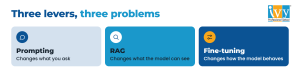
The good news is that the decision becomes straightforward once you understand the trade-offs. Prompting changes what you ask. Retrieval-Augmented Generation (RAG) changes what the model can see. Fine-tuning changes how the model behaves. These are three different levers for three different problems.
This guide to FINE-TUNING vs RAG vs PROMPTING is written for data professionals, developers and technology leaders. It explains how each technique works, compares them side by side, gives you a four-step framework for choosing, and walks through real enterprise examples. By the end, you will know how to customize Large Language Models to fit your problem, your data and your budget, instead of reaching for the most complex option first.
Foundation models are trained on large public datasets, and that training gives them broad language ability. It does not give them knowledge of your business. Three limitations show up almost immediately in production.
Knowledge cutoffs. A model only knows what was in its training data up to a fixed date. Ask about a policy changed last month or a regulation updated this quarter, and it will either admit it does not know or, worse, answer confidently with outdated information.
No access to private enterprise data. Your pricing sheets, support tickets, contracts, internal wikis and customer records were never part of the model’s training. It cannot cite what it has never seen, and pushing sensitive data into a shared model is rarely acceptable for compliance reasons.
Generic tone, format and behavior. Out of the box, models write in a neutral, chatty style. Your business may need strict JSON, a specific brand voice, a regulated disclosure format, or domain terms that a general model handles loosely. Consistency at scale is hard to get from a model that was never shaped for your task.
These limitations explain why customization is a core skill in applied Generative AI. Three techniques address them:
None of them is universally better. Understanding FINE-TUNING vs RAG vs PROMPTING starts with seeing that each one fixes a different weakness.
Each technique works at a different layer of the system. Here is how they operate, what they do well and where they fall short.
Prompting shapes a model’s output through the instructions and context you send with each request. No model weights change and no extra infrastructure is needed, which makes it the fastest way to start.
A prompt usually has a system prompt that sets the role, tone and rules, followed by the task itself. Zero-shot prompting gives only the instruction. Few-shot prompting adds a handful of worked examples so the model copies the pattern and format. Chain-of-thought reasoning asks the model to work through intermediate steps before answering, which tends to help on multi-step logic. Long-context windows now let you paste large documents straight into the prompt, which covers many small knowledge tasks without a retrieval system.
Pros:
Limitations:
RAG connects the model to an external knowledge source at query time. Instead of hoping the model remembers a fact, the system looks the fact up and hands it over. The steps are:
Pros: fresh data without retraining, private data stays under your control, answers can be traced to sources, and access rules can be applied at retrieval.
Limitations: answer quality depends on chunking, embeddings and retrieval; there are more components to build and monitor; the extra retrieval step adds latency; and RAG does not change the model’s style or reasoning.
Fine-tuning continues the training of a pre-trained model on your own examples. The model’s weights are updated, so the new behavior becomes part of the model itself.
You prepare a dataset of input and output pairs that show the behavior you want. Supervised Fine-Tuning (SFT) trains the model to reproduce those outputs. Preference alignment methods, such as RLHF or Direct Preference Optimization (DPO), go further by teaching the model which of two responses people prefer.
Full fine-tuning updates every parameter and is costly. Parameter-Efficient Fine-Tuning (PEFT) trains only a small set of added parameters. LoRA adds small low-rank adapter matrices while the base weights stay frozen. QLoRA does the same on a quantized base model, which cuts memory needs enough to tune sizeable models on modest hardware.
Pros: consistent style and output structure, strong results on narrow and repetitive tasks, shorter prompts at inference, and smaller models that can match larger ones on a specific job.
Limitations: it needs clean, labeled data; training and evaluation take time; knowledge is frozen at training time; it is unreliable for storing facts; and there is a risk of overfitting or losing general skills.
The table below compares the three approaches on the factors that most often decide a project.
| Dimension | Prompting | RAG | Fine-Tuning |
| Primary purpose | Steer task, tone and format on each request | Ground answers in external or private knowledge | Change the model’s built-in behavior, style or specialization |
| Data freshness | As current as what you place in the prompt | High; updates when the index is refreshed | Low; frozen at training time |
| Hallucination risk | Medium to high when facts are not supplied | Lower when retrieval is good and answers must cite sources | Can still invent facts; improves format and domain fluency, not factual reliability |
| Upfront setup cost | Very low | Moderate: ingestion pipeline, vector store, evaluation | High: data curation, training runs, evaluation |
| Ongoing inference cost | Grows with prompt length | Moderate; retrieved context adds tokens | Often lower per request, as prompts shrink and smaller models can be used |
| Latency | Low to moderate; long prompts slow it down | Higher, because of the retrieval step | Low once deployed |
| Technical skills required | Clear writing, domain knowledge, basic evaluation | Data engineering, search, embeddings, backend work | ML engineering, dataset design, training and evaluation |

What the table tells us
The FINE-TUNING vs RAG vs PROMPTING decision is easier when you treat customization as a ladder. Move up a rung only when the one below has been tested and found insufficient.
A quick rule of thumb

Three common scenarios show how the right mix depends on the problem.
Basic chat prompting is now a baseline skill, not a differentiator. In 2026, employers hiring for Generative AI roles look for practitioners who can build and run an end-to-end LLM pipeline. That means ingesting and chunking documents, generating embeddings, setting up vector search, measuring retrieval quality, fine-tuning a model with LoRA when behavior needs to change, and orchestrating agents that call tools and workflows.
The reason is practical. A demo that answers three questions well is easy to build. A system that stays accurate, affordable and secure across thousands of real queries is not. That takes people who understand the trade-offs in this guide and can measure them.
Skills that stand out in hiring conversations include:
These skills are best learned by building, with feedback from people who have shipped such systems. Ivy Professional School has trained data and AI professionals since 2008, and it structures its Generative AI and Data Science programs around live mentorship and hands-on capstone projects. Learners work through prompting, RAG pipelines and fine-tuning on realistic problems, so they finish with working projects they can explain in an interview.
Whichever route you choose, favor learning that makes you build something end to end.
Most failed projects trace back to a small set of avoidable errors when teams weigh FINE-TUNING vs RAG vs PROMPTING.
RAG gives the model outside knowledge at query time. Fine-tuning changes the model’s weights to alter its behavior. Use RAG for facts that change or are private, and fine-tuning for style, format and specialized tasks.
No. It reduces them by grounding answers in retrieved text, but weak retrieval or loose instructions can still produce errors. Citations and regular evaluation keep the risk visible.
Stay with prompting when the task is simple, the needed knowledge fits in the prompt, and a measured baseline already meets your quality target. Add complexity only when tests show a gap.
Yes, and many production systems do. Fine-tune for consistent behavior and output format, and use RAG for current knowledge. The text-to-SQL example above follows this pattern.
It is far cheaper than full fine-tuning, because only small adapter layers are trained, and QLoRA lowers memory needs further. Exact cost depends on model size, dataset and hardware. Preparing and evaluating data often takes more effort than the training run.
The choice in FINE-TUNING vs RAG vs PROMPTING comes down to matching the technique to the problem. Prompting guides the task and is the right place to start. RAG supplies fresh and private knowledge. Fine-tuning shapes behavior, format and efficiency. Strong production systems usually earn their way up this ladder, guided by evaluation results rather than assumptions.
If you are planning an LLM project, begin with a prompt baseline and a small evaluation set this week. Let the failures tell you whether you need retrieval, fine-tuning or both.
If you want to build these skills in a structured way, explore the Generative AI and Data Science learning paths at Ivy Professional School, where you can practise prompting, RAG pipelines and fine-tuning through mentored, hands-on projects.
