
Team Oct 19, 2022 No Comments
In the HR (Human resource) niche, decision-making is changing. At a time when the traditional ways of operating HR are no longer sufficient to keep pace with the new technologies and competition, the field is at crossroads. This is a perfect case study to find out the effectiveness of analytics in HR.
When we talk about analytics in HR there are many facets that come into play. HR analytics aims to offer insight into how effectively to manage employees and attain business goals. Because so much data is accessible, it is crucial for HR teams to initially identify which data is most relevant, along with how to use it for optimum ROI.
Modern talent analytics mix data from HR and other business operations to address challenges related to:
So, a leading Multinational Professional Service Company reached Ivy Professional School for upskilling of their HR department to obtain optimum benefit from their operations.
Upskilling as the name suggests implies taking your skill to a next level. This has various benefits for any organization and the individual as well. Upskilling is very crucial as it:
Each employee searches for a purpose in their work, and innovation comes its way when the goal of the organization aligns with individual career aims.
When an employee leaves an organization, you must fill that position, which again starts the hiring and recruiting processes.
Along with upskilling, this analytics program is aimed at creating domain knowledge among the employees in the HR department. Domain knowledge is basically the knowledge of a specific, specialized discipline or niche, in contrast to general (or domain-independent) knowledge.
Considering the characteristics of the job profile and the expectations set by the company, a special curriculum was created.
Analytics in HR is reaching new horizons now. By using people analytics you don’t have to depend on gut feeling anymore. So now many organizations are inclining towards upskilling their employees in the HR department so that they get a good domain knowledge and become a more valuable resource of their company.
You can also reach out to us if you want us to organize similar analytical programs for your organization. Please email us your requirement at [email protected]
Team Oct 11, 2022 No Comments

Guess how much data engineers earn? An average salary of ₹7,44,500 per year in India. And senior data engineers earn between ₹11 lakhs to ₹24 lakhs per year.
And if you search for data engineering jobs on Indeed or LinkedIn, you will find over 20,000 vacancies in India alone. But why am I telling you all this?
Because I want to show how in-demand data engineers are in the market. With more and more companies relying on data to make smart decisions, data engineering has become a necessity.
Now, if you want to start a career in data engineering, you have to learn some technical and soft skills. In this post, I will tell you what those essential data engineering skills are and how you can start your career in this field.
You can think of data engineers as the architects of the data world. They build and maintain systems and architecture to collect, store, and manage data.
For example, they work with ETL (extract, transform, load) processes to combine data from multiple sources into a central repository. Similarly, they build data pipelines, work with databases, and manage data warehouses.
They basically prepare the raw data for analysis so that data analysts and data scientists can do their jobs. This way, they work together to help the company find valuable insights and make decisions that lead to business growth.
To perform all those tasks, data engineers need to gain expertise in various processes, tools, and technologies. They also need soft skills to work together as a team and communicate effectively. Here are all the skills you would need to become a pro data engineer:
Aspiring data engineers often ask me, “Is coding important?” And I always tell them that coding is one of the most important skills for data engineers. It is what will help you optimize and automate data workflows as well as improve data quality and reliability. Here are some programming languages often used in data engineering:
Python: It’s good for handling big data, automating tasks, and working with different data formats. It has a range of libraries that make data processing easier and faster.
SQL: It helps manage and query large databases. It’s also needed for data handling tasks like extracting, organizing, and updating data stored in databases.
Java: This language helps you build scalable, high-performance data pipelines. It helps you develop large, reliable systems that handle big data processing efficiently.
Scala: It helps you work with distributed data systems like Apache Spark. It’s specifically designed to handle large datasets while maintaining performance.
R: It helps in data analysis and statistical tasks. You will need it to perform complex data manipulation and generate insights from data sets.
You can go through this data engineering syllabus to learn more about technical skills that are valued in the present market.
One of the most important roles of data engineers is to store and organize raw data in data warehouses. Data warehouses are simply central repositories that allow access to real-time data for analysis and decision-making.
Without this skill, you won’t be able to manage the high volume and complex data most companies handle today. So, you need to know about data warehousing solutions like Panopoly or Amazon Redshift. This way, you can make data storage, retrieval, and processing more efficient.
Knowing programming languages isn’t enough. You also need an understanding of operating systems to design, develop, and troubleshoot systems. As a data engineer, you will work with operating systems like Linux, UNIX, macOS, and Windows because data infrastructure often runs on these platforms. For example, Linux is widely used in data engineering because of its stability, flexibility, and performance.
This data engineering skill helps you design, maintain, and optimize databases. SQL is the most widely used language for managing relational databases, allowing you to query, update, and manipulate data efficiently. You also need to learn NoSQL databases like Cassandra or Bigtable, which are better suited for handling unstructured data.
You can learn basic SQL queries, cleaning and modifying data, aggregating and analyzing data, working with multiple data tables, troubleshooting and error handling, advanced filters in SQL, data definition language, data manipulation language, using subqueries, creating user-defined functions, etc.
This is an important data engineering skill because you will often have to work with big datasets that traditional databases can’t handle. It will make you an expert at managing and processing data on a large scale.
For this, you can learn Hadoop, which includes topics like MapReduce, YARN, HDFS, data spilling, data replication, Daemons, etc. You have to learn Apache Hive to query large datasets using HiveQL. You also need to know Apache Spark, how to optimize it, and how to process data in real time. A good understanding of real-time data processing with Kafka and its integration with Spark is also important.
Microsoft Azure is a cloud platform that provides scalable, secure, and cost-effective data storage and processing solutions. So, this skill helps you build and maintain data pipelines, store data, and run large-scale analytics in the cloud.
Here, you will learn about Azure services like virtual machines, storage, and database services. Next, you can understand advanced data engineering with Azure and real-time data streaming and processing. Learning hybrid cloud scenarios, governance, and compliance is also necessary.
This data engineering skill helps you better analyze and evaluate a situation. You need this to identify problems related to data collection, storage, or analysis and then develop effective solutions. You have to come up with innovative solutions to improve the performance of the systems and the quality of the data. This is where critical thinking helps you.
As a data engineer, you will collaborate with other team members and business leaders with and without any technical expertise. So, better communication skills help you explain data processes and systems and share updates without any misunderstandings. For example, you may have to work with data scientists or analysts and share findings and suggestions. And you know, this skill not only helps you in data engineering but also in your entire life.
Now, let’s understand how to become a data engineer:
Even though formal education may not be that important these days, most employers need data engineers to hold at least a bachelor’s degree. You should hold a degree in something like computer science, computer engineering, information technology, software engineering, applied math, statistics, physics, or a related area.
You just saw the important data engineering skills in the above section. You need to master them. And one of the best ways to do it is to take a comprehensive course.
For example, Ivy Professional School’s IIT-certified Data Engineering Certification course helps you learn all the in-demand skills like SQL for data engineering, Python essentials for data, Big data processing, and Azure cloud engineering.
This 45-week live online course will make you an expert at building a complete ETL data pipeline on the cloud with tools like Azure, Hive, MongoDB, Spark, Hadoop, etc. The really interesting thing about this program is that you will learn from IIT Guwahati professors and expert professionals at Amazon, Google, Microsoft, etc.
Just gaining theoretical knowledge isn’t enough. You also need to know how to implement your knowledge and solve real business problems. And you can do this by working on data engineering projects and doing internships.
Again, Ivy Professional School’s Data Engineering Certification course helps you work on 30+ real-life projects. This way, you not only gain practical experience but also build an effective portfolio that showcases your skills. Besides, you will earn a valuable certificate from E&ICT Academy, IIT Guwahati, after completing the course. This way, you can become a credible data engineer.
Related: 6 Best Data Engineering Courses
The demand for data engineer roles has increased astronomically. Organizations are actively searching for data engineers to enhance their data processes and ultimately make smart business decisions. The above data engineering skills are in demand, and those who can master these skills will have a good chance of earning high salaries. The question is, will you be one of those?

Prateek Agrawal is the founder and director of Ivy Professional School. He is ranked among the top 20 analytics and data science academicians in India. With over 16 years of experience in consulting and analytics, Prateek has advised more than 50 leading companies worldwide and taught over 7,000 students from top universities like IIT Kharagpur, IIM Kolkata, IIT Delhi, and others.
Team Sep 21, 2022 No Comments

Updated on August, 2024
Data science interviews can be scary.
Just imagine sitting across from a panel of serious-looking experts who are here to judge you. Your heart is racing, your palms are sweating, and you start breathing quickly. You can feel it.
It’s normal to feel a little overwhelmed in interviews. But here’s the good news: You can overcome this fear with the right preparation.
In this blog post, I will guide you through the essential steps and useful tips for data science interview preparation. This will help you walk into the room feeling confident and positive.
But before that, let’s first understand this…
The simple answer is data science interviews can be challenging. You need to prepare several different topics like data analysis, statistics and probability, machine learning, deep learning, programming, etc. You may have to revise the whole data science syllabus.
And these technical skills aren’t enough. You also need good communication skills, business understanding, and the ability to explain your work to business stakeholders.
You know the purpose of a data science interview is to test your knowledge, skills, and problem-solving abilities. If you haven’t brushed up on your skills recently, it can be a lot of work. So, let’s start from the beginning…
As I said earlier, preparation is the key to success in data science interviews. And it all starts with a strong foundation that involves:
If you don’t have these, you can join a good course like Ivy Professional School’s Data Science Certification Program made with E&ICT Academy, IIT Guwahati.
It will not only help you learn in-demand skills and work on interesting projects but also prepare for interviews by building a good resume, improving soft skills, practicing mock interviews, etc.
Besides, you will receive an industry-recognized certificate from IIT on completion of the course. This will surely boost your credibility and help you stand out in the interview.
Now, I will share some tips for data science interview preparation that have helped thousands of students secure placements in big MNCs.
These tips will boost your preparation and help you understand how to crack a data science interview like a pro.
This is the first and most important thing to do. Why? Because it will show the interviewer that you are serious about the opportunity. It will also help you provide relevant answers and ask the right questions in the interview.
All you have to do is go to the company’s website and read their About page and blog posts to understand their products, services, customers, values, mission, etc. Also, thoroughly read the job description to understand the key skills and responsibilities.
The goal is to find out how your knowledge and experiences make you a suitable candidate for the role.
Your resume is your first impression. It helps you stand out, catch the interviewer’s attention, and show why you are the right fit for the job. So, you have to make sure it’s good.
What do you mention in your resume? Here are some of the important sections:
Here’s the most important thing: Tailor your resume according to the company’s needs, values, and requirements. That means you should have a different resume for each job application.
What projects you have worked on is one of the most common areas where interviewers focus. That’s because it directly shows how strong a grasp you have over data science skills and whether you can use your skills to solve real-world problems.
So, go through each project you have listed in your data science portfolio. See the code you wrote, the techniques you used, the challenges you faced, and the steps you took to solve the problem. You should be able to explain each project clearly and concisely, from the problem statement to the results you got.
Technical interviews are where the interviewer evaluates whether you have the skills and expertise to perform the job effectively. For this, you need a solid foundation of the latest data science skills.
You should revise all the tools and programming languages like Excel, SQL, Python, Tableau, R, etc., which you have mentioned in your resume. Besides, go through the core concepts like data analysis, data visualization, machine learning, deep learning, etc.
Pro tip: Learn from the data science interview experience of people who have already cracked interviews and secured placements. For instance, this YouTube video shares the experience of one of Ivy Pro’s learners who cracked the interview at NielsenIQ:
I can’t emphasize the importance of this step. Being prepared helps you answer effectively and make a lasting impression.
So, find common questions asked in data science interviews and prepare clear and concise answers. Here are some technical and behavioral questions:
These are just examples. You can do your research or ask professionals in your network to find the most common questions. This will surely make you more confident about your data science interview preparation.
Albert Mehrabian, a professor of Psychology, found that communication is 55% body language, 38% tone of voice, and 7% words only.
So, while your technical skills and experience are important, your body language can make or break your chances of success in the interview.
Here are simple ways to improve your body language:
Your body language shows your confidence and attitude, so try to make it perfect.
Mock interviews can boost your data science interview preparation. It helps you improve your answers and body language, increase confidence, and get used to the scary interview environment.
You can simply practice it with your friends or do it alone by recording yourself while you speak. But the best way to do it is to join a course where they let you practice mock interviews.
For instance, Ivy Pro’s Data Science Course with IIT Guwahati helps you practice mock interviews and learn soft skills. This way, you get feedback to understand your strengths and areas of improvement.
Now, you know how to prepare for a data science interview and crack it with confidence. You need to build a strong foundation in relevant skills, gain hands-on experience, and create a compelling portfolio. Your technical expertise, body language, and attitude are what will help you stand out and land your dream job. So, get started with it. The stronger the preparation, the more your chances of success.
Prateek Agrawal is the founder and director of Ivy Professional School. He is ranked among the top 20 analytics and data science academicians in India. With over 16 years of experience in consulting and analytics, Prateek has advised more than 50 leading companies worldwide and taught over 7,000 students from top universities like IIT Kharagpur, IIM Kolkata, IIT Delhi, and others.
Team Sep 18, 2022 No Comments
Everywhere we read, we see the power of data science. Data science is changing the world we are living in. Everyone is concerned about data. Businesses are keen on evaluating how data can help them to cut off expenses and enhance their bottom line. Businesses from every niche are now interested in data science and the stock market is no different. In this article, we will have a look at stock market data analytics and how it boosts the graphs of the stock market.
Data science is typically portrayed in numbers. But these numbers should imply anything that ranges from the number of users who buy a product to the amount of inventory that is sold. Of course, these numbers should also portray cash.
Now coming to stock market data analytics. Here we can either sell, buy, or hold. The aim is to make the biggest profit possible. The question that many are aiming to answer is about the role that data science plays in helping us conduct trades in the stock market. Trading platforms have become very famous in the last two decades, but each platform provides varied options, fees, tools, and many more. Despite the evolving trend, there are many nations that have still not been able to access zero trading commission platforms. This article is based on stock market data analytics India.
There are numerous phrases that are used in data science that a person would be required to be a scientist to understand. At its most primary level, data science is mathematics that is carved with an understanding of statistics and programming.
There are various concepts in data science that are applied when analysing the market. In this respect, we are employing the term “analyze” to evaluate whether it is worth it to make investment in it. There are some primary data science ideas that are ideal to be familiar with.
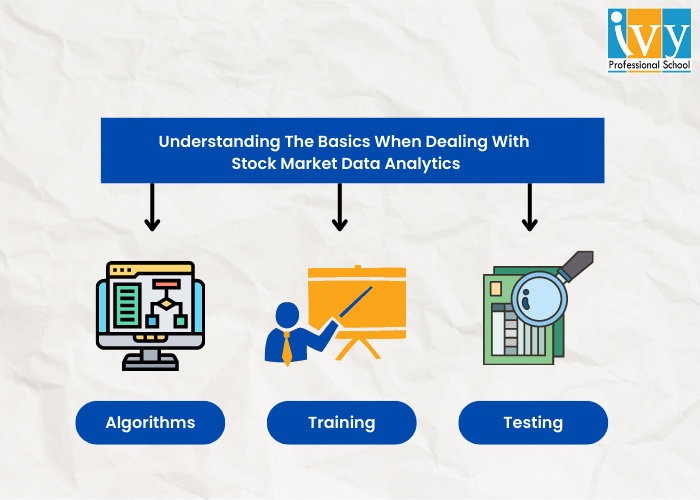
Algorithms are utilized extensively in data science. Basically an algorithm is a group of regulation required to perform a task. You have mostly heard about algorithms being used when purchased and selling stocks. Algorithmic trading is where algorithms fix rules for things such as when to purchase a stock or when to sell a stock.
For instance, an algorithm could be created to buy a stock once it drops by 8% in the entire day or to sell the stocks if it loses 10% of its value in comparison to when it was bought initially. Algorithms are formed to operate without human intervention. You might have heard about them referred to as bots. Like robots, they make calculated decisions that are devoid of emotions.
We are not discussing preparing to operate a 50 metre race. In ML (Machine learning) and also data science, training is where data is utilized in training a machine on how to revert back. We can formulate a learning structure. This machine learning framework makes it possible for a computer to offer accurate predictions that are based on the data it learned from the past. If you wish to teach a machine to anticipate the future of the values of stocks, it would require a structure of the stock prices of the last year to utilise as a base to anticipate what will occur.
Let us start with a stock market data analysis project. We have the real data for stock values from the previous year. The training set would be the real data from January to October. Then the data from November to December can be used for any testing set. Our machines should have understood by assessing how the stocks operated from January through October. Now, we will ask our machines to anticipate what should have occurred in November and December of that year. The predictions that will be made by the machine will be then compared to real values. The amount of variation seen in the prediction of the model and the real data are what we are aiming to discard as we adjust our training framework.
Data science depends heavily on structuring. This is a strategy that uses mathematics to examine previous behaviours with the aim of forecasting upcoming results. In the stock market, a time series model is employed.
A time series is basically data which in this scenario refers to the value of a stock that is indexed over a span of time. This span of time could be divided on an hourly, daily, monthly, or even minute basis. A time series module is formulated by using machine learning or deep learning models to fit the time data. The data requires to be analyzed and then fitted to match the structure. This is why it is effective to anticipate future values of stocks over a fixed timetable.
A second form of modeling that is employed in data science and machine learning is termed as a classification structure. These structures are offered data points and they aim to anticipate or classify what is portrayed by those data points.
When talking about the stock market or even stocks in general, a ML framework can be given financial data such as the P/E ratio, volume, total debt, and many more and then evaluate if you are making a sound investment. Depending on the basic financials we offer, a model can evaluate if now is the time to hold, sell, or purchase a stock.
A model could anticipate something with so many complications that it overlooks the relationship between the feature and the target variable. This is termed as overfitting. Underfitting is where a framework does not sufficiently cater to the data, so the outcomes are anticipations that are very simple.
Overfitting is an issue in stock market data analytics if the model finds it hard to identify stock market trends, so it cannot adapt to future incidents. It is where a structure anticipates the simple average price that is based on the complete history of the stocks. Both overfitting & underfitting lead to poor anticipations and forecasts.
We have barely scratched the surface when talking about the connection between machine learning ideas and stock market investments. However, it is crucial to evaluate the primary concepts we have discussed previously as they cater as a basis for comprehending how ML is employed to anticipate what the stock market can do. There are more ideas that can be learned by those who wish to receive the nitty-gritty stock market data analytics.
Team Sep 17, 2022 No Comments
Keras is an easy-to-use, strong, free open-source Python library for evaluating and developing deep learning frameworks. This is a part of the TensorFlow library and enables you to illustrate and train neural network structures in just some lines of code. In this article, we will be talking about what is Keras and TensorFlow.
Let us start this Keras tutorial. Keras was formulated to be quite user-friendly, easy to extend, modular, and to work with Python. The API was “designed for human beings, not machines” and “follows best practices for reducing cognitive load.”
Neural layers, optimizers, cost operations, activation operations, initialization schemes, and regularization schemes are all standalone structures that one can combine to formulate a new module. New modules are easy to add, as new functions and classes. Models are illustrated in Python code, not different structure configuration models.
In this article on what is Keras in Python, let us have a look at the key features of Keras:
Being a high-level library and is a convenient interface, Kears certainly boosts as one of the deep learning libraries that is available. There are several features of itself, which makes it more convenient to use and also offers more features.
– If Keras is compared with and Theano, it tries to offer a better “user Experience” and this zones Keras above the other two libraries.
– As this is a Python library, it is more available to the general public because of the inherent simplicity of the Python programming language.
– Lasagne is a library that is very similar to Kears. But using both the libraries I can say Keras is much more convenient.
Now that you know the advantages of using the Keras library, you should also be aware of the disadvantages of Kears.
– Since this Python library has its dependency on low-level languages such as TensorFlow and Theano, so this performs as a double-edged sword for Keras. This is the primary reason why Keras cannot move beyond the realms of these libraries. For instance, both TensorFlow and Theano presently do not support GPUs except Nvidia. That is the reason Keras also does not have the corresponding support.
– Similar to Lasagne, eras also wholly abstract the low, level languages. So this is less flexible when it comes to creating custom functions.
– The final point is that this is new in this niche. Its very first version was launched in late 2015, and it has gone through various alterations since then. Then even though Keras is already used in the process of production, one should always think twice before they deploy Keras models for production.
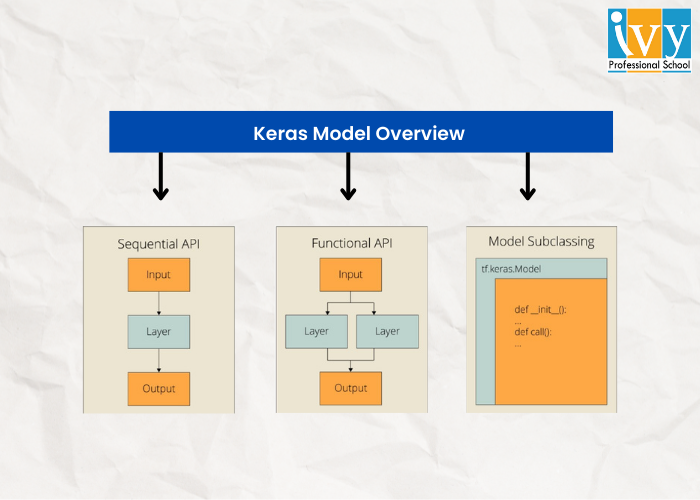
Models are the primary entity one will be working with when using Keras. The structures are used in defining TensorFlow neural networks by mentioning the attributes, operations, and layers you wish.
Keras provides a range of APIs you can employ to illustrate your neural network, involving:
– Sequential API allows one to formulate a model structure by structure for most issues. It is straightforward but restricted to single-input, single-output stacks of layers.
– Functional API is mainly a full-feature API that supports arbitrary framework architecture. It is more complicated and flexible in comparison to the sequential API.
– Model Subclassing allows one to enact everything from scratch. Ideal for research and highly complicated use scenarios, but it is hardly used in practice.
ML (Machine Learning) algorithms use a special form of an algorithm that is known as a Neural Network. Same as every machine learning algorithm, it also abides by the general ML workflow of data preprocessing and model evaluation. For ease of use, here are some of the to-dos on how to approach a Neural Network problem.
– See if there are issues where a neural network offers you an uplift over traditional algorithms.
– Conduct a survey for which neural network architecture is the most ideal required issue.
– Illustrate neural network architecture via language or library as per your choice.
– Change data into the ideal format and divide it into varied batches.
– As per your requirements, pre-process the data.
– Augmented data is utilized to magnify size and make better-trained frameworks.
– Batches are nourished by the neural network.
– Track alterations in training and validation data sets, and also train them.
– Test your frameworks.
After this article on what is Keras model, you come to know about how this is useful in the area of deep learning along with its benefits and also limitations. We have also seen how this Python library depends on low-level languages such as Theanos and TensorFlow. Also if you were wondering what is Keras vs TensorFlow, then you must have got your answer.
Career prospects in data science and data analytics have increased over time and this has become a much-acclaimed niche presently. If you wish to start your career in data science then there can be no better place than Ivy Professional School. It offers a complete course on data science conducted by industry experts. For more details, you can visit their website.
Team Sep 13, 2022 No Comments

Updated in May, 2024
Do you know Netflix and Spotify use the Scikit-learn library for content recommendations?
Scikit-learn is a powerful machine learning library in Python that’s primarily used for predictive analytics tasks such as classification and regression.
If you are a Python programmer or aspiring data scientist, you must master this library in depth. It will help you with projects like building content-based recommendation systems, predicting stock prices, analyzing customer behavior, etc.
In this blog post, we will explain what is Scikit-learn and what it is used for. So, let’s get started…
Scikit-learn is an open-source library in Python that helps us implement machine learning models. This library provides a collection of handy tools like regression and classification to simplify complex machine learning problems.
For programmers, AI professionals, and data scientists, Scikit-learn is a lifesaver. The library has a range of algorithms for different tasks, so you can easily find the right tool for your problem.
Now, there is often a slight confusion between “Sklearn” and “Scikit-learn.” Remember, both terms refer to the same thing: an efficient Python library.
Although Scikit-learn is specifically designed to build machine learning models, it’s not the best choice for tasks like data manipulation, reading, or summary generation.
Scikit-learn is built on the following Python libraries:
Scikit-learn was developed with real-world problems in mind. It’s user-friendly with a simple and intuitive interface. It improves your code quality, making it more robust and optimizing the speed.
Besides, the Scikit-learn community is supportive. With a massive user base and great documentation, you can learn from others and get help when you need it. You can discuss code, ask questions, and collaborate with developers.
Scikit-learn was created by David Cournapeau as a “Google Summer Of Code” project in 2007. It quickly caught the attention of the Python scientific computing community, with others joining to build the framework.
Since it was one of many extensions built on top of the core SciPy library, it was called “scikits.learn.”
Matthieu Brucher joined the project later, and he began to use it as a part of his own thesis work.
Then, in 2010, INRIA stepped in for a major turning point. They took the lead and released the first public version of Scikit-learn.
Since then, its popularity has exploded. A dedicated international community drives its development, with frequent new releases that improve functionality and add cutting-edge algorithms.
Scikit-learn development and maintenance is currently supported by major organizations like Microsoft, Nvidia, INRIA foundation, Chanel, etc.
The Scikit-learn library has become the de facto standard for ML (Machine Learning) implementations thanks to its comparatively easy-to-use API and supportive community. Here are some of the primary uses of Scikit-learn:
Here’s a small example of how Scikit-learn is used in Python for Logistic Regression:
from sklearn.linear_model import LogisticRegression; model = LogisticRegression().fit(X_train, y_train)
Explanation:
Now, you must have understood what is Scikit-learn in Python and what it is used for. Scikit-learn is a versatile Python library that is widely used for various machine learning tasks. Its simplicity and efficiency make it a valuable tool for beginners and professionals.
If you want to learn machine learning with the Scikit-learn library, you can join Ivy’s Data Science with Machine Learning and AI certification course.
This online course teaches everything from data analytics, data visualization, and machine learning to Gen AI in 45 weeks with 50+ real-life projects.
The course is made in partnership with E&ICT Academy IIT Guwahati, IBM, and NASSCOM to create effective and up-to-date learning programs.
Since 2008, Ivy has trained over 29,000+ students who are currently working in over 400 organizations, driving the technology revolution. If you want to be the next one, visit this page to learn more about Ivy’s Data Science with ML and AI Certification course.
Team Sep 10, 2022 No Comments
Machine learning is a complicated drill, but enacting machine learning structures is far less scary than it previously was because of the machine learning framework like Google’s TensorFlow. This framework eases the process of obtaining the data, training models, serving anticipations, and refining future outcomes. In this article, we will have a detailed look at what is TensorFlow and how it operates.
Formulated by the Google Brain team and primarily released to the audience in 2015, TensorFlow is an open-source library for numerical computation and large-scale ML. TensorFlow bundles together a range of deep learning and machine learning structures and also algorithms and makes them useful by way of relevant programmatic metaphors. It employs JavaScript or Python to offer an easy front-end API for constructing applications while implementing those apps in high-performance C++. Let us now start with tensor flow basics.
Let us begin this article on what is TensorFlow by knowing about his history. Many years ago, deep learning began to exceed all other ML algorithms when offering extensive data. Google has found it could utilize these deep neural networks to upgrade its services:
They constructed a framework known as TensorFlow to allow researchers and also developers to operate together in an AI structure. Once it is approved and is scaled, it enables a lot of people to employ it.
OIT was initially launched in 2015 while the first stable version came in 20170. It is an open-source platform under Apache Open Source Licence. The users can use it, modify it, and reorganise the revised variant for free without paying anything to Google.
To understand what is TensorFlow, you should first know about the various components of TensorFlow. So without any further delay, let us begin with this guide.
The name TensorFlow is obtained from its basic framework, “Tensor.” A tensor is basically a vector or matrix of n-dimensional that portrays all forms of data. Every value in a tensor holds a similar type of data with a relevant shape. The shape of the data is the dimension of the matrix or even an array.
A tensor can be developed from the outcome or the input data of a computation. In this data analytics framework, all tensor flow uses are conducted within a graph. The group is a set of calculations that occurs successively. Every transaction known as an op node is linked.
TensorFlow makes use of a graph structure. The chart assembles and also illustrates all the computations done at the time of the training.
You can consider the following expressions a= (b+c)*(c+2)
You can break the functions into components as given below:
d=b+c
e=c+2
a=d*e
A session can implement the operation from the graph. To stuff the graph with values of a tensor, we are required to open a session. Within a session, we must run an operator to form a result.
This data analytics framework is the better library for all as it is easily accessible to all. TensorFlow library accommodates varied API to formulate a scale deep learning frameworks such as Convolutional Neural Network (CNN) or Recurrent Neural Network (RNN).
This framework is based on graph computation as it can enable the developer to formulate the creation of the neural network along with Tensorboard. His tools enable debugging the program. It operates on GPU or CPU.
TensorFlow offers great operations and services when compared to other famous deep learning frameworks. TensorFlow is used to formulate a large-scale neural network with many layers.
It is primarily used for machine learning or deep learning issues such as Perception, Classification, Understanding, Discovering Predictions, and Creation.
Sound and voice recognition applications are the most popular use cases of deep learning. If the neural networks have proper input data feed, neural networks are capable of evaluating audio signals.
For Instance:
Image recognition is the first application that made machine learning and deep learning popular. Social Media, Telecom, and handset manufacturers, motion detection, image search, photo clustering, and machine vision.
For instance, image recognition is used to identify and recognize objects and people in the form of images. This is used to evaluate the context and content of any image.
In the case of object recognition, TensorFlow allows to classification and identify arbitrary objects within larger images. This is also availed in engineering applications to recognize shapes for the purpose of modeling and by Facebook for photo tagging.
For instance, deep learning utilizes TensorFlow for evaluating thousands of photos of cats. So a deep learning algorithm can learn to identify a cat as this algorithm is used in finding general features of objects, peoples, and animals.
Deep learning is using Time Series algorithms for examining the time series data for extracting meaningful statistics. For instance, it has employed the time series to anticipate the stock market.
A recommendation is the most common use scenario for Time Series. Amazon, Facebook, Google, and Netflix are employing deep learning for the suggestion. So, the algorithms of deep learning is used to evaluate customer activity and compare it to numerius of other users to evaluate what the user may wish to buy or watch.
For instance, it can be used to suggest us TV shows or even movies that people wish to see based pn movies and TV shows already watched.
The deep learning algorithm is jused for the purpose of video detection. It is used in the case of motion detection, real time threat detection in security, gaming, airports, and UI/UX areas.
For instance, NASA is formulating a deep learning network for objects clustering of orbit and asteroids classifications. So, it can anticipate and classify NEOs (Near Earth Objects).
Text based applications is also a famous deep learning algorithm. Sentimentals analysis, threat detection, social media, and fraud detection are the instanes of Text-based applications.
For instance, Google Translate supports more than 100 languages.
This article on what is TensorFlow would be incomplete if we do not talk about the features of this popular tool. TensorFlow has a synergistic multiplatform programming interface which is reliable and scalable in comparison to other deep learning libraries which is available. These features of TensorFlow will narrate us about the popularity of TensorFlow.
We can visualize every part of the graph which is not an option while utilizing SciKit or Numpy. To develop a deep learning application, primarily there are two or three components that are needed to formulate a deep learning application and require a programming language.
It is among the important TensorFlow features as per its operability. It offers modularity and parts of it which we wish to make standalone.
It can be trained conveniently on CPUs and in case of GPUs in distributed computing.
TensorFlow provides to the pipeline in the sense that we acn educated numerous neural networks and several GPUs which makes the frameworks very effective on large scale mechanisms.
Google has developed it, and there already is a big team of software engineers who operate on stability enhancement continuously.
The best thing about the machine learning library is that it is open so that any individual can it as much as they connection with the internet. So, individuals can manipulate the library andcome up with a great variety of useful items. And this has become another DIY space which has a huge forum for people who plan to start with and also those who find it difficult to work with.
TensorFlow has feature columns which could be identified of as intermediates between estimators and raw data, as per bridging input data with our framework.
We come to the colnclusing lines on what in TensorFlow? In recent times, this software has become the popular data learning library. Any deep learning framework like a RNN, CNN, or basic artificial neural network may be constructed using TensorFlow.
Startups, academics, and major corporations are the most common users of thai software. This is used in digitally all the products of Google that includes Gmail, Photos, and Google Search Engine.
Team Nov 06, 2021 No Comments
Today, we are going to learn about one of the most interesting and exclusive concepts that apply everywhere in business applications: Case Studies. A case study is an important and useful way to learn about the practical applications of business using science models. These science models are usually those which help us apply logic to business scenarios. Our very t
Anubinda Oct 16, 2021 No Comments
How Artificial Intelligence Can Improve Your Pay-Per-Click Ad Efforts:
Improving your PPC efforts is much easier when you implement A.I. in your strategy. Because of this, humans are still highly involve
Anubinda Oct 01, 2021 No Comments
In this blog, we will be covering the conversation of Eeshani Agarwal and Ruchika Saha, who bring us the second episode of the Learn to Visualize series where we are going to learn about Dashboard Actions. Eeshani Agarwal (Data Storyteller and Data Visualization Expert (Tableau, PowerBI, VBA, SQL, Excel). Coached 9,000