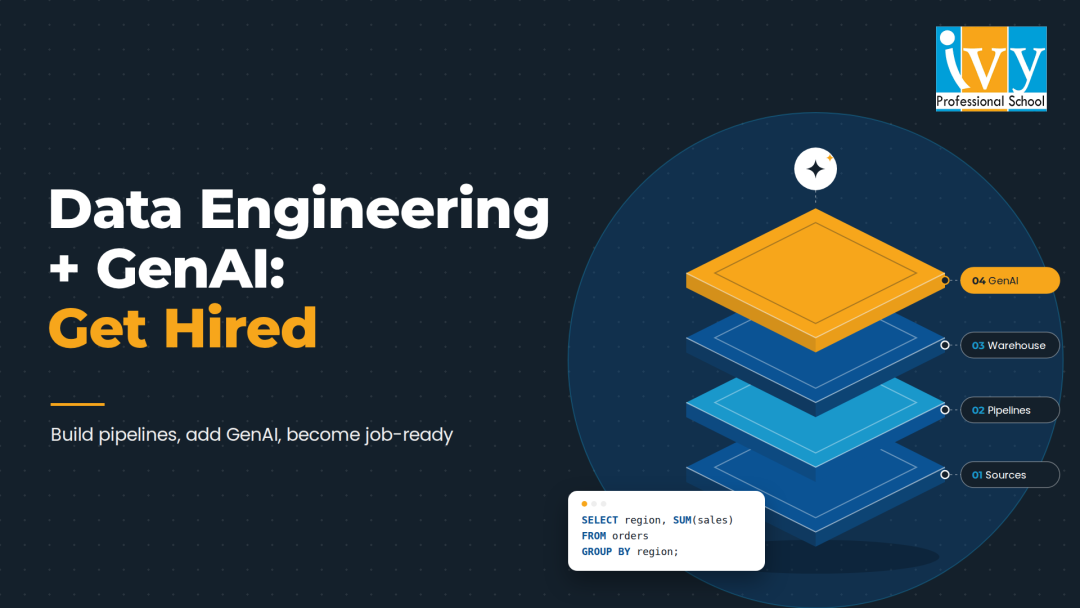
data engineering

Best AI Institute in Kolkata: How to Choose the Right Artificial Intelligence Course in 2026

Table of Contents

Add a header to begin generating the table of contents

Finding the best AI institute in Kolkata can feel overwhelming when every training centre promises placements, certificates and “industry-ready” skills. The truth is that the right choice depends on your goals, your background and how you like to le

Best Data Engineering Course with Placement: A Complete Guide for Generative AI Careers

data_engineering_genai
Table of Contents
    Add a header to begin generating the table of contents

    If you are searching for the best data engineering course with placement, you have probably noticed a second trend: almost every job description now mentions generative AI. That is no coincidence. Companies cannot build chatbots, copilots or AI search tools without clean, reliable data, and the professionals who build those pipelines are data engineers. This guide explains how to choose a generative AI course with placement support, why data engineering sits at the centre of modern AI, and how to check whether a programme will really help you get hired.

    Why Generative AI and Data Engineering Are Now Inseparable

    Generative AI gets the headlines, but most of the work behind it is data work. A large language model is only as useful as the information it can reach. When a bank builds an AI assistant for its support team, someone has to collect thousands of policy documents, clean them, split them into searchable chunks, store them in a vector database and keep everything current as policies change. When an e-commerce company wants personalised product descriptions, someone has to build pipelines that feed product, pricing and customer data into the model every day, at scale, without breaking.

    That someone is a data engineer. This is why learners who want a generative AI course with placement are asking a sharper question: should I learn GenAI on its own, or pair it with data engineering? For most freshers and career switchers, the smarter move is to pick the best data engineering course with placement that also shows how modern AI applications consume data.

     

    The reasoning is practical. Writing prompts is a skill thousands of people already have. Building the production pipeline that makes a model dependable is rarer, harder to replace and valued more highly by employers. Hiring managers know this, and their job postings increasingly ask for both skill sets in one candidate.

    What Makes the Best Data Engineering Course with Placement?

    Plenty of programmes use the phrase, but few deserve it. Judge every option on these five factors.

    1. Curriculum depth. The best data engineering course with placement should cover Python, advanced SQL, data modelling, ETL and ELT pipelines, Apache Spark, workflow orchestration with Airflow, cloud platforms and data warehousing. If the syllabus stops at SQL and dashboards, you are looking at a data analytics course wearing a data engineering label.
    2. Real, portfolio-ready projects. You should finish with pipelines you can demonstrate: ingesting raw data, transforming it, scheduling it, monitoring it and storing it in a warehouse. Recruiters trust a working GitHub project far more than a list of tools on a certificate.
    3. Live mentorship from practitioners. Recorded videos alone rarely build job-ready skill. Look for live classes, doubt-clearing sessions and instructors who have worked on production systems.
    4. Recognised certification and industry partnerships. Credentials from respected institutions and technology partners help your profile pass the first screening round, especially when you are switching careers.
    5. Placement support you can measure. The best data engineering course with placement explains exactly what it offers: resume building, mock interviews, interview referrals and hiring-partner access. Vague promises of “100% placement” without details should make you cautious.

    If a course scores well on all five, it deserves to be called the best data engineering course with placement on your shortlist. If it fails two or more, keep looking.

    What a Generative AI Course with Placement Should Teach

    A credible generative AI course with placement goes well beyond teaching you to use ChatGPT. By the end, you should be able to build and deploy something real. Look for these building blocks:

    • Python and data foundations: Pandas, APIs and clean coding practices.
    • LLM fundamentals: how transformers work, tokens, context windows and the differences between major models.
    • Prompt engineering: structured prompting, few-shot examples and techniques for reliable outputs.
    • Retrieval-Augmented Generation (RAG): connecting a model to your own documents so answers stay accurate and grounded.
    • Vector databases and embeddings: the storage layer behind semantic search.
    • LLM APIs and orchestration: frameworks such as LangChain or LlamaIndex, and function calling.
    • AI agents: systems that plan, use tools and complete multi-step tasks.
    • Evaluation and responsible AI: testing outputs, reducing hallucinations and handling privacy.
    • Deployment: wrapping your application in an API or app that others can use.

    Notice how many of these items are data problems in disguise. RAG, embeddings and vector search all depend on ingestion pipelines, data quality and storage design. That overlap is the reason many learners now look for the best data engineering course with placement alongside a GenAI programme, or inside a combined learning path. Someone who understands both can build the full system, not just the demo.

    Also check whether the generative AI course with placement includes capstone projects. A document question-answering bot, a customer-support assistant or a content automation tool gives you something concrete to discuss in interviews.

    How the Two Skill Sets Map to Real Job Roles

    The job market now has several overlapping titles. Here is how they differ:

    RoleWhat you do day to dayCore skills
    Data EngineerBuild and maintain pipelines and warehousesPython, SQL, Spark, Airflow, cloud
    Generative AI EngineerBuild LLM-powered applicationsPython, prompting, RAG, APIs, agents
    AI Data EngineerPrepare and serve data for AI systemsPipelines, vector databases, embeddings
    Analytics EngineerModel clean data for reportingSQL, data modelling, BI tools
    ML EngineerTrain, deploy and monitor modelsPython, ML, MLOps, cloud

    The “AI Data Engineer” row is where the two paths meet, and it is growing fast. Choosing the best data engineering course with placement gives you the foundation for several of these roles, while adding GenAI skills keeps your options open as the market evolves.

    Roadmap: Using the Best Data Engineering Course with Placement Effectively

    Enrolling in the best data engineering course with placement is only the start. Here is a sensible six-month plan to get the most from any strong programme.

    Months 1-2: Foundations. Master Python and SQL. Practise daily on real datasets rather than only watching lectures. Learn data modelling basics such as star schemas and normalisation.

    Months 3-4: Core engineering. Learn Spark, Airflow and a major cloud platform. Build at least two end-to-end pipelines and document them clearly on GitHub with a readable README.

    Month 5: Add GenAI. Learn LLM fundamentals, embeddings and RAG. Extend one of your pipelines so it feeds a vector database and powers a simple question-answering app.

    Month 6: Job preparation. Polish your resume and LinkedIn profile, practise mock interviews, and revise SQL and system design questions. Apply consistently rather than waiting until you feel perfectly ready.

     

    Learners who follow a structure like this tend to walk into interviews with stronger stories to tell. The course gives you the framework, but your consistency decides the outcome.

    How to Judge Placement Claims Before You Enrol

    Placement is the most abused word in education marketing, so verify it carefully. When you compare the best data engineering course with placement options, ask these questions directly:

    1. What does “placement support” include? Resume reviews, mock interviews, referrals and hiring drives are different things. Ask which ones you will actually receive.
    2. Which companies hire from the programme? Request real examples, and ideally speak to alumni on LinkedIn.
    3. Are there eligibility conditions? Some programmes require minimum attendance, project completion or assessment scores. Read these terms in advance.
    4. What happens if you do not get placed? A transparent answer here separates serious institutes from careless ones.
    5. How is the fee structured? Some institutes use a Pay After Placement model, where part of the fee depends on you securing a job. Understand the exact terms, amounts and timelines in writing.

    Treat the answers as evidence. An institute confident in its outcomes will not mind detailed questions. Be equally careful with any generative AI course with placement that cannot name hiring partners or explain its process.

    Remember, too, that no institute can guarantee a job. Even the best data engineering course with placement can only prepare you thoroughly, open doors and keep supporting you until you convert an opportunity. Your effort on projects and interview preparation remains the biggest variable.

    Red Flags to Avoid

    Whether you are shortlisting the best data engineering course with placement or a GenAI programme, watch out for these warning signs:

    • Guaranteed jobs or salaries with no written terms
    • A syllabus that lists tools but shows no projects
    • Instructors whose industry experience cannot be verified
    • No live sessions, only pre-recorded content
    • Pressure to pay immediately because “seats are filling”
    • Outdated content, such as GenAI modules that ignore RAG and agents
    • No alumni you can contact

    If you spot more than one of these, walk away. Any provider of the best data engineering course with placement should welcome your scrutiny.

    Where Ivy Professional School Fits

    Ivy Professional School in Kolkata has been training learners for 18 years and runs programmes in Data Science, Data Analytics, Data Engineering, Generative AI and AI, with a presence in Bangalore and Delhi as well. For learners comparing the best data engineering course with placement, a few facts are worth checking against the criteria above:

    • Certification: Ivy’s programmes carry an IIT Guwahati E&ICT Academy certification.
    • Industry partnerships: The institute works with NASSCOM and IBM.
    • Placement model: Ivy follows a Pay After Placement model, which ties the learner’s financial commitment more closely to job outcomes.
    • Network: Ivy reports 37,500+ alumni and 500+ hiring partners.

    Those are claims worth verifying yourself, like any other. Visit ivyproschool.com, review the current syllabus and placement terms, speak to counsellors and ask to connect with alumni. Doing so lets you test whether Ivy is the best data engineering course with placement for your goals instead of relying on an article.

    Ivy also offers a Generative AI course. Compare its syllabus against the checklist earlier in this guide, and ask the counsellor how it can be combined with data engineering. The best data engineering course with placement for one learner may differ from another’s, depending on background and career goals.

    Which Path Suits You?

    • Fresh graduates: Start with data engineering fundamentals, then add GenAI. A strong foundation makes you more employable than someone who knows only prompting. The best data engineering course with placement suits you well here because it provides structure, projects and hiring access.
    • Working professionals in IT: If you already code, you can move faster toward Spark, cloud and RAG. Use the best data engineering course with placement as a bridge, and prioritise weekend or evening batches and project depth.
    • Non-IT career switchers: Allow extra time for Python and SQL. Choose a programme with patient mentorship and strong doubt-clearing.
    • Analysts: You already know SQL and business context. Moving into data engineering, then GenAI, is a natural upgrade.

    Frequently Asked Questions

    What is the best data engineering course with placement? The best data engineering course with placement is one that combines a deep, project-based curriculum, live mentorship, a recognised certification and transparent placement support. Compare syllabus, projects, alumni outcomes and fee terms, then choose the one that matches your background and goals.

    Is a generative AI course with placement worth it in 2026? Yes, if it teaches practical skills such as RAG, vector databases, agents and deployment, not just prompting. Pairing it with the best data engineering course with placement makes you more valuable because you can build the entire pipeline behind an AI application.

    Can I learn data engineering without a coding background? Yes. Many learners begin from scratch. Python and SQL are learnable with consistent practice and good mentoring. Look for a programme that starts at the basics, and expect to spend extra time on fundamentals.

    How long does it take to become job-ready? Most learners need around six to nine months of consistent effort, depending on prior experience and time available. Projects and interview practice matter as much as finishing the lectures.

    How do I know if the best data engineering course with placement claims are genuine? Ask for named hiring partners, speak to alumni, read the placement terms in writing and check whether the institute explains what happens if you are not placed. Genuine providers answer these questions openly.

    Does Pay After Placement mean the course is free until I get a job? Not necessarily. Terms differ between institutes, so confirm exactly what you pay upfront, what you pay later and under which conditions.

    Final Thoughts

    Generative AI is reshaping the job market, but it is data engineers who make AI systems reliable in the real world. That is why choosing the best data engineering course with placement is one of the smartest decisions a learner can make in 2026, especially when it also builds your understanding of GenAI. Look for depth, projects, mentorship, credible certification and placement you can verify. Pair that with consistent practice, and you will be competing for the most in-demand roles in tech.

    If you are ready to explore, visit ivyproschool.com, compare the Data Engineering and Generative AI courses, and book a counselling session to find the best data engineering course with placement for your career stage. Your first pipeline, and your first AI application, are closer than you think

    Data Engineering Skillset: Essential Skills, Tools and Career Roadmap

    Table of Contents
      Add a header to begin generating the table of contents

      Every digital business depends on reliable data. Customer transactions, website events, financial records, application logs and sensor readings must be collected, cleaned, organised and delivered to the people and systems that need them. Data engineers build the infrastructure that makes this possible.

      A strong data engineering skillset goes beyond knowing a programming language or operating a cloud tool. It combines database knowledge, software engineering, data architecture, distributed processing, security, problem-solving and business understanding.

      This guide explains the core data engineer skills employers expect, the tools associated with each skill and a practical roadmap for developing job-ready capability.

      What Is a Data Engineering Skillset?

      A data engineering skillset is the combination of technical, analytical and professional abilities required to design, build, operate and improve data systems.

      A data engineer may extract data from databases, APIs and applications; transform raw data into consistent datasets; build batch and streaming pipelines; design warehouses and lakes; maintain data quality; and support analytics, machine learning and AI applications.

      Data Engineering Skills at a Glance

      Skill areaWhat you should knowCommon tools
      SQLQueries, joins, windows and optimisationPostgreSQL, MySQL, SQL Server
      ProgrammingAutomation, APIs, transformation and testingPython, Java, Scala
      Data modellingSchemas, facts, dimensions and normalisationdbt, modelling tools
      PipelinesETL, ELT, retries and incremental loadingAirflow, ADF, AWS Glue
      Distributed processingLarge-scale data processingSpark, Databricks
      StreamingEvents, producers, consumers and offsetsKafka, Kinesis
      CloudStorage, compute, identity and cost controlAWS, Azure, Google Cloud
      Quality and governanceTesting, lineage and access controlGreat Expectations, Purview
      DevOpsVersion control and automated deploymentGit, Docker, CI/CD tools
      Business skillsRequirements, documentation and communicationJira, Confluence

      1. Advanced SQL Skills

      SQL is the foundation of the data engineering skillset. Engineers use it to inspect source systems, transform data, validate results, create warehouse models and troubleshoot pipeline failures.

      A job-ready professional should be comfortable with joins, common table expressions, subqueries, aggregate functions, window functions, date and string functions, deduplication, views, stored procedures, indexes, partitions and query execution plans.

      Returning the correct result is only the first step. A data engineer must also consider how a query performs when a table contains millions of records. This requires knowledge of filtering, indexing, partition pruning, data distribution and unnecessary data movement.

      2. Python and Programming Fundamentals

      Python is commonly used for data ingestion, transformation, API integration, automation and testing. Its standard data structures and extensive ecosystem make it practical for reusable data workflows.

      Important skills include:

      • Functions and exception handling
      • Lists, dictionaries, sets and tuples
      • CSV, JSON and Parquet file processing
      • REST API integration
      • Database connectivity
      • Logging and configuration management
      • Object-oriented programming
      • Unit testing
      • Package and dependency management

      Libraries such as pandas are useful for moderate-sized data, while PySpark supports distributed processing. Python should be learned through practical tasks such as extracting paginated API data, validating schemas, processing files and loading results into databases.

      3. Data Modelling and Database Design

      Pipelines create value only when their outputs are structured for business use. Data modelling is therefore a core part of the data engineering skillset.

      Engineers should understand:

      • Entities and relationships
      • Primary and foreign keys
      • Normalisation and denormalisation
      • Star and snowflake schemas
      • Fact and dimension tables
      • Surrogate keys
      • Slowly changing dimensions
      • Schema evolution

      Operational databases are designed for frequent inserts and updates. Analytical systems are designed for large scans, aggregations and historical analysis. Recognising this difference helps engineers build models that are both accurate and efficient.

      Modern frameworks such as dbt allow teams to create modular SQL models and combine them with testing, documentation, lineage and version-controlled workflows.

       

      4. ETL, ELT and Data Pipeline Development

      ETL means extract, transform and load. ELT means extract, load and transform. Both patterns move data from source systems into analytical platforms.

      A capable data engineer should know how to:

      • Connect with databases, APIs, SaaS applications and file systems
      • Perform full and incremental loads
      • Use timestamps or change data capture
      • Handle changing schemas
      • Manage dependencies between tasks
      • Configure retries and failure notifications
      • Quarantine invalid records
      • Maintain audit information
      • Reconcile source and target totals

      Reliable pipelines should be idempotent, meaning they can be rerun safely without creating duplicates or corrupting results. They should also account for late files, network failures, API rate limits and changing source schemas.

      5. Data Warehouses, Data Lakes and Lakehouses

      A complete data engineering skillset includes the major patterns used to store analytical data.

      A data warehouse stores curated data optimised for reporting and analysis. Common examples include Snowflake, Google BigQuery, Amazon Redshift and Azure-based warehouse services.

      A data lake stores large volumes of structured, semi-structured and unstructured data, typically in object storage.

      A lakehouse combines the flexibility of data-lake storage with warehouse-style performance, management and governance.

      Important storage concepts include:

      • Columnar versus row-based storage
      • Partitioning and clustering
      • Compression
      • File formats such as Parquet, Avro and ORC
      • Schema enforcement and evolution
      • Metadata catalogues
      • Open table formats
      • Retention rules
      • Separation of storage and compute
      • Workload and cost management

      The objective is not to memorise every product interface. It is to understand why a storage pattern suits a workload and what trade-offs it creates in performance, governance and cost.

      6. Distributed Processing with Apache Spark

      When data becomes too large or processing too complex for one machine, distributed computing becomes necessary. Apache Spark is widely used for data engineering, data science and machine learning workloads.

      A practical Spark skillset includes:

      • DataFrames and Spark SQL
      • Transformations and actions
      • Lazy evaluation
      • Partitions and shuffles
      • Join and aggregation strategies
      • Caching and persistence
      • Handling data skew
      • Distributed file formats
      • Structured Streaming
      • Performance monitoring

      Many beginners focus only on PySpark syntax. Employers need engineers who can diagnose why a job is slow, why a join creates excessive shuffling or why thousands of small files reduce performance.

      7. Streaming and Event-Driven Data

      Batch pipelines process data at scheduled intervals. Streaming systems process events continuously or in short windows.

      Apache Kafka is a distributed event-streaming platform used to publish, retain and process streams of events.

      Engineers working with streaming data should understand:

      • Events, topics and partitions
      • Producers and consumers
      • Consumer groups
      • Offsets
      • Ordering
      • Message retention
      • Delivery guarantees
      • Event time and processing time
      • Windows and watermarks
      • Late-arriving events
      • Schema registries
      • Dead-letter queues

      Managed alternatives include Amazon Kinesis and Azure Event Hubs. AWS describes Kinesis as a service for collecting, processing and analysing real-time streaming data.

      A practical streaming project could process e-commerce clickstream events, calculate rolling product views and store the resulting metrics for a dashboard.

      8. Workflow Orchestration

      Production data platforms contain dependent tasks that must run in the correct order. Orchestration tools schedule these tasks, manage dependencies and monitor their status.

      Apache Airflow is designed for developing, scheduling and monitoring batch-oriented workflows, typically represented as directed acyclic graphs or DAGs.

      Relevant orchestration skills include:

      • DAG design
      • Task dependencies
      • Scheduling and backfills
      • Parameters and environment variables
      • Retries and failure handling
      • Sensors and external dependencies
      • Secrets management
      • Logging and alerts
      • Monitoring service-level expectations

      Other options include Azure Data Factory, Google Cloud Composer, Databricks Workflows and Microsoft Fabric Data Factory.

      The core skill is understanding how workflows behave when tasks fail, data arrives late or historical periods must be reprocessed.

      9. Cloud Data Engineering Skills

      Most modern data engineering roles require exposure to at least one major cloud platform: Microsoft Azure, Amazon Web Services or Google Cloud.

      A cloud-ready data engineering skillset should cover:

      • Object storage
      • Managed databases and warehouses
      • Serverless query engines
      • Identity and access management
      • Encryption and key management
      • Virtual networks and private endpoints
      • Compute sizing and autoscaling
      • Monitoring and logging
      • Infrastructure as code
      • Cost estimation and optimisation

      AWS, for example, provides analytics services across querying, processing, governance, warehousing and streaming, including Athena, EMR, Glue, Redshift, Lake Formation and Kinesis. Azure and Google Cloud offer comparable capability categories under different service names.

      Beginners should not attempt to master all three clouds simultaneously. Choose one ecosystem, build an end-to-end project and then map the concepts to equivalent services elsewhere.

      10. Data Quality, Testing and Observability

      A pipeline is not successful merely because it finishes without an error. It must deliver accurate, complete, timely and trustworthy data.

      Engineers should create checks for:

      • Null values
      • Duplicate records
      • Invalid formats
      • Accepted value ranges
      • Referential integrity
      • Unexpected row-count changes
      • Data freshness
      • Schema drift
      • Distribution anomalies
      • Source-to-target reconciliation

      Testing operates at several levels. Unit tests validate code components. Integration tests confirm that systems work together. Data tests verify the properties of output datasets.

      Observability extends this approach by monitoring pipeline duration, failure rates, data freshness, volume changes, lineage and downstream impact.

      Engineers must also decide what happens when a check fails. Depending on the level of risk, the pipeline may stop, quarantine records, issue a warning or continue with an audit flag.

      11. Git, DevOps and Software Engineering

      Data engineering is a software engineering discipline. Production pipelines should not depend on manually edited scripts stored on individual computers.

      Core engineering practices include:

      • Git branches, commits and pull requests
      • Clear repository structures
      • Reusable functions and modules
      • Code reviews
      • Automated testing
      • Continuous integration and deployment
      • Environment-specific configuration
      • Docker containers
      • Infrastructure as code
      • Release and rollback procedures

      dbt explicitly applies software engineering practices such as version control, modularity, testing, CI/CD and documentation to data transformation workflows.

      12. Security, Privacy and Data Governance

      Data engineers frequently work with financial, customer, employee and operational data. Security must be built into the system.

      Relevant skills include:

      • Role-based access control
      • Least-privilege permissions
      • Encryption at rest and in transit
      • Secrets and credential management
      • Data masking and tokenisation
      • Audit logging
      • Data classification
      • Retention and deletion policies
      • Lineage and metadata management

      Governance ensures users understand where data came from, what it means, who owns it and who may access it. A catalogue, business glossary and lineage system make data easier to discover while reducing misuse.

      Engineers do not need to act as legal experts, but they must translate security and governance requirements into technical controls.

      13. Business Understanding and Communication

      Technical skill alone does not create useful data products. Data engineers must understand the business meaning behind the requested data.

      If a stakeholder asks for “daily sales data,” the engineer must clarify:

      • What qualifies as a sale?
      • Should cancelled orders be included?
      • How should returns be treated?
      • Which time zone defines a day?
      • How quickly must the data become available?
      • How much historical data is required?
      • Who may access customer-level details?
      • Should totals reconcile with the finance system?

      Useful professional skills include requirement gathering, documentation, estimation, prioritisation, stakeholder communication and incident reporting.

      Engineers should be able to explain technical trade-offs in terms of reliability, time, risk and cost.

      14. AI-Assisted Data Engineering

      AI coding assistants can generate SQL, explain unfamiliar code, create documentation and accelerate troubleshooting. Data platforms are also adding AI-supported development features.

      dbt, for example, documents AI capabilities grounded in project context such as lineage, tests, contracts and metric definitions.

      However, generated code may be inefficient or apply incorrect business logic. Suggested configurations may also create security, performance or cost issues.

      The emerging skill is not simply using AI. It is using AI with sufficient context, review, testing and governance. Engineers who understand the fundamentals can use these tools to move faster without sacrificing reliability.

      A Practical Data Engineering Roadmap

      Beginners do not need to master every technology before applying for roles. A practical sequence is:

      1. Learn SQL thoroughly.
      2. Build Python programming fundamentals.
      3. Understand relational databases and data modelling.
      4. Create ETL pipelines using files, APIs and databases.
      5. Learn Git, testing and documentation.
      6. Choose one cloud platform.
      7. Study one warehouse and one orchestration tool.
      8. Add Spark and streaming when the use case requires them.
      9. Build two or three documented, end-to-end projects.

      This sequence develops depth before breadth. It is more effective than gaining superficial exposure to dozens of tools.

      Experienced professionals should move beyond tool operation towards architecture, platform reliability, cost optimisation, governance, reusable components and technical leadership.

      Projects That Demonstrate Data Engineer Skills

      A portfolio should demonstrate complete workflows and engineering decisions.

      1. E-commerce Batch Pipeline

      Extract order and customer data from an API, store raw files in object storage, transform the data, load warehouse tables and produce daily sales metrics.

      2. Real-Time Clickstream Pipeline

      Generate website events, publish them to a streaming platform, calculate windowed metrics and store the results for analysis.

      3. Data Quality Framework

      Create configurable checks for duplicates, nulls, row counts, freshness and source-to-target totals. Produce an audit report after every pipeline run.

      4. Cloud Data Warehouse Project

      Build a dimensional model, implement incremental loading, add role-based access and document cost-optimisation decisions.

      Each project should contain a README, architecture diagram, data model, source code, tests, sample outputs and deployment instructions. Explain trade-offs and limitations instead of presenting the work as flawless.

      Common Mistakes to Avoid

      Common mistakes when building data engineer skills include:

      • Learning tools without understanding architecture
      • Treating SQL as a basic skill
      • Building pipelines that cannot be rerun safely
      • Ignoring data quality and reconciliation
      • Using distributed systems for small problems
      • Pursuing certifications without practical projects
      • Keeping all work in notebooks
      • Neglecting Git, testing and documentation
      • Assuming AI-generated code is production-ready

      A balanced data engineering skillset combines conceptual depth, implementation ability and operational discipline.

      Frequently Asked Questions

      What are the most important data engineer skills?

      The most important skills are SQL, Python, data modelling, ETL or ELT, databases, cloud platforms, orchestration, data quality, Git and communication. Spark and streaming tools become important for large-scale or real-time systems.

      Is Python enough for data engineering?

      No. Python is valuable, but data engineering also requires SQL, database concepts, modelling, pipeline design, cloud services, testing and operational skills.

      Does a data engineer need machine learning knowledge?

      Deep machine learning expertise is not mandatory for most roles. However, understanding model-training data, feature pipelines and production inference helps when supporting AI and machine learning teams.

      Which cloud platform is best for data engineering?

      Azure, AWS and Google Cloud all support enterprise data engineering. The best starting platform depends on your target employers, existing experience and technology environment. Learn one platform deeply before covering all three.

      Is data engineering suitable for freshers?

      Yes. Entry-level candidates should focus on SQL, Python, databases, ETL, Git and one cloud ecosystem, then demonstrate these skills through complete projects.

      How long does it take to become job-ready?

      The timeline depends on prior programming and database experience. Readiness is better measured by whether you can independently design, build, test, explain and troubleshoot an end-to-end pipeline.

      Final Takeaway

      The ideal data engineering skillset is not a checklist of fashionable tools. It is the ability to build data systems that are accurate, scalable, secure, maintainable and useful to the business.

      Start with SQL, Python, databases and data modelling. Progress to pipelines, cloud platforms, orchestration, distributed processing, data quality and governance. Reinforce each stage with practical projects and professional engineering practices.

      As organisations expand analytics, machine learning and enterprise AI, reliable data engineering becomes increasingly valuable. Professionals who combine technical depth with business understanding will be better positioned to build the trusted data foundation these systems require.

      To develop these capabilities through structured training and hands-on projects, explore the Data Engineering Programme at Ivy Professional School.


      Data Engineer Salary in India (2026): A Complete Guide

      Data Engineer Salary 2026
      Table of Contents
        Add a header to begin generating the table of contents

        The demand for data engineers in India has exploded, and Data Engineer Salary in India 2026 is now one of the hottest topics among job seekers and professionals looking to switch careers. As companies double down on data-driven decision-making, the role of a data engineer has become critical to business success.

        But how much do data engineers actually earn in 2026? And what factors truly influence these salaries?

        Let’s break it down in a practical, no-fluff way.

        Why Data Engineering Salaries Are Rising in 2026

        India’s data ecosystem is maturing rapidly. Organizations are no longer just experimenting with data, they are building entire products, platforms, and strategies around it. This shift is directly impacting Data Engineer Salary in India 2026, pushing compensation higher across industries.

        Here’s what’s driving this growth:

        • The explosion of AI and Generative AI applications that depend on clean, structured data
        • Rapid adoption of cloud platforms like AWS, Azure, and Google Cloud
        • Real-time analytics becoming a business necessity
        • A shortage of skilled professionals who can build scalable data pipelines

        In simple terms: companies have data, but they desperately need experts who can make it usable.

        What is the Data Engineer Salary in India in 2026?

        Let’s get straight to the numbers. The Data Engineer Salary in India 2026 varies significantly based on experience.

        Salary by Experience Level

        Experience LevelAverage Salary (₹ per annum)
        0–2 years (Fresher)₹5 – ₹10 LPA
        2–5 years₹10 – ₹20 LPA
        5–8 years₹20 – ₹35 LPA
        8–12 years₹35 – ₹60 LPA
        12+ years₹60 LPA – ₹1 Cr+


        These figures reflect realistic market trends across startups, mid-sized firms, and large enterprises.

        One key insight: the jump from mid-level to senior roles is where salaries accelerate sharply. This is where skills and real-world impact start to matter more than just experience.

        How Does Company Type Impact Data Engineer Salary in India in 2026?

        Not all companies pay equally, even for similar roles. The variation in Data Engineer Salary in India 2026 is heavily influenced by the type of organization.

        Service-Based Companies

        • ₹4 – ₹12 LPA (entry to mid-level)
        • Slower growth but stable career progression

        Product-Based Companies

        • ₹12 – ₹40 LPA
        • Higher pay due to direct impact on business outcomes

        Global Tech / MNCs

        • ₹25 LPA – ₹1 Cr+
        • Highly competitive roles with top-tier compensation

        Funded Startups

        • ₹10 – ₹50 LPA + ESOPs
        • Fast growth, high ownership, and variable risk

        If your goal is to maximize your Data Engineer Salary in India 2026, moving toward product-based companies or high-growth startups is often the smartest move.

        What Skills Drive Higher Data Engineer Salary in India in 2026?

        When analyzing Data Engineer Salary in India 2026, one thing becomes clear: tools alone don’t drive salary—your ability to solve real problems does.

        That said, certain skills consistently command higher pay.

        High-Paying Skills

        • Cloud platforms (AWS, Azure, GCP) → 20–40% salary boost
        • Big data tools (Apache Spark, Hadoop)
        • Streaming technologies (Kafka, Flink)
        • Data warehousing (Snowflake, BigQuery, Redshift)
        • Advanced Python and SQL

        Emerging Edge Skills

        • Data engineering for GenAI pipelines
        • Real-time data processing systems
        • DataOps and pipeline automation
        • Lakehouse architectures

        Professionals who combine 2–3 of these capabilities often see a significant jump in their Data Engineer Salary in India 2026.

        How Does Location Affect Data Engineer Salary in India?

        Location still plays a role in determining salaries, although remote work is gradually reducing these differences.

        Average Salaries by City

        • Bangalore: ₹10 – ₹40 LPA (highest demand and pay)
        • Hyderabad: ₹8 – ₹30 LPA
        • Pune: ₹7 – ₹25 LPA
        • Gurgaon: ₹8 – ₹28 LPA
        • Mumbai: ₹7 – ₹25 LPA
        • Kolkata: ₹5 – ₹18 LPA

        While metro cities dominate high-paying roles, remote opportunities are allowing professionals from smaller cities to access better compensation.

        What Are Real-World Data Engineer Salary Scenarios in India in 2026?

        To better understand Data Engineer Salary in India 2026, let’s look at practical scenarios.

        Scenario 1: Career Switcher

        A professional transitioning from a non-tech role may start at ₹6–10 LPA. With consistent upskilling, they can reach ₹15–20 LPA within 2–3 years.

        Scenario 2: Mid-Level Professional

        With 3–5 years of experience, salaries range from ₹18–30 LPA in product companies. Adding cloud and big data skills can push this beyond ₹25 LPA.

        Scenario 3: Top 10% Talent

        Highly skilled engineers working on large-scale systems earn between ₹40 LPA and ₹1 Cr+. These roles demand strong system design and deep technical expertise.

        How to Increase Data Engineer Salary in India in 2026

        Many professionals make the mistake of focusing only on tools instead of impact. If you want to grow your Data Engineer Salary in India 2026, you need to think differently.

        Here’s what actually works:

        • Build end-to-end data projects, not just follow tutorials
        • Learn system design for scalable data pipelines
        • Gain hands-on experience with cloud platforms
        • Showcase your work through GitHub and a strong portfolio
        • Target product-based companies instead of mass recruiters

        The market rewards those who can deliver business outcomes, not just technical knowledge.

        Future Outlook: Is Data Engineering Still Worth It?

        The short answer is yes and it’s getting even better.

        However, the role is evolving rapidly, which will continue to influence Data Engineer Salary in India 2026 and beyond.

        What’s Changing

        • Data engineers are becoming AI infrastructure builders
        • Traditional ETL roles are increasingly automated
        • Demand is shifting toward real-time and scalable systems

        What This Means for You

        If you stay at a basic skill level, your salary growth will plateau. But if you evolve with AI, cloud, and distributed systems, you will move into the top earning bracket.

        Conclusion

        Data engineering in India in 2026 is no longer just a “good career option” it’s a strategic, high-income career path.

        The gap in Data Engineer Salary in India 2026 between average and top professionals is massive. And that gap is driven by one key factor: the ability to create real business impact through data.

        If you are entering this field or looking to grow, focus less on certifications and more on building systems that companies actually need.

        Because in today’s market, skills get you hired but impact gets you paid.

        Prateek Agrawal is the founder and director of Ivy Professional School. He is ranked among the top 20 analytics and data science academicians in India. With over 16 years of experience in consulting and analytics, Prateek has advised more than 50 leading companies worldwide and taught over 7,000 students from top universities like IIT Kharagpur, IIM Kolkata, IIT Delhi, and others.

        This is a

        Prateek Agrawal

        Prateek Agrawal is the founder and director of Ivy Professional School. He is ranked among the top 20 analytics and data science academicians in India. With over 16 years of experience in consulting and analytics, Prateek has advised more than 50 leading companies worldwide and taught over 7,000 students from top universities like IIT Kharagpur, IIM Kolkata, IIT Delhi, and others.

        Important Data Engineering Tips For Beginners

        Data engineering is among the most in-demand career options presently and a highly profitable one at that. And if you are thinking about what data engineering holds, what will be the growth pathway, or how to become a data engineer, then you are at the right place. In this article, we are going to have a look at some of the most effective data engineering tips that you can imbibe for a better data engineering career option. 

        Data engineers basically create reservoirs for storing data and also take care of these reservoirs. They are generally guardians of the data which is available to companies. They manage all our personal data and also preserve it. They help in making sufficient unorganized data into data that can be used so that business analysts and also data scientists can anticipate it. 

        A data engineer basically arranges datasets as per the requirement of the industry. They test, construct, and maintain the primary database mechanism. They are also responsible for creating algorithms for converting data into useful structures and formulating the latest data analytics tools. Data engineers collaborate with management teams to know the aim of the company.

        Data Engineering Tips

        important-data-engineer-tips
        Important Data Engineer

        As stated above, data engineering is an interdisciplinary profession that needs a mixture of technical and also business knowledge to create the most impact. Beginning a career in data engineering, it is not always clear what is important to be successful. So these data engineering tips will help you in navigating your career better. 

        There are five primary tips that we would recommend to any data engineer who is just starting their career.

        1. Learn The Important Tips

        Skill is the key. It opens avenues to many new chances. Skills are required for every job role and one needs to learn the skill sets that are needed so that one can have a roadmap of what that specific job entails. The below-mentioned skills are needed to be a successful data engineer.

        Learn the programming languages

        Coding is an important skill you need to work with data on a bigger scale. Python is one of the most used languages to master data science. Along with Python, you can also master Java, Scala, and many more. These are crucial for analysis.

        Master the databases

        As a data engineer, you will basically be needing to function with databases, constructing, handling, and extracting data from databases. These are basically two types of databases (DBMS) that you will work with:

        • Relational databases (RDBMS) offer a set of data in a tabular format with rows and columns. SQL is the primary programming language for RDBMS.
        • On the other hand, a non-relational database does not show the dataset in tabular form. The majority of data engineers are often experts in NoSQL.

        Learn To Manage Data With ETL Mechanism

        Moving data from several sources of data to a single database is a part of the ETL process. By using these technologies, data can be converted into valuable data.

        Learn To Store Data

        The ETL process involves transferring data from various sources of data to a single database. These technologies allow data to be transformed into useful data.

        Try Storing Data Online With Cloud Computing

        It’s excellent to know how to save data, but you should also be familiar with online data storage. Data is stored online using cloud computing to boost accessibility.

        Learn All The Machine Learning Algorithms

        It helps to have a foundational understanding of machine learning. Although it is not directly related to data engineers, machine learning aids them in understanding the requirements of a data scientist.

        Work On Your Communication Skills

        Data engineers, like those in every other profession, must frequently communicate with a variety of people, including business analysts, data scientists, and other data engineers.

        2. Create Credibility With Certificates

        Your skills can be validated with a certificate. It gives the potential employer a sense of your abilities and experience. You can choose from a number of reputable platforms for accredited courses. You can choose professional courses and one best in the industry is from Ivy Professional School.

        3. Put Your Skills To Use

        A certificate can be used to verify your abilities. It provides the prospective employer with information about your skills and experience. For authorized courses, you have a variety of trustworthy sites to pick from. Create a solid portfolio, do industry-level projects, and get into case studies that will help you to a great extent.

        4. Keep Learning

        Once you get a job, you will know that data engineering is a growing career. You should keep in mind nevertheless that learning doesn’t end here. Working with data requires ongoing learning and development. Languages are constantly evolving, so it’s important to stay up with these changes if you want to advance as a data engineer. Join or start a group that focuses on data engineering and associated skills so that everyone in the community can contribute their thoughts and continue to hone their abilities.

        5. Start Working with Organizations as a Freelancer or as an Intern

        Using your Linkedin profile, you can get in touch with various businesses or work for yourself. Share your resume with them, ask them to provide you with some work, and show your want to work for the organization and team. Your college career and confidence will grow if you work on beginner-level assignments. Extrovert yourself. Make friends with others. Every day, acquire new knowledge. You will benefit from having an internship in your early career.

        Summary

        Working on tasks at the introductory level will advance your academic career and confidence. Be outgoing yourself. Make new acquaintances. Learn something new every day. You will benefit from having an internship in your early career. Such a large amount of data requires laborious management. Industries can manage their data effectively thanks to data engineers. It is simple for you to find employment in this industry if you have the necessary talents and follow all the above-mentioned data engineering tips, such as coding, data storage, cloud storage, etc. Obtaining a legitimate certificate will elevate your profile.

        8 In-Demand Data Engineering Skills

        data engineering skills
        What are the most important data engineering skills?

        Guess how much data engineers earn? An average salary of ₹7,44,500 per year in India. And senior data engineers earn between ₹11 lakhs to ₹24 lakhs per year.

        And if you search for data engineering jobs on Indeed or LinkedIn, you will find over 20,000 vacancies in India alone. But why am I telling you all this? 

        Because I want to show how in-demand data engineers are in the market. With more and more companies relying on data to make smart decisions, data engineering has become a necessity.

        Now, if you want to start a career in data engineering, you have to learn some technical and soft skills. In this post, I will tell you what those essential data engineering skills are and how you can start your career in this field. 

        Table of Contents
          Add a header to begin generating the table of contents

          What Does a Data Engineer Do?

          You can think of data engineers as the architects of the data world. They build and maintain systems and architecture to collect, store, and manage data.

          For example, they work with ETL (extract, transform, load) processes to combine data from multiple sources into a central repository. Similarly, they build data pipelines, work with databases, and manage data warehouses.

          They basically prepare the raw data for analysis so that data analysts and data scientists can do their jobs. This way, they work together to help the company find valuable insights and make decisions that lead to business growth. 


          Data Engineering Skills You Must Learn

          To perform all those tasks, data engineers need to gain expertise in various processes, tools, and technologies. They also need soft skills to work together as a team and communicate effectively. Here are all the skills you would need to become a pro data engineer:


          1. Programming

          Aspiring data engineers often ask me, “Is coding important?” And I always tell them that coding is one of the most important skills for data engineers. It is what will help you optimize and automate data workflows as well as improve data quality and reliability. Here are some programming languages often used in data engineering:

          Python: It’s good for handling big data, automating tasks, and working with different data formats. It has a range of libraries that make data processing easier and faster.

          SQL: It helps manage and query large databases. It’s also needed for data handling tasks like extracting, organizing, and updating data stored in databases.

          Java: This language helps you build scalable, high-performance data pipelines. It helps you develop large, reliable systems that handle big data processing efficiently.

          Scala: It helps you work with distributed data systems like Apache Spark. It’s specifically designed to handle large datasets while maintaining performance.

          R: It helps in data analysis and statistical tasks. You will need it to perform complex data manipulation and generate insights from data sets.

          You can go through this data engineering syllabus to learn more about technical skills that are valued in the present market.


          2. Data Warehousing

          One of the most important roles of data engineers is to store and organize raw data in data warehouses. Data warehouses are simply central repositories that allow access to real-time data for analysis and decision-making. 

          Without this skill, you won’t be able to manage the high volume and complex data most companies handle today. So, you need to know about data warehousing solutions like Panopoly or Amazon Redshift. This way, you can make data storage, retrieval, and processing more efficient.


          3. Operating Systems

          Knowing programming languages isn’t enough. You also need an understanding of operating systems to design, develop, and troubleshoot systems. As a data engineer, you will work with operating systems like Linux, UNIX, macOS, and Windows because data infrastructure often runs on these platforms. For example, Linux is widely used in data engineering because of its stability, flexibility, and performance. 


          4. Database Management

          This data engineering skill helps you design, maintain, and optimize databases. SQL is the most widely used language for managing relational databases, allowing you to query, update, and manipulate data efficiently. You also need to learn NoSQL databases like Cassandra or Bigtable, which are better suited for handling unstructured data.

          You can learn basic SQL queries, cleaning and modifying data, aggregating and analyzing data, working with multiple data tables, troubleshooting and error handling, advanced filters in SQL, data definition language, data manipulation language, using subqueries, creating user-defined functions, etc. 


          5. Big Data Engineering

          This is an important data engineering skill because you will often have to work with big datasets that traditional databases can’t handle. It will make you an expert at managing and processing data on a large scale.

          For this, you can learn Hadoop, which includes topics like MapReduce, YARN, HDFS, data spilling, data replication, Daemons, etc. You have to learn Apache Hive to query large datasets using HiveQL. You also need to know Apache Spark, how to optimize it, and how to process data in real time. A good understanding of real-time data processing with Kafka and its integration with Spark is also important.


          6. Azure Cloud Engineering

          Microsoft Azure is a cloud platform that provides scalable, secure, and cost-effective data storage and processing solutions. So, this skill helps you build and maintain data pipelines, store data, and run large-scale analytics in the cloud. 

          Here, you will learn about Azure services like virtual machines, storage, and database services. Next, you can understand advanced data engineering with Azure and real-time data streaming and processing. Learning hybrid cloud scenarios, governance, and compliance is also necessary.


          7. Critical Thinking

          This data engineering skill helps you better analyze and evaluate a situation. You need this to identify problems related to data collection, storage, or analysis and then develop effective solutions. You have to come up with innovative solutions to improve the performance of the systems and the quality of the data. This is where critical thinking helps you. 


          8. Communication

          As a data engineer, you will collaborate with other team members and business leaders with and without any technical expertise. So, better communication skills help you explain data processes and systems and share updates without any misunderstandings. For example, you may have to work with data scientists or analysts and share findings and suggestions. And you know, this skill not only helps you in data engineering but also in your entire life. 


          How to Become a Data Engineer

          Now, let’s understand how to become a data engineer:

          1. Complete Your Education

          Even though formal education may not be that important these days, most employers need data engineers to hold at least a bachelor’s degree. You should hold a degree in something like computer science, computer engineering,  information technology, software engineering, applied math, statistics, physics, or a related area. 


          2. Learn Industry-Relevant Skills

          You just saw the important data engineering skills in the above section. You need to master them. And one of the best ways to do it is to take a comprehensive course.

          For example, Ivy Professional School’s IIT-certified Data Engineering Certification course helps you learn all the in-demand skills like SQL for data engineering, Python essentials for data, Big data processing, and Azure cloud engineering. 

          This 45-week live online course will make you an expert at building a complete ETL data pipeline on the cloud with tools like Azure, Hive, MongoDB, Spark, Hadoop, etc. The really interesting thing about this program is that you will learn from IIT Guwahati professors and expert professionals at Amazon, Google, Microsoft, etc.


          3. Gain Experience and Build Your Portfolio

          Just gaining theoretical knowledge isn’t enough. You also need to know how to implement your knowledge and solve real business problems. And you can do this by working on data engineering projects and doing internships. 

          Again, Ivy Professional School’s Data Engineering Certification course helps you work on 30+ real-life projects. This way, you not only gain practical experience but also build an effective portfolio that showcases your skills. Besides, you will earn a valuable certificate from E&ICT Academy, IIT Guwahati, after completing the course. This way, you can become a credible data engineer. 

          Related: 6 Best Data Engineering Courses


          Summing Up

          The demand for data engineer roles has increased astronomically. Organizations are actively searching for data engineers to enhance their data processes and ultimately make smart business decisions. The above data engineering skills are in demand, and those who can master these skills will have a good chance of earning high salaries. The question is, will you be one of those?

          Prateek Agrawal

          Prateek Agrawal is the founder and director of Ivy Professional School. He is ranked among the top 20 analytics and data science academicians in India. With over 16 years of experience in consulting and analytics, Prateek has advised more than 50 leading companies worldwide and taught over 7,000 students from top universities like IIT Kharagpur, IIM Kolkata, IIT Delhi, and others.

          An Easy & Thorough Guide On What Is Data Engineering?

          Before a model is created, before the existing data is cleaned and made ready for exploration, even before the responsibilities of a data scientist start – this is where data engineers come into the frame. In this article, we are going to have a look at what is data engineering. 

          Every data-driven business requires a framework in place for the flow of data science, otherwise, it is a setup for failure. Most people enter the data science niche with the focus of becoming a data scientist, without ever knowing what is data engineering and analytics are and what the role of a data engineer is. They are crucial parts of any data science venture and their demand in the sector is evolving exponentially in the present data-rich scenario. 

          There is presently no coherent or official path available for data engineers. Most people in this role reach there by learning on the job, rather than abiding by a detailed avenue.

          What Is Data Engineering?

          A data engineer is responsible for constructing and maintaining the data frame of a data science project. These engineers have to make sure that there is an uninterrupted flow of data between applications and servers. Some of the responsibilities of a data engineer involve enhancing data foundational procedures, including the latest data management technologies and also software into the prevailing mechanism, and constructing data collection pipelines among various other things.

          One of the most crucial skills in data engineering is the potential to design and construct data warehouses. This is where all the raw data is collected, kept, and retrieved. Without data warehouses, all the activities that a data scientist does will become either too pricey or too big to scale. 

          Extract, Transform, and Load (ETL) are the steps that are followed by a data engineer to construct the data pipelines. ETL is crucially a blueprint for how the assembled data is processed and changed into data ready for the purpose of analysis. 

          Data engineers usually have an engineering background. Unlike data scientists, there is not much scientific or academic evaluation needed for this role. Engineers or developers who are interested in constructing large-scale frameworks and architecture are ideal for this role.

          Difference Between Data Scientist & Data Engineer

           It is crucial to know the difference between these 2 roles. Broadly speaking, a data scientist formulates models using a combination of statistics, machine learning, mathematics, and domain-based knowledge. He or she has to code and construct these structures using similar tools or languages and also structures that the team supports. 

          A data engineer on the contrary has to maintain and build data frameworks and architectures for the purpose of data ingestion, processing, and deploying of large-scale data-heavy applications. Construct a pipeline for data storage and collection, funnel the data to the data scientist, to put the structure into production – these are just some of the activities a data engineer has to do.

          Role Of A Data Engineer

          job-roles-of-a-data-engineer
          Job Role Of A Data Engineer

          Now that you know what is data engineering, let us have a look at the roles of a data engineer. 

          • Data Architect: A data architect lays down the basics for a data management mechanism to ingest, include and maintain all the data sources. This role needs knowledge of elements such as XML, SQL, Pig, Hive, Spark, etc. 
          • Database Administrator: As the name recommends, a person operating in this data engineering role needs high knowledge of databases. Responsibilities include making sure the databases are accessible to all the needed users, are maintained effectively, and operate without any disruptions when any new features are added. 
          • Data Engineers: They are the master of the lot. A data engineer as we have already witnessed requires to have basic knowledge of database tools, languages such as Java and Python, and distributed systems such as Hadoop, among other various things. It is a mixture of tasks into one single role.


          Skills Required By Data Engineers

          skills-requried-by-data-engineers
          Skills Required By Data Engineers

          Here are some of the skills that every data engineer should be well versed in. 

          • Basic knowledge of data engineering. 
          • Good knowledge of Python. 
          • Solid knowledge of operating systems. 
          • In-depth, heavy database knowledge – NoSQL and SQL. 
          • Data warehousing – MapReduce, HIVE, PIG, Hadoop, Apache Spark, Kafka
          • Basic machine learning familiarity

          Wrapping Up

          After this guide on what is data engineering, you must have known that becoming a data engineer is not an easy job. It needs a deep evaluation of tools, technologies, and a solid work ethic to become one. This data engineering job role is presently in huge demand in the industry because of the recent data boom and will prevail to be a rewarding career choice for anyone who is willing to adopt it.

          Paste your AdWords Remarketing code here
          0
          0
          0
          0
          0
          0
          0