
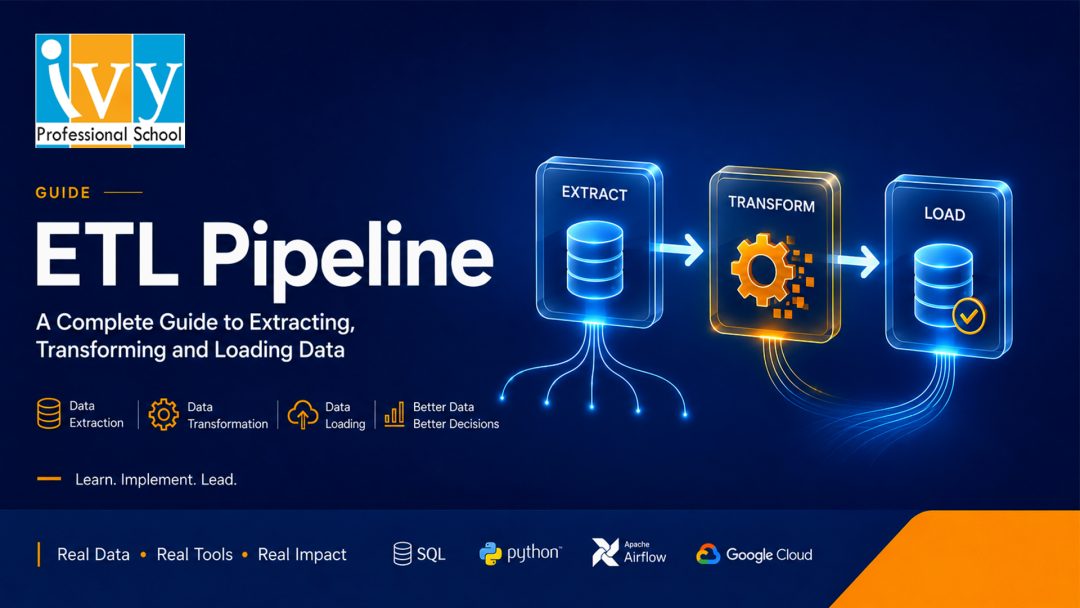
Modern organisations generate data from websites, mobile applications, business software, sensors, customer interactions, financial systems, and cloud platforms. However, collecting data is only the beginning. Before organisations can analyse this information, generate reports, build machine learning models, or make informed decisions, the data must be extracted, cleaned, organised, and moved to a suitable destination.
This process is commonly managed through an ETL pipeline.
An ETL pipeline provides a structured method for moving data from multiple source systems into a centralised data warehouse, database, data lake, or analytics platform. It ensures that raw information is converted into accurate, consistent, and usable data.
In this comprehensive guide, we will explain what an ETL pipeline is, how it works, its key components, benefits, challenges, architecture, use cases, tools, best practices, and how it differs from other data integration approaches.
An ETL pipeline is an automated data workflow that extracts data from one or more sources, transforms it into a required format, and loads it into a target system.
ETL stands for:
Each stage performs a specific function in the data integration process.
The primary objective of an ETL pipeline is to convert fragmented and inconsistent source data into reliable information that can be used for reporting, analytics, business intelligence, artificial intelligence, and operational decision-making.
For example, a retail company may collect data from:
An ETL pipeline can extract data from all these systems, standardise the information, remove duplicates, calculate required metrics, and load the final dataset into a cloud data warehouse.
Business users can then analyse revenue, product performance, inventory levels, customer behaviour, campaign effectiveness, and profitability from a single source of truth.
Business data is rarely generated in a clean and consistent format. Different systems may use different field names, date formats, currencies, customer identifiers, product codes, and data structures.
Without a proper ETL pipeline, analysts may spend significant time manually collecting, cleaning, and combining data before they can perform any meaningful analysis.
An effective ETL pipeline helps organisations:
The ETL pipeline acts as a bridge between raw operational data and business-ready analytical data.
An ETL pipeline operates through three main stages: extraction, transformation, and loading.
The extraction stage involves retrieving data from one or more source systems.
Common data sources include:
The extraction process must retrieve data without negatively affecting the performance of the source application.
There are several extraction methods.
In full extraction, the ETL pipeline retrieves the entire dataset during every run.
This method is relatively simple but can become inefficient when working with large datasets. It may also increase network usage, processing time, and infrastructure costs.
Full extraction is generally suitable for smaller datasets or systems where incremental tracking is unavailable.
Incremental extraction retrieves only the records that have been added or modified since the previous ETL pipeline run.
This method is more efficient and is commonly used in production environments.
Incremental extraction may rely on:
Real-time extraction continuously captures new or updated data as events occur.
This approach is useful for scenarios such as fraud detection, operational monitoring, recommendation engines, stock tracking, and customer activity analysis.
The transformation stage converts extracted data into a clean, consistent, and business-ready format.
This is often the most complex part of an ETL pipeline because source data may contain errors, inconsistencies, missing values, duplicated records, or incompatible structures.
Common transformation activities include:
Data cleaning identifies and corrects inaccurate or incomplete records.
Examples include:
Data standardisation converts values into a consistent format.
For example:
Validation ensures that data complies with predefined rules.
Examples include:
Aggregation summarises detailed records into higher-level metrics.
An ETL pipeline may calculate:
Filtering removes records that are not required for the target system.
For example, an organisation may exclude:
Data enrichment adds new information to existing records.
For example, a company may enrich customer data by adding:
Data joining combines related datasets using common fields.
For example, order data may be joined with:
The transformation stage should follow clearly defined business rules. These rules must be documented, tested, and regularly reviewed.
The loading stage transfers transformed data into the target system.
Common ETL pipeline destinations include:
There are two common loading methods.
A full load replaces or reloads the entire target dataset.
This may be appropriate for smaller datasets, reference tables, or initial data migrations.
An incremental load adds or updates only the records that have changed.
This approach reduces processing time and is more suitable for large-scale, recurring ETL pipeline operations.
The loading stage may also apply rules for:

A typical ETL pipeline architecture contains several connected layers.
The source layer contains the original systems from which data is collected.
These may include operational databases, software applications, files, APIs, and external platforms.
The staging layer is a temporary storage area where extracted data is placed before transformation.
It allows the ETL pipeline to:
The transformation layer applies business rules, validation checks, calculations, mappings, and cleaning operations.
This layer is responsible for converting raw information into a structured and usable dataset.
The target layer stores the processed data.
Depending on the use case, the target may be a data warehouse, database, reporting system, data lake, or machine learning platform.
This layer manages scheduling, dependencies, logging, alerts, retries, and pipeline execution.
It ensures that each ETL pipeline task runs in the correct sequence.
For example, a sales transformation process should not begin until customer, product, and transaction data have been successfully extracted.

ETL pipelines can process data in batches or in real time.
A batch ETL pipeline processes data at scheduled intervals.
It may run:
Batch processing is commonly used for:
Batch ETL is generally simpler and less expensive to implement.
A real-time ETL pipeline processes data continuously or within a very short interval after an event occurs.
Real-time processing is useful for:
Real-time ETL pipelines require more sophisticated architecture, monitoring, and infrastructure than batch pipelines.
The correct approach depends on the organisation’s data volume, business requirements, latency expectations, and budget.
ETL and ELT are both data integration methods, but the order of transformation and loading differs.
In an ETL pipeline:
In an ELT pipeline:
ELT has become increasingly common with cloud data warehouses because these platforms provide scalable computing resources.
An ETL pipeline may be preferable when:
ELT may be preferable when:
Many organisations use a combination of ETL and ELT depending on the specific use case.
An ETL pipeline can support a wide range of business and technical requirements.
ETL pipelines prepare data for dashboards, scorecards, and management reports.
For example, data from sales, finance, operations, and marketing systems can be consolidated into a business intelligence platform.
Organisations often store customer information across multiple systems.
An ETL pipeline can combine:
This creates a unified customer view.
ETL pipelines are frequently used when organisations move data from legacy systems to new applications or cloud platforms.
The pipeline can map old fields to new structures, validate records, and identify migration errors.
Machine learning models require clean and consistent training data.
An ETL pipeline can prepare features, remove invalid records, standardise values, and create labelled datasets.
Finance teams can use ETL pipelines to combine data from accounting systems, bank statements, payment platforms, billing applications, and enterprise systems.
This supports profitability analysis, cash flow reporting, budgeting, and forecasting.
An ETL pipeline can create auditable data flows for regulatory reporting.
It can also mask sensitive information, validate mandatory fields, maintain historical records, and generate processing logs.
Marketing teams can consolidate information from advertising platforms, CRM tools, email campaigns, social media systems, and website analytics.
This helps measure campaign performance, cost per lead, attribution, customer acquisition cost, and return on marketing investment.
Organisations can build an ETL pipeline using commercial platforms, open-source tools, cloud services, or custom code.
Common categories include:
Cloud providers offer managed data integration services that support scheduling, connectors, transformations, monitoring, and scalability.
These services are suitable for organisations already operating within a specific cloud ecosystem.
Enterprise ETL platforms provide graphical interfaces, governance features, metadata management, security controls, and extensive system connectors.
They are often used by large organisations with complex integration requirements.
Open-source tools offer flexibility and lower licensing costs.
However, they may require more technical expertise for deployment, maintenance, monitoring, and scaling.
Data engineering teams may build custom pipelines using programming languages such as Python, Java, or SQL.
Custom development provides greater control but increases responsibility for testing, documentation, monitoring, security, and maintenance.
When selecting an ETL pipeline tool, organisations should evaluate:
A properly designed ETL pipeline provides several business and technical benefits.
The pipeline applies consistent validation and cleaning rules, reducing errors in reports and analytical models.
Manual data preparation tasks can be automated, allowing analysts to spend more time interpreting information.
Reliable and timely data enables business teams to make decisions more quickly.
An ETL pipeline helps ensure that departments use the same definitions for revenue, profit, active customers, conversion rates, and other metrics.
Modern ETL pipelines can process increasing data volumes as an organisation grows.
Processing rules, data ownership, lineage, access controls, and audit logs can be incorporated into the ETL pipeline.
The pipeline connects isolated applications and creates a unified analytical environment.

Despite its benefits, developing and maintaining an ETL pipeline can be difficult.
Missing values, duplicate records, inconsistent identifiers, and incorrect formats can create transformation errors.
A change in an API, database schema, file structure, or application field can cause the pipeline to fail.
Large joins, complex transformations, and high-volume data movement may increase execution time.
Incorrect incremental logic can load the same records multiple times.
A pipeline should be able to recover from partial failures without reprocessing unnecessary data.
Without proper logs and alerts, failures may remain undetected until users notice missing or incorrect reports.
Transformation logic can become difficult to manage when business definitions are unclear or frequently changing.
ETL pipelines may process confidential customer, employee, financial, or operational data. Weak access controls can expose sensitive information.
A reliable ETL pipeline should be designed for accuracy, maintainability, scalability, and failure recovery.
Before building the pipeline, clarify:
Avoid full extraction and loading when only a small portion of the data changes.
Incremental processing improves efficiency and reduces infrastructure usage.
Include validation rules at multiple stages of the ETL pipeline.
Checks may include:
Data lineage documents where data originated, how it was transformed, and where it was loaded.
This is essential for troubleshooting, governance, and compliance.
Every pipeline run should capture:
Alerts should notify the appropriate team when failures or unusual conditions occur.
An idempotent ETL pipeline can be rerun without creating duplicate or inconsistent results.
This is particularly important when recovering from failures.
Database connections, file paths, API endpoints, scheduling details, and environment settings should be managed through configuration files or secure environment variables.
Apply encryption, masking, tokenisation, access controls, and secure credential management.
Sensitive fields should only be available to authorised users.
Testing should include:
Every important transformation should have a documented business definition.
This reduces confusion and makes future maintenance easier.
Building an ETL pipeline usually involves the following steps.
List the databases, applications, files, APIs, and platforms that contain the required data.
Determine where the processed data will be stored and how users will access it.
Define target tables, fields, relationships, keys, and historical tracking requirements.
Decide whether the pipeline will use full, incremental, or real-time extraction.
Document cleaning, mapping, aggregation, enrichment, validation, and calculation requirements.
Use an ETL platform, cloud service, orchestration tool, SQL scripts, or programming language to implement the workflow.
Create processes for rejected records, retries, partial failures, and notifications.
Compare source and target data to ensure completeness and accuracy.
Deploy the ETL pipeline into the production environment and configure the required schedule.
Track performance, failure rates, processing time, data quality, and infrastructure consumption.
As data volumes increase, ETL pipeline performance becomes increasingly important.
Common optimisation techniques include:
Performance tuning should focus on the complete pipeline rather than one isolated component.
The ETL pipeline remains a core component of modern data engineering.
Although technologies and architectures continue to evolve, organisations still need dependable processes for collecting, cleaning, transforming, and delivering data.
Modern ETL pipelines increasingly support:
The focus is shifting from simply moving data to building observable, governed, resilient, and reusable data products.
An ETL pipeline is a process that collects data from different sources, cleans and restructures it, and moves it into a system where it can be analysed.
The three stages are extraction, transformation, and loading.
No. An ETL pipeline can load data into databases, data lakes, analytics platforms, machine learning systems, and business applications.
Yes. Python is widely used for custom ETL development because it supports data processing, database connectivity, APIs, automation, and workflow integration.
A data pipeline is a broader term for any automated movement or processing of data. An ETL pipeline is a specific type of data pipeline that follows the extract, transform, and load sequence.
The frequency depends on business requirements. A pipeline may run monthly, daily, hourly, every few minutes, or continuously.
A reliable ETL pipeline includes automated validation, monitoring, logging, error handling, retry mechanisms, secure access, documentation, and clear recovery procedures.
An ETL pipeline is essential for converting raw, fragmented data into accurate and actionable information. It extracts data from multiple sources, applies cleaning and transformation rules, and loads the results into a centralised target system.
A well-designed ETL pipeline improves data quality, reduces manual effort, supports consistent reporting, and enables business intelligence, machine learning, operational analytics, and regulatory reporting.
However, creating an effective pipeline requires more than connecting source and target systems. Organisations must carefully define business rules, implement data quality checks, monitor failures, protect sensitive information, optimise performance, and document the complete data flow.
As businesses generate greater volumes of information, the ETL pipeline will continue to play a critical role in modern data architecture. Organisations that build scalable, secure, and observable ETL workflows will be better positioned to use their data for faster decisions, improved efficiency, and long-term competitive advantage.


Leave a Reply