
Prateek Agrawal Jul 25, 2026 No Comments
AI business automation is no longer a buzzword reserved for Silicon Valley giants, it is the single biggest competitive advantage available to businesses of every size in 2026. From automating customer support tickets to predicting inventory demand, AI business automation is transforming how companies operate, cutting costs, saving time, and unlocking growth that simply wasn’t possible with manual processes. If you are a business owner, a working professional, or someone exploring a career shift into technology, understanding AI business automation is no longer optional, it’s essential.
In this guide, we’ll break down what AI business automation actually means, why it matters, how companies across industries are using it, the tools driving this revolution, and how you can build the skills to lead this transformation yourself.
AI business automation refers to the use of artificial intelligence technologies — including machine learning, natural language processing, computer vision, and generative AI — to automate repetitive, rule-based, and even complex decision-making tasks within a business. Unlike traditional automation, which follows fixed, pre-programmed rules, AI business automation systems learn from data, adapt to new situations, and improve over time.
Think of traditional automation as a simple “if this, then that” system. AI business automation, on the other hand, can read an email, understand its intent, decide the right department to route it to, draft a response, and even flag it for human review if the sentiment suggests urgency — all without a human lifting a finger. This is the fundamental shift that makes AI business automation so powerful for modern businesses.
The demand for AI business automation has exploded because businesses today are under pressure to do more with less. Here’s why companies are racing to adopt AI business automation solutions:
AI business automation significantly reduces operational costs by minimizing the need for manual labor on repetitive tasks like data entry, invoice processing, and customer query resolution.
Tasks that once took days can now be completed in minutes. AI business automation tools process thousands of transactions, emails, or records simultaneously — something no human team could match.
Human error is one of the costliest problems in business operations. AI business automation dramatically reduces mistakes in data processing, reporting, and compliance-related tasks.
With AI business automation, businesses can offer 24/7 customer support through chatbots, personalized recommendations, and instant query resolution — improving customer satisfaction and retention.
As your business grows, AI business automation scales with you without the need to proportionally increase your workforce, making it a critical tool for startups and SMEs looking to expand efficiently.

One of the most visible applications of AI business automation is in customer service. AI-powered chatbots and virtual assistants can now handle a majority of customer queries without human intervention, using natural language processing to understand context and intent. This form of AI business automation allows human agents to focus on complex, high-value interactions while routine questions are resolved instantly.
AI business automation has transformed digital marketing. Predictive analytics tools use AI to identify which leads are most likely to convert, allowing sales teams to prioritize their efforts. Email marketing platforms use AI business automation to personalize content, subject lines, and send times for each subscriber, dramatically improving open and conversion rates.
From automated invoice processing to fraud detection, AI business automation is reshaping finance departments. AI systems can flag anomalies in transactions, reconcile accounts, and even generate financial forecasts — tasks that once required entire teams of analysts.
AI business automation tools now screen resumes, schedule interviews, and even conduct preliminary candidate assessments. This doesn’t just save HR teams time — it also helps remove unconscious bias from the hiring process when implemented correctly.
Retail and manufacturing businesses are increasingly relying on AI business automation to predict demand, optimize inventory levels, and manage logistics. AI-driven supply chain automation minimizes stockouts and overstocking, directly improving profitability.
AI business automation tools like intelligent document processing (IDP) can extract, classify, and process information from invoices, contracts, and forms with minimal human oversight, saving businesses countless hours of manual data entry.
Understanding the tools behind AI business automation helps professionals and businesses choose the right stack for their needs:
Learning to work with these tools is quickly becoming a core skill expectation across marketing, operations, HR, and finance roles — which is exactly why AI business automation training has become one of the most in-demand skill areas today.

Imagine a small e-commerce business struggling to manage customer queries, inventory tracking, and marketing campaigns with a lean team. By implementing AI business automation:
This is the real, tangible power of AI business automation — it isn’t just for large corporations. Small and medium businesses stand to gain the most because AI business automation levels the playing field, allowing lean teams to compete with much larger organizations.
While the benefits are massive, implementing AI business automation isn’t without hurdles:
The good news? Most of these challenges are solved not by better software alone, but by better-trained people who understand how to strategically implement AI business automation within an organization.
Given how rapidly AI business automation is being adopted across industries, professionals who understand how to design, implement, and manage these systems are in extremely high demand. Whether you’re a marketer, an analyst, an entrepreneur, or a fresh graduate, developing skills in AI business automation can significantly boost your career prospects.
Here’s what you typically need to get started in AI business automation:
This is precisely the gap that Ivy Pro School’s Generative AI Course is designed to fill. The course is built for professionals and entrepreneurs who want to master AI business automation, generative AI tools, and practical implementation strategies — not just theory. With a curriculum covering real-world automation case studies, hands-on projects, and tools that businesses are actively using today, learners walk away with the confidence to lead AI business automation initiatives in their own organizations.
For entrepreneurs and business owners specifically, Ivy Pro School’s AI for Entrepreneurs Course, led by industry expert Prateek Agrawal, is tailored to help you apply AI business automation directly to your business — whether that’s automating customer service, marketing, operations, or financial processes. Instead of generic AI theory, this course focuses on practical, business-first applications of AI business automation that you can implement immediately.
Both programs come with the backing of a Pay After Placement option, access to the proprietary PrepAI tool for interview preparation, and the support of a thriving community of 37,500+ alumni and 500+ hiring partners — giving learners not just knowledge of AI business automation, but a genuine career and business growth pathway.

Looking ahead, AI business automation is expected to become even more deeply embedded into everyday business operations. Here’s what to expect:
The next wave of AI business automation involves autonomous AI agents that can execute multi-step tasks — from researching a topic to drafting a report to sending it for approval — with minimal human input.
AI business automation will increasingly allow businesses to deliver hyper-personalized experiences at scale, tailoring everything from product recommendations to pricing based on individual customer behavior.
As AI business automation platforms become more user-friendly, business teams without technical backgrounds will be able to build and deploy sophisticated automation workflows themselves.
Expect AI business automation solutions tailored specifically for healthcare, legal, real estate, and other niche industries, offering deeper domain-specific value than generic tools.
As AI business automation adoption grows, so will the need for ethical guidelines, data privacy safeguards, and responsible AI governance frameworks within organizations.
Q1: What is AI business automation in simple terms? AI business automation is the use of artificial intelligence to handle business tasks — like answering customer queries, processing data, or managing marketing campaigns — automatically and intelligently, without constant human supervision.
Q2: Is AI business automation only for large companies? No. In fact, AI business automation often delivers the biggest relative benefit to small and medium businesses, since it allows lean teams to accomplish more without hiring additional staff.
Q3: Will AI business automation replace human jobs? AI business automation tends to replace repetitive tasks rather than entire jobs. It shifts human focus toward higher-value, creative, and strategic work while automating routine processes.
Q4: What skills do I need to work in AI business automation? You’ll need a foundational understanding of AI and machine learning, hands-on experience with automation and generative AI tools, and the business judgment to identify where automation adds real value — all of which are covered in Ivy Pro School’s Generative AI Course and AI for Entrepreneurs Course.
Q5: How much does it cost to implement AI business automation? Costs vary widely depending on the scale and complexity of the AI business automation system, ranging from free or low-cost no-code tools to enterprise-grade platforms requiring significant investment.
Q6: How long does it take to learn AI business automation? With a structured, hands-on program like the courses offered at Ivy Pro School, most learners can build practical AI business automation skills within a few months, depending on prior experience and time commitment.
AI business automation is fundamentally reshaping how businesses operate — from customer service and marketing to finance and supply chain management. The organizations and professionals who understand how to strategically implement AI business automation today will be the ones leading their industries tomorrow.
Whether you’re a business owner looking to streamline operations or a professional aiming to future-proof your career, now is the time to invest in AI business automation skills. Explore Ivy Pro School’s Generative AI Course or the AI for Entrepreneurs Course with Prateek Agrawal, and take the first step toward mastering AI business automation for real-world impact.
Prateek Agrawal Jul 18, 2026 No Comments
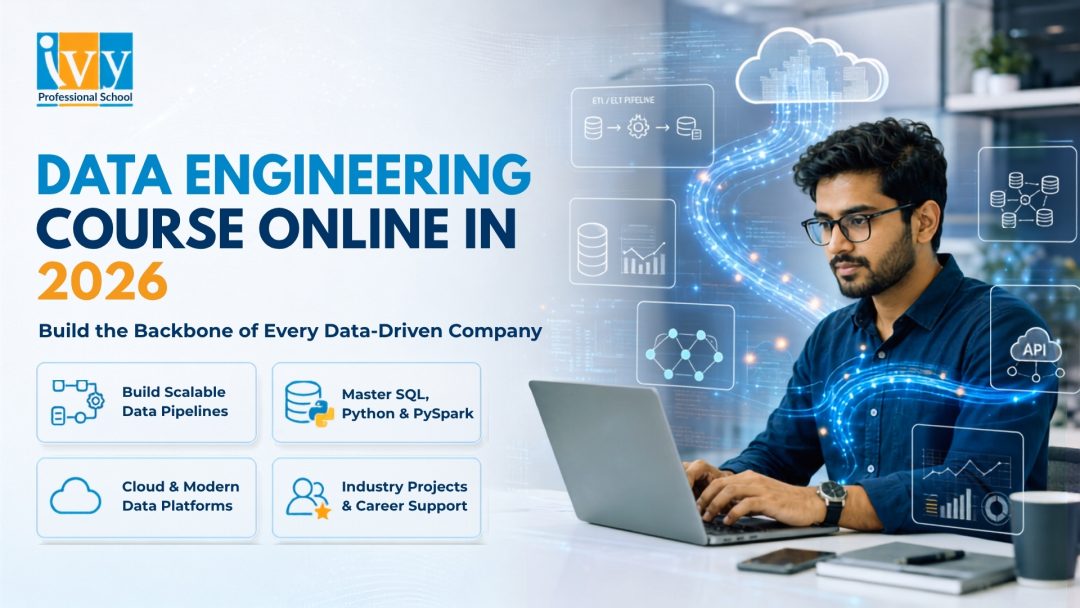
The demand for skilled data engineers has never been stronger, and finding the right data engineering course online in 2026 is the smartest first step you can take toward this high-paying, high-growth career. India alone is projected to need over 11 lakh data professionals by 2026, and data engineers sit at the very top of that hiring list. Whether you are a fresh graduate, a software developer looking to pivot, or a data analyst ready to level up, a data engineering course online in 2026 gives you the flexibility to build industry-relevant skills without pausing your life. This guide covers everything, what data engineering actually is, what to learn, which tools matter, and how to land your first role.
Before choosing a data engineering course online in 2026, it helps to understand what the job actually involves. Data engineers are the architects of the data world. They design, build, and maintain the pipelines, systems, and infrastructure that move data from where it originates to where it can be analysed and used.
Think of it this way: a data scientist cannot build a machine learning model without clean, well-structured data. A business analyst cannot generate accurate reports without reliable pipelines feeding the right numbers into the right dashboards. Data engineers are the professionals who make all of that possible.
In 2026, the role has expanded significantly. Modern data engineers are not just writing SQL queries and building ETL pipelines — they are deploying real-time streaming systems, managing cloud data warehouses at petabyte scale, orchestrating complex workflows, and increasingly working alongside AI systems that demand consistent, high-quality data inputs.
The average salary for a data engineer in India ranges from ₹8 LPA at the entry level to ₹30 LPA or more for experienced professionals — making it one of the most financially rewarding technical careers available to Indian graduates today.
Not all programmes are equal. A strong data engineering course online in 2026 should go well beyond the basics and prepare you for the tools and workflows that real employers are actually using. Here is what to look for:
Every credible data engineering course online in 2026 begins with Python and SQL — the two languages that form the foundation of all data engineering work.
Python is used for writing data pipelines, automating workflows, interacting with APIs, and building ETL (Extract, Transform, Load) scripts. Key libraries to learn include:
SQL remains the lingua franca of data. You should be comfortable with:
Building pipelines is the core of data engineering work. A solid data engineering course online in 2026 will teach you how to design and implement pipelines that extract data from multiple sources, transform it into usable formats, and load it into target systems reliably and efficiently.
You should learn both batch processing (scheduled jobs that run at set intervals) and real-time streaming (continuous data flows that process events as they happen). Tools covered should include:

In 2026, virtually all enterprise data infrastructure runs on the cloud. A data engineering course online in 2026 that does not cover cloud platforms is leaving you underprepared for the job market. The three major clouds you should understand are:
You do not need to master all three. Most programmes recommend starting with one cloud platform deeply and developing familiarity with the others. AWS and GCP are the most in-demand in India’s data engineering job market in 2026.
Modern data infrastructure has evolved beyond traditional data warehouses. A high-quality data engineering course online in 2026 will teach you about:
Understanding when to use each architecture — and how to design data models that serve both operational and analytical needs — is a critical skill that separates strong data engineers from average ones.
Good data engineering is not just about moving data — it is about structuring it intelligently. A rigorous data engineering course online in 2026 covers:
A data engineering course online in 2026 should give you hands-on experience with pipeline orchestration — the practice of scheduling, monitoring, and managing complex multi-step workflows. Apache Airflow is the industry standard, but in 2026 you should also be aware of:
Professional data engineers do not work in isolation. They collaborate using the same software engineering practices as developers. A well-rounded data engineering course online in 2026 includes:
One of the fastest-growing areas in data engineering is real-time data processing. Consumer apps, financial systems, logistics platforms, and IoT devices all generate continuous streams of data that must be processed instantly. A forward-looking data engineering course online in 2026 will cover:

With dozens of platforms and hundreds of programmes available, selecting the right data engineering course online in 2026 requires careful evaluation. Here is what to assess:
The tools in data engineering evolve rapidly. Check that the data engineering course online in 2026 you are considering covers current tools — dbt, Delta Lake, Kafka, modern cloud services — not legacy technologies from five years ago. Ask the provider when the curriculum was last updated.
A data engineering course online in 2026 should be project-heavy. Look for programmes that have you building end-to-end pipelines on real datasets — ingesting raw data from APIs or databases, processing it through transformation layers, loading it into a cloud data warehouse, and orchestrating the workflow with Airflow. Employers want to see working pipelines in your portfolio, not just certificate screenshots.
Online learning can feel isolating without the right support structure. The best data engineering course online in 2026 will include live doubt-clearing sessions, peer cohorts, code review from experienced data engineers, and access to an alumni community that can refer you to job openings.
Look for programmes that offer resume reviews, mock technical interviews, and direct connections to hiring partners. The ideal data engineering course online in 2026 treats placement as a core deliverable — not an afterthought — because completing the course is only valuable if it translates into a job offer.
A serious data engineering course online in 2026 typically runs 6–10 months for working professionals studying part-time. Accelerated bootcamps can cover the material in 3–4 months with full-time commitment. Be realistic about your available hours per week before enrolling.

Completing the right data engineering course online in 2026 opens doors to several well-defined and well-compensated roles:
After completing a data engineering course online in 2026, you will find demand across virtually every sector:
Certificates from a data engineering course online in 2026 matter far less than the proof you can actually do the work. Here are portfolio projects that will impress interviewers:
Each project should be documented on GitHub with a clear architecture diagram, README, and notes on design decisions. A well-presented portfolio from a data engineering course online in 2026 can outweigh a postgraduate degree in data-related hiring decisions.
Supplement your primary programme with these high-quality free resources:
Skipping the fundamentals. Many learners jump straight to Spark and Kafka without mastering Python and SQL first. Every strong data engineering course online in 2026 is built on these foundations — do not rush past them.
Learning tools instead of concepts. Tools change; architectural thinking does not. Understand why you use a data lake versus a warehouse, why you choose streaming over batch — not just how to configure a specific tool.
Not building in public. Share your projects on LinkedIn and GitHub as you build them. The data engineering community in India is active and supportive, and visibility often leads directly to interview opportunities.
Ignoring data quality. Real pipelines break, data arrives late, schemas change unexpectedly. A serious data engineering course online in 2026 will teach you data validation, monitoring, and alerting — skills that separate production-ready engineers from hobbyists.
Underestimating soft skills. Data engineers collaborate closely with data scientists, analysts, product managers, and infrastructure teams. Communication, documentation, and the ability to translate technical decisions into business language are essential alongside technical proficiency.
Data engineering is the backbone of the modern data economy, and 2026 is an exceptional time to enter the field. The right data engineering course online in 2026 gives you the skills, tools, portfolio, and industry connections to compete for roles that pay well, grow fast, and sit at the heart of every data-driven organisation.
Be intentional about your choice. Look for a data engineering course online in 2026 that is current, hands-on, mentor-supported, and placement-focused. Build real pipelines. Document your work. Engage with the data engineering community. And remember — the best data engineers are not just technical experts; they are problem-solvers who understand that their job is to make data work reliably for the people who depend on it.
Your data engineering journey starts with one decision. Make it the right one.

Prateek Agrawal Jul 11, 2026 No Comments
Every digital business depends on reliable data. Customer transactions, website events, financial records, application logs and sensor readings must be collected, cleaned, organised and delivered to the people and systems that need them. Data engineers build the infrastructure that makes this possible.
A strong data engineering skillset goes beyond knowing a programming language or operating a cloud tool. It combines database knowledge, software engineering, data architecture, distributed processing, security, problem-solving and business understanding.
This guide explains the core data engineer skills employers expect, the tools associated with each skill and a practical roadmap for developing job-ready capability.
A data engineering skillset is the combination of technical, analytical and professional abilities required to design, build, operate and improve data systems.
A data engineer may extract data from databases, APIs and applications; transform raw data into consistent datasets; build batch and streaming pipelines; design warehouses and lakes; maintain data quality; and support analytics, machine learning and AI applications.
| Skill area | What you should know | Common tools |
| SQL | Queries, joins, windows and optimisation | PostgreSQL, MySQL, SQL Server |
| Programming | Automation, APIs, transformation and testing | Python, Java, Scala |
| Data modelling | Schemas, facts, dimensions and normalisation | dbt, modelling tools |
| Pipelines | ETL, ELT, retries and incremental loading | Airflow, ADF, AWS Glue |
| Distributed processing | Large-scale data processing | Spark, Databricks |
| Streaming | Events, producers, consumers and offsets | Kafka, Kinesis |
| Cloud | Storage, compute, identity and cost control | AWS, Azure, Google Cloud |
| Quality and governance | Testing, lineage and access control | Great Expectations, Purview |
| DevOps | Version control and automated deployment | Git, Docker, CI/CD tools |
| Business skills | Requirements, documentation and communication | Jira, Confluence |
SQL is the foundation of the data engineering skillset. Engineers use it to inspect source systems, transform data, validate results, create warehouse models and troubleshoot pipeline failures.
A job-ready professional should be comfortable with joins, common table expressions, subqueries, aggregate functions, window functions, date and string functions, deduplication, views, stored procedures, indexes, partitions and query execution plans.
Returning the correct result is only the first step. A data engineer must also consider how a query performs when a table contains millions of records. This requires knowledge of filtering, indexing, partition pruning, data distribution and unnecessary data movement.
Python is commonly used for data ingestion, transformation, API integration, automation and testing. Its standard data structures and extensive ecosystem make it practical for reusable data workflows.
Important skills include:
Libraries such as pandas are useful for moderate-sized data, while PySpark supports distributed processing. Python should be learned through practical tasks such as extracting paginated API data, validating schemas, processing files and loading results into databases.
Pipelines create value only when their outputs are structured for business use. Data modelling is therefore a core part of the data engineering skillset.
Engineers should understand:
Operational databases are designed for frequent inserts and updates. Analytical systems are designed for large scans, aggregations and historical analysis. Recognising this difference helps engineers build models that are both accurate and efficient.
Modern frameworks such as dbt allow teams to create modular SQL models and combine them with testing, documentation, lineage and version-controlled workflows.

ETL means extract, transform and load. ELT means extract, load and transform. Both patterns move data from source systems into analytical platforms.
A capable data engineer should know how to:
Reliable pipelines should be idempotent, meaning they can be rerun safely without creating duplicates or corrupting results. They should also account for late files, network failures, API rate limits and changing source schemas.
A complete data engineering skillset includes the major patterns used to store analytical data.
A data warehouse stores curated data optimised for reporting and analysis. Common examples include Snowflake, Google BigQuery, Amazon Redshift and Azure-based warehouse services.
A data lake stores large volumes of structured, semi-structured and unstructured data, typically in object storage.
A lakehouse combines the flexibility of data-lake storage with warehouse-style performance, management and governance.
Important storage concepts include:
The objective is not to memorise every product interface. It is to understand why a storage pattern suits a workload and what trade-offs it creates in performance, governance and cost.
When data becomes too large or processing too complex for one machine, distributed computing becomes necessary. Apache Spark is widely used for data engineering, data science and machine learning workloads.
A practical Spark skillset includes:
Many beginners focus only on PySpark syntax. Employers need engineers who can diagnose why a job is slow, why a join creates excessive shuffling or why thousands of small files reduce performance.
Batch pipelines process data at scheduled intervals. Streaming systems process events continuously or in short windows.
Apache Kafka is a distributed event-streaming platform used to publish, retain and process streams of events.
Engineers working with streaming data should understand:
Managed alternatives include Amazon Kinesis and Azure Event Hubs. AWS describes Kinesis as a service for collecting, processing and analysing real-time streaming data.
A practical streaming project could process e-commerce clickstream events, calculate rolling product views and store the resulting metrics for a dashboard.
Production data platforms contain dependent tasks that must run in the correct order. Orchestration tools schedule these tasks, manage dependencies and monitor their status.
Apache Airflow is designed for developing, scheduling and monitoring batch-oriented workflows, typically represented as directed acyclic graphs or DAGs.
Relevant orchestration skills include:
Other options include Azure Data Factory, Google Cloud Composer, Databricks Workflows and Microsoft Fabric Data Factory.
The core skill is understanding how workflows behave when tasks fail, data arrives late or historical periods must be reprocessed.

Most modern data engineering roles require exposure to at least one major cloud platform: Microsoft Azure, Amazon Web Services or Google Cloud.
A cloud-ready data engineering skillset should cover:
AWS, for example, provides analytics services across querying, processing, governance, warehousing and streaming, including Athena, EMR, Glue, Redshift, Lake Formation and Kinesis. Azure and Google Cloud offer comparable capability categories under different service names.
Beginners should not attempt to master all three clouds simultaneously. Choose one ecosystem, build an end-to-end project and then map the concepts to equivalent services elsewhere.
A pipeline is not successful merely because it finishes without an error. It must deliver accurate, complete, timely and trustworthy data.
Engineers should create checks for:
Testing operates at several levels. Unit tests validate code components. Integration tests confirm that systems work together. Data tests verify the properties of output datasets.
Observability extends this approach by monitoring pipeline duration, failure rates, data freshness, volume changes, lineage and downstream impact.
Engineers must also decide what happens when a check fails. Depending on the level of risk, the pipeline may stop, quarantine records, issue a warning or continue with an audit flag.
Data engineering is a software engineering discipline. Production pipelines should not depend on manually edited scripts stored on individual computers.
Core engineering practices include:
dbt explicitly applies software engineering practices such as version control, modularity, testing, CI/CD and documentation to data transformation workflows.
Data engineers frequently work with financial, customer, employee and operational data. Security must be built into the system.
Relevant skills include:
Governance ensures users understand where data came from, what it means, who owns it and who may access it. A catalogue, business glossary and lineage system make data easier to discover while reducing misuse.
Engineers do not need to act as legal experts, but they must translate security and governance requirements into technical controls.
Technical skill alone does not create useful data products. Data engineers must understand the business meaning behind the requested data.
If a stakeholder asks for “daily sales data,” the engineer must clarify:
Useful professional skills include requirement gathering, documentation, estimation, prioritisation, stakeholder communication and incident reporting.
Engineers should be able to explain technical trade-offs in terms of reliability, time, risk and cost.
AI coding assistants can generate SQL, explain unfamiliar code, create documentation and accelerate troubleshooting. Data platforms are also adding AI-supported development features.
dbt, for example, documents AI capabilities grounded in project context such as lineage, tests, contracts and metric definitions.
However, generated code may be inefficient or apply incorrect business logic. Suggested configurations may also create security, performance or cost issues.
The emerging skill is not simply using AI. It is using AI with sufficient context, review, testing and governance. Engineers who understand the fundamentals can use these tools to move faster without sacrificing reliability.

Beginners do not need to master every technology before applying for roles. A practical sequence is:
This sequence develops depth before breadth. It is more effective than gaining superficial exposure to dozens of tools.
Experienced professionals should move beyond tool operation towards architecture, platform reliability, cost optimisation, governance, reusable components and technical leadership.
A portfolio should demonstrate complete workflows and engineering decisions.
Extract order and customer data from an API, store raw files in object storage, transform the data, load warehouse tables and produce daily sales metrics.
Generate website events, publish them to a streaming platform, calculate windowed metrics and store the results for analysis.
Create configurable checks for duplicates, nulls, row counts, freshness and source-to-target totals. Produce an audit report after every pipeline run.
Build a dimensional model, implement incremental loading, add role-based access and document cost-optimisation decisions.
Each project should contain a README, architecture diagram, data model, source code, tests, sample outputs and deployment instructions. Explain trade-offs and limitations instead of presenting the work as flawless.
Common mistakes when building data engineer skills include:
A balanced data engineering skillset combines conceptual depth, implementation ability and operational discipline.
The most important skills are SQL, Python, data modelling, ETL or ELT, databases, cloud platforms, orchestration, data quality, Git and communication. Spark and streaming tools become important for large-scale or real-time systems.
No. Python is valuable, but data engineering also requires SQL, database concepts, modelling, pipeline design, cloud services, testing and operational skills.
Deep machine learning expertise is not mandatory for most roles. However, understanding model-training data, feature pipelines and production inference helps when supporting AI and machine learning teams.
Azure, AWS and Google Cloud all support enterprise data engineering. The best starting platform depends on your target employers, existing experience and technology environment. Learn one platform deeply before covering all three.
Yes. Entry-level candidates should focus on SQL, Python, databases, ETL, Git and one cloud ecosystem, then demonstrate these skills through complete projects.
The timeline depends on prior programming and database experience. Readiness is better measured by whether you can independently design, build, test, explain and troubleshoot an end-to-end pipeline.
The ideal data engineering skillset is not a checklist of fashionable tools. It is the ability to build data systems that are accurate, scalable, secure, maintainable and useful to the business.
Start with SQL, Python, databases and data modelling. Progress to pipelines, cloud platforms, orchestration, distributed processing, data quality and governance. Reinforce each stage with practical projects and professional engineering practices.
As organisations expand analytics, machine learning and enterprise AI, reliable data engineering becomes increasingly valuable. Professionals who combine technical depth with business understanding will be better positioned to build the trusted data foundation these systems require.
To develop these capabilities through structured training and hands-on projects, explore the Data Engineering Programme at Ivy Professional School.
Prateek Agrawal Jul 04, 2026 No Comments
Modern organisations generate data from websites, mobile applications, business software, sensors, customer interactions, financial systems, and cloud platforms. However, collecting data is only the beginning. Before organisations can analyse this information, generate reports, build machine learning models, or make informed decisions, the data must be extracted, cleaned, organised, and moved to a suitable destination.
This process is commonly managed through an ETL pipeline.
An ETL pipeline provides a structured method for moving data from multiple source systems into a centralised data warehouse, database, data lake, or analytics platform. It ensures that raw information is converted into accurate, consistent, and usable data.
In this comprehensive guide, we will explain what an ETL pipeline is, how it works, its key components, benefits, challenges, architecture, use cases, tools, best practices, and how it differs from other data integration approaches.
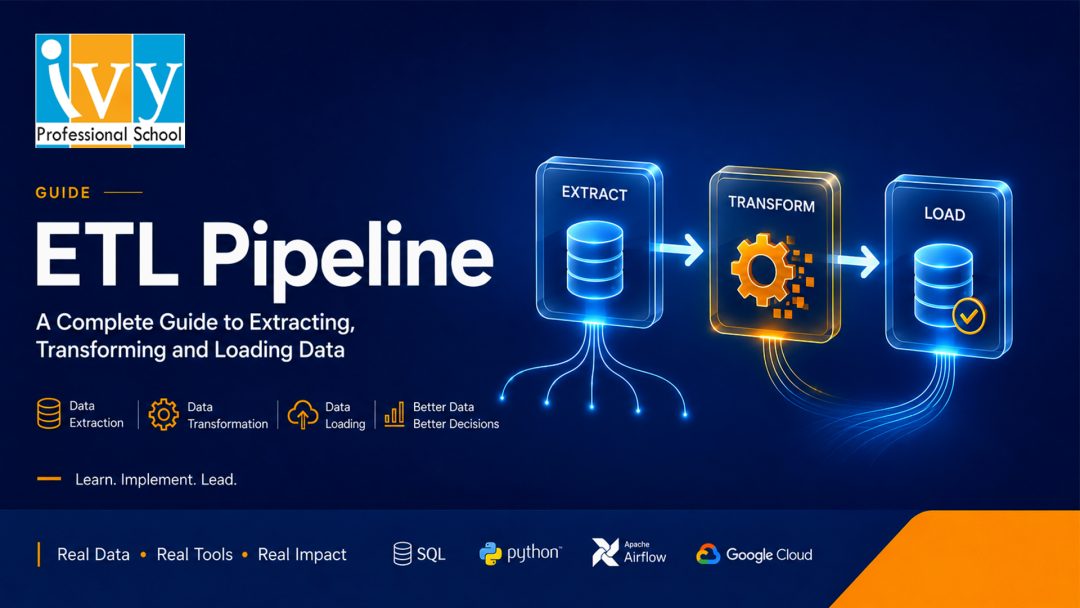
An ETL pipeline is an automated data workflow that extracts data from one or more sources, transforms it into a required format, and loads it into a target system.
ETL stands for:
Each stage performs a specific function in the data integration process.
The primary objective of an ETL pipeline is to convert fragmented and inconsistent source data into reliable information that can be used for reporting, analytics, business intelligence, artificial intelligence, and operational decision-making.
For example, a retail company may collect data from:
An ETL pipeline can extract data from all these systems, standardise the information, remove duplicates, calculate required metrics, and load the final dataset into a cloud data warehouse.
Business users can then analyse revenue, product performance, inventory levels, customer behaviour, campaign effectiveness, and profitability from a single source of truth.
Business data is rarely generated in a clean and consistent format. Different systems may use different field names, date formats, currencies, customer identifiers, product codes, and data structures.
Without a proper ETL pipeline, analysts may spend significant time manually collecting, cleaning, and combining data before they can perform any meaningful analysis.
An effective ETL pipeline helps organisations:
The ETL pipeline acts as a bridge between raw operational data and business-ready analytical data.
An ETL pipeline operates through three main stages: extraction, transformation, and loading.
The extraction stage involves retrieving data from one or more source systems.
Common data sources include:
The extraction process must retrieve data without negatively affecting the performance of the source application.
There are several extraction methods.
In full extraction, the ETL pipeline retrieves the entire dataset during every run.
This method is relatively simple but can become inefficient when working with large datasets. It may also increase network usage, processing time, and infrastructure costs.
Full extraction is generally suitable for smaller datasets or systems where incremental tracking is unavailable.
Incremental extraction retrieves only the records that have been added or modified since the previous ETL pipeline run.
This method is more efficient and is commonly used in production environments.
Incremental extraction may rely on:
Real-time extraction continuously captures new or updated data as events occur.
This approach is useful for scenarios such as fraud detection, operational monitoring, recommendation engines, stock tracking, and customer activity analysis.
The transformation stage converts extracted data into a clean, consistent, and business-ready format.
This is often the most complex part of an ETL pipeline because source data may contain errors, inconsistencies, missing values, duplicated records, or incompatible structures.
Common transformation activities include:
Data cleaning identifies and corrects inaccurate or incomplete records.
Examples include:
Data standardisation converts values into a consistent format.
For example:
Validation ensures that data complies with predefined rules.
Examples include:
Aggregation summarises detailed records into higher-level metrics.
An ETL pipeline may calculate:
Filtering removes records that are not required for the target system.
For example, an organisation may exclude:
Data enrichment adds new information to existing records.
For example, a company may enrich customer data by adding:
Data joining combines related datasets using common fields.
For example, order data may be joined with:
The transformation stage should follow clearly defined business rules. These rules must be documented, tested, and regularly reviewed.
The loading stage transfers transformed data into the target system.
Common ETL pipeline destinations include:
There are two common loading methods.
A full load replaces or reloads the entire target dataset.
This may be appropriate for smaller datasets, reference tables, or initial data migrations.
An incremental load adds or updates only the records that have changed.
This approach reduces processing time and is more suitable for large-scale, recurring ETL pipeline operations.
The loading stage may also apply rules for:

A typical ETL pipeline architecture contains several connected layers.
The source layer contains the original systems from which data is collected.
These may include operational databases, software applications, files, APIs, and external platforms.
The staging layer is a temporary storage area where extracted data is placed before transformation.
It allows the ETL pipeline to:
The transformation layer applies business rules, validation checks, calculations, mappings, and cleaning operations.
This layer is responsible for converting raw information into a structured and usable dataset.
The target layer stores the processed data.
Depending on the use case, the target may be a data warehouse, database, reporting system, data lake, or machine learning platform.
This layer manages scheduling, dependencies, logging, alerts, retries, and pipeline execution.
It ensures that each ETL pipeline task runs in the correct sequence.
For example, a sales transformation process should not begin until customer, product, and transaction data have been successfully extracted.

ETL pipelines can process data in batches or in real time.
A batch ETL pipeline processes data at scheduled intervals.
It may run:
Batch processing is commonly used for:
Batch ETL is generally simpler and less expensive to implement.
A real-time ETL pipeline processes data continuously or within a very short interval after an event occurs.
Real-time processing is useful for:
Real-time ETL pipelines require more sophisticated architecture, monitoring, and infrastructure than batch pipelines.
The correct approach depends on the organisation’s data volume, business requirements, latency expectations, and budget.
ETL and ELT are both data integration methods, but the order of transformation and loading differs.
In an ETL pipeline:
In an ELT pipeline:
ELT has become increasingly common with cloud data warehouses because these platforms provide scalable computing resources.
An ETL pipeline may be preferable when:
ELT may be preferable when:
Many organisations use a combination of ETL and ELT depending on the specific use case.
An ETL pipeline can support a wide range of business and technical requirements.
ETL pipelines prepare data for dashboards, scorecards, and management reports.
For example, data from sales, finance, operations, and marketing systems can be consolidated into a business intelligence platform.
Organisations often store customer information across multiple systems.
An ETL pipeline can combine:
This creates a unified customer view.
ETL pipelines are frequently used when organisations move data from legacy systems to new applications or cloud platforms.
The pipeline can map old fields to new structures, validate records, and identify migration errors.
Machine learning models require clean and consistent training data.
An ETL pipeline can prepare features, remove invalid records, standardise values, and create labelled datasets.
Finance teams can use ETL pipelines to combine data from accounting systems, bank statements, payment platforms, billing applications, and enterprise systems.
This supports profitability analysis, cash flow reporting, budgeting, and forecasting.
An ETL pipeline can create auditable data flows for regulatory reporting.
It can also mask sensitive information, validate mandatory fields, maintain historical records, and generate processing logs.
Marketing teams can consolidate information from advertising platforms, CRM tools, email campaigns, social media systems, and website analytics.
This helps measure campaign performance, cost per lead, attribution, customer acquisition cost, and return on marketing investment.
Organisations can build an ETL pipeline using commercial platforms, open-source tools, cloud services, or custom code.
Common categories include:
Cloud providers offer managed data integration services that support scheduling, connectors, transformations, monitoring, and scalability.
These services are suitable for organisations already operating within a specific cloud ecosystem.
Enterprise ETL platforms provide graphical interfaces, governance features, metadata management, security controls, and extensive system connectors.
They are often used by large organisations with complex integration requirements.
Open-source tools offer flexibility and lower licensing costs.
However, they may require more technical expertise for deployment, maintenance, monitoring, and scaling.
Data engineering teams may build custom pipelines using programming languages such as Python, Java, or SQL.
Custom development provides greater control but increases responsibility for testing, documentation, monitoring, security, and maintenance.
When selecting an ETL pipeline tool, organisations should evaluate:
A properly designed ETL pipeline provides several business and technical benefits.
The pipeline applies consistent validation and cleaning rules, reducing errors in reports and analytical models.
Manual data preparation tasks can be automated, allowing analysts to spend more time interpreting information.
Reliable and timely data enables business teams to make decisions more quickly.
An ETL pipeline helps ensure that departments use the same definitions for revenue, profit, active customers, conversion rates, and other metrics.
Modern ETL pipelines can process increasing data volumes as an organisation grows.
Processing rules, data ownership, lineage, access controls, and audit logs can be incorporated into the ETL pipeline.
The pipeline connects isolated applications and creates a unified analytical environment.

Despite its benefits, developing and maintaining an ETL pipeline can be difficult.
Missing values, duplicate records, inconsistent identifiers, and incorrect formats can create transformation errors.
A change in an API, database schema, file structure, or application field can cause the pipeline to fail.
Large joins, complex transformations, and high-volume data movement may increase execution time.
Incorrect incremental logic can load the same records multiple times.
A pipeline should be able to recover from partial failures without reprocessing unnecessary data.
Without proper logs and alerts, failures may remain undetected until users notice missing or incorrect reports.
Transformation logic can become difficult to manage when business definitions are unclear or frequently changing.
ETL pipelines may process confidential customer, employee, financial, or operational data. Weak access controls can expose sensitive information.
A reliable ETL pipeline should be designed for accuracy, maintainability, scalability, and failure recovery.
Before building the pipeline, clarify:
Avoid full extraction and loading when only a small portion of the data changes.
Incremental processing improves efficiency and reduces infrastructure usage.
Include validation rules at multiple stages of the ETL pipeline.
Checks may include:
Data lineage documents where data originated, how it was transformed, and where it was loaded.
This is essential for troubleshooting, governance, and compliance.
Every pipeline run should capture:
Alerts should notify the appropriate team when failures or unusual conditions occur.
An idempotent ETL pipeline can be rerun without creating duplicate or inconsistent results.
This is particularly important when recovering from failures.
Database connections, file paths, API endpoints, scheduling details, and environment settings should be managed through configuration files or secure environment variables.
Apply encryption, masking, tokenisation, access controls, and secure credential management.
Sensitive fields should only be available to authorised users.
Testing should include:
Every important transformation should have a documented business definition.
This reduces confusion and makes future maintenance easier.
Building an ETL pipeline usually involves the following steps.
List the databases, applications, files, APIs, and platforms that contain the required data.
Determine where the processed data will be stored and how users will access it.
Define target tables, fields, relationships, keys, and historical tracking requirements.
Decide whether the pipeline will use full, incremental, or real-time extraction.
Document cleaning, mapping, aggregation, enrichment, validation, and calculation requirements.
Use an ETL platform, cloud service, orchestration tool, SQL scripts, or programming language to implement the workflow.
Create processes for rejected records, retries, partial failures, and notifications.
Compare source and target data to ensure completeness and accuracy.
Deploy the ETL pipeline into the production environment and configure the required schedule.
Track performance, failure rates, processing time, data quality, and infrastructure consumption.
As data volumes increase, ETL pipeline performance becomes increasingly important.
Common optimisation techniques include:
Performance tuning should focus on the complete pipeline rather than one isolated component.
The ETL pipeline remains a core component of modern data engineering.
Although technologies and architectures continue to evolve, organisations still need dependable processes for collecting, cleaning, transforming, and delivering data.
Modern ETL pipelines increasingly support:
The focus is shifting from simply moving data to building observable, governed, resilient, and reusable data products.
An ETL pipeline is a process that collects data from different sources, cleans and restructures it, and moves it into a system where it can be analysed.
The three stages are extraction, transformation, and loading.
No. An ETL pipeline can load data into databases, data lakes, analytics platforms, machine learning systems, and business applications.
Yes. Python is widely used for custom ETL development because it supports data processing, database connectivity, APIs, automation, and workflow integration.
A data pipeline is a broader term for any automated movement or processing of data. An ETL pipeline is a specific type of data pipeline that follows the extract, transform, and load sequence.
The frequency depends on business requirements. A pipeline may run monthly, daily, hourly, every few minutes, or continuously.
A reliable ETL pipeline includes automated validation, monitoring, logging, error handling, retry mechanisms, secure access, documentation, and clear recovery procedures.
An ETL pipeline is essential for converting raw, fragmented data into accurate and actionable information. It extracts data from multiple sources, applies cleaning and transformation rules, and loads the results into a centralised target system.
A well-designed ETL pipeline improves data quality, reduces manual effort, supports consistent reporting, and enables business intelligence, machine learning, operational analytics, and regulatory reporting.
However, creating an effective pipeline requires more than connecting source and target systems. Organisations must carefully define business rules, implement data quality checks, monitor failures, protect sensitive information, optimise performance, and document the complete data flow.
As businesses generate greater volumes of information, the ETL pipeline will continue to play a critical role in modern data architecture. Organisations that build scalable, secure, and observable ETL workflows will be better positioned to use their data for faster decisions, improved efficiency, and long-term competitive advantage.