
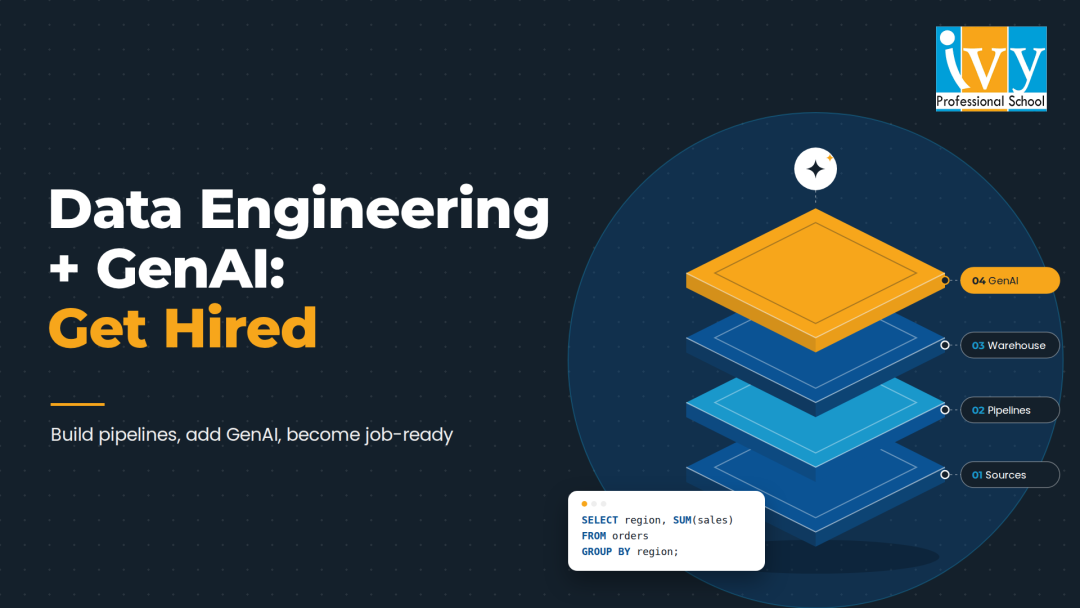
If you are searching for the best data engineering course with placement, you have probably noticed a second trend: almost every job description now mentions generative AI. That is no coincidence. Companies cannot build chatbots, copilots or AI search tools without clean, reliable data, and the professionals who build those pipelines are data engineers. This guide explains how to choose a generative AI course with placement support, why data engineering sits at the centre of modern AI, and how to check whether a programme will really help you get hired.
Generative AI gets the headlines, but most of the work behind it is data work. A large language model is only as useful as the information it can reach. When a bank builds an AI assistant for its support team, someone has to collect thousands of policy documents, clean them, split them into searchable chunks, store them in a vector database and keep everything current as policies change. When an e-commerce company wants personalised product descriptions, someone has to build pipelines that feed product, pricing and customer data into the model every day, at scale, without breaking.
That someone is a data engineer. This is why learners who want a generative AI course with placement are asking a sharper question: should I learn GenAI on its own, or pair it with data engineering? For most freshers and career switchers, the smarter move is to pick the best data engineering course with placement that also shows how modern AI applications consume data.

The reasoning is practical. Writing prompts is a skill thousands of people already have. Building the production pipeline that makes a model dependable is rarer, harder to replace and valued more highly by employers. Hiring managers know this, and their job postings increasingly ask for both skill sets in one candidate.
Plenty of programmes use the phrase, but few deserve it. Judge every option on these five factors.

If a course scores well on all five, it deserves to be called the best data engineering course with placement on your shortlist. If it fails two or more, keep looking.
A credible generative AI course with placement goes well beyond teaching you to use ChatGPT. By the end, you should be able to build and deploy something real. Look for these building blocks:
Notice how many of these items are data problems in disguise. RAG, embeddings and vector search all depend on ingestion pipelines, data quality and storage design. That overlap is the reason many learners now look for the best data engineering course with placement alongside a GenAI programme, or inside a combined learning path. Someone who understands both can build the full system, not just the demo.
Also check whether the generative AI course with placement includes capstone projects. A document question-answering bot, a customer-support assistant or a content automation tool gives you something concrete to discuss in interviews.
The job market now has several overlapping titles. Here is how they differ:
| Role | What you do day to day | Core skills |
| Data Engineer | Build and maintain pipelines and warehouses | Python, SQL, Spark, Airflow, cloud |
| Generative AI Engineer | Build LLM-powered applications | Python, prompting, RAG, APIs, agents |
| AI Data Engineer | Prepare and serve data for AI systems | Pipelines, vector databases, embeddings |
| Analytics Engineer | Model clean data for reporting | SQL, data modelling, BI tools |
| ML Engineer | Train, deploy and monitor models | Python, ML, MLOps, cloud |
The “AI Data Engineer” row is where the two paths meet, and it is growing fast. Choosing the best data engineering course with placement gives you the foundation for several of these roles, while adding GenAI skills keeps your options open as the market evolves.
Enrolling in the best data engineering course with placement is only the start. Here is a sensible six-month plan to get the most from any strong programme.
Months 1-2: Foundations. Master Python and SQL. Practise daily on real datasets rather than only watching lectures. Learn data modelling basics such as star schemas and normalisation.
Months 3-4: Core engineering. Learn Spark, Airflow and a major cloud platform. Build at least two end-to-end pipelines and document them clearly on GitHub with a readable README.
Month 5: Add GenAI. Learn LLM fundamentals, embeddings and RAG. Extend one of your pipelines so it feeds a vector database and powers a simple question-answering app.
Month 6: Job preparation. Polish your resume and LinkedIn profile, practise mock interviews, and revise SQL and system design questions. Apply consistently rather than waiting until you feel perfectly ready.

Learners who follow a structure like this tend to walk into interviews with stronger stories to tell. The course gives you the framework, but your consistency decides the outcome.
Placement is the most abused word in education marketing, so verify it carefully. When you compare the best data engineering course with placement options, ask these questions directly:
Treat the answers as evidence. An institute confident in its outcomes will not mind detailed questions. Be equally careful with any generative AI course with placement that cannot name hiring partners or explain its process.
Remember, too, that no institute can guarantee a job. Even the best data engineering course with placement can only prepare you thoroughly, open doors and keep supporting you until you convert an opportunity. Your effort on projects and interview preparation remains the biggest variable.
Whether you are shortlisting the best data engineering course with placement or a GenAI programme, watch out for these warning signs:
If you spot more than one of these, walk away. Any provider of the best data engineering course with placement should welcome your scrutiny.
Ivy Professional School in Kolkata has been training learners for 18 years and runs programmes in Data Science, Data Analytics, Data Engineering, Generative AI and AI, with a presence in Bangalore and Delhi as well. For learners comparing the best data engineering course with placement, a few facts are worth checking against the criteria above:
Those are claims worth verifying yourself, like any other. Visit ivyproschool.com, review the current syllabus and placement terms, speak to counsellors and ask to connect with alumni. Doing so lets you test whether Ivy is the best data engineering course with placement for your goals instead of relying on an article.
Ivy also offers a Generative AI course. Compare its syllabus against the checklist earlier in this guide, and ask the counsellor how it can be combined with data engineering. The best data engineering course with placement for one learner may differ from another’s, depending on background and career goals.
What is the best data engineering course with placement? The best data engineering course with placement is one that combines a deep, project-based curriculum, live mentorship, a recognised certification and transparent placement support. Compare syllabus, projects, alumni outcomes and fee terms, then choose the one that matches your background and goals.
Is a generative AI course with placement worth it in 2026? Yes, if it teaches practical skills such as RAG, vector databases, agents and deployment, not just prompting. Pairing it with the best data engineering course with placement makes you more valuable because you can build the entire pipeline behind an AI application.
Can I learn data engineering without a coding background? Yes. Many learners begin from scratch. Python and SQL are learnable with consistent practice and good mentoring. Look for a programme that starts at the basics, and expect to spend extra time on fundamentals.
How long does it take to become job-ready? Most learners need around six to nine months of consistent effort, depending on prior experience and time available. Projects and interview practice matter as much as finishing the lectures.
How do I know if the best data engineering course with placement claims are genuine? Ask for named hiring partners, speak to alumni, read the placement terms in writing and check whether the institute explains what happens if you are not placed. Genuine providers answer these questions openly.
Does Pay After Placement mean the course is free until I get a job? Not necessarily. Terms differ between institutes, so confirm exactly what you pay upfront, what you pay later and under which conditions.
Generative AI is reshaping the job market, but it is data engineers who make AI systems reliable in the real world. That is why choosing the best data engineering course with placement is one of the smartest decisions a learner can make in 2026, especially when it also builds your understanding of GenAI. Look for depth, projects, mentorship, credible certification and placement you can verify. Pair that with consistent practice, and you will be competing for the most in-demand roles in tech.
If you are ready to explore, visit ivyproschool.com, compare the Data Engineering and Generative AI courses, and book a counselling session to find the best data engineering course with placement for your career stage. Your first pipeline, and your first AI application, are closer than you think


Leave a Reply