
Prateek Agrawal Nov 21, 2026 No Comments
Prateek Agrawal May 23, 2026 No Comments
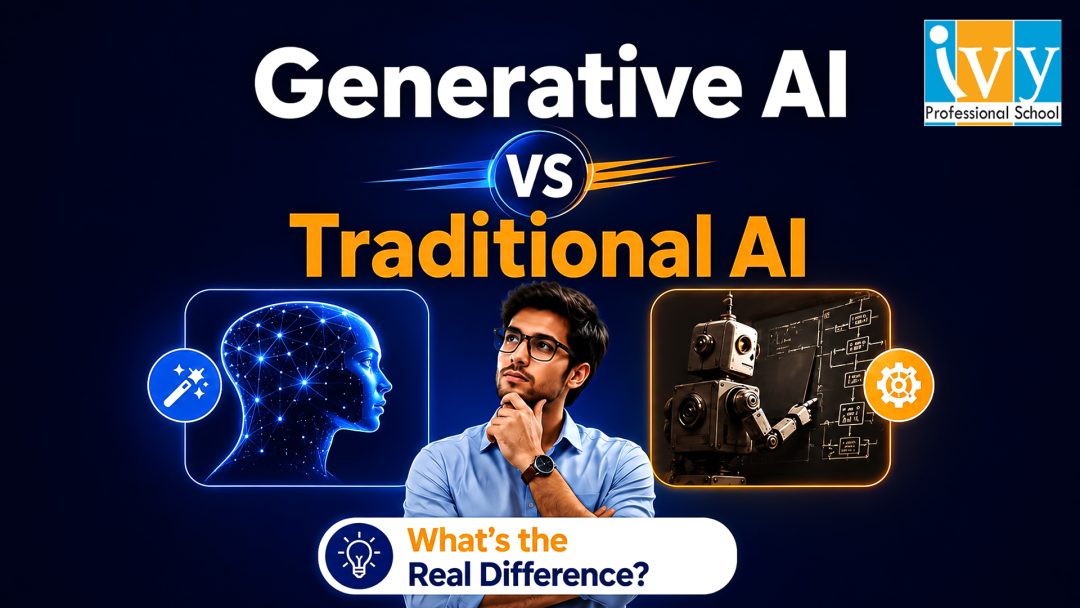
Every few years, a technology arrives that genuinely changes the rules. Not incrementally but structurally. The internet changed how information moves. Smartphones changed how people interact with technology. Generative AI is doing something of the same order: it is changing what machines can do, and by extension, what humans need to do to remain relevant in the workforce.
But there is a confusion problem. When most people say “AI,” they are collapsing two fundamentally different categories of technology into one word. Traditional AI and generative AI are not the same thing. They work differently, they do different things, they are used differently by businesses, and they require different skills to work with.
If you are trying to understand where to invest your learning time in 2026 or simply trying to make sense of the technology reshaping your industry, understanding this distinction is the place to start.
This article will explain the difference clearly, without jargon, and connect it directly to what it means for careers in data science and analytics in India today.
Traditional AI, also called conventional AI, predictive AI, or narrow AI is the form of artificial intelligence that has been powering business decisions for the last two decades. It is the AI behind your bank’s fraud detection system, the recommendation engine on a streaming platform, the credit scoring model that decides loan eligibility, and the demand forecasting tool that tells a retailer how much stock to order next month.
Traditional AI works by learning patterns from historical data and using those patterns to make predictions or decisions about new data. Feed it millions of past loan applications labelled “default” or “no default,” and it learns to predict which future applications are risky. Feed it years of sales data and it learns to forecast what sales will look like next quarter. Feed it thousands of customer profiles labelled “churned” or “retained” and it learns to identify which current customers are most likely to leave.
The key characteristics of traditional AI are:
It is trained on labelled data. Most traditional AI models require human-labelled examples to learn from. Someone or a team of someones has to tag data as spam or not spam, fraudulent or legitimate, positive sentiment or negative sentiment. This labelling process is expensive, time-consuming, and a significant bottleneck.
It is narrow by design. A traditional AI model trained to detect credit card fraud cannot suddenly also predict customer churn. Each model is built for one specific task. It is extraordinarily good at that task, often better than humans but it cannot generalise beyond its training objective.
It produces predictions and classifications, not content. The output of a traditional AI model is typically a number, a category, or a probability. A fraud detection model outputs “fraud” or “not fraud.” A demand forecasting model outputs a sales number. A churn prediction model outputs a probability score. Traditional AI tells you what is likely to happen or what category something belongs to. It does not create anything new.
It is highly interpretable in well-designed systems. Many traditional AI models, particularly decision trees, logistic regression, and gradient boosting models can be examined to understand why they made a particular prediction. This interpretability is critically important in regulated industries like banking, insurance, and healthcare, where a decision must be explainable to a regulator or a customer.
Traditional AI has delivered enormous value across industries. It is not obsolete. It is not going away. But it has a hard ceiling and generative AI operates above that ceiling.

Generative AI is a fundamentally different category of artificial intelligence. Rather than learning patterns to make predictions about existing data, generative AI learns the underlying structure of data to create entirely new data that resembles what it was trained on.
The models at the heart of generative AI large language models like GPT-4o, Claude, and Gemini, image generation models like Stable Diffusion and DALL-E, and code generation tools like GitHub Copilot are trained on vast quantities of text, images, code, and other content. Through that training, they develop a deep statistical understanding of how human-created content is structured. They learn, in essence, the grammar of language, the composition rules of images, the syntax of code.
Then, given a prompt, they use that understanding to generate new content that follows those same structural patterns. The output is not retrieved from a database. It is not assembled from templates. It is created, token by token, word by word, pixel by pixel, from the model’s learned representation of how that type of content is typically constructed.
The key characteristics of generative AI are:
It is trained on unstructured data at massive scale. Unlike traditional AI, which typically requires carefully labelled datasets of thousands or millions of examples, generative AI models are pre-trained on trillions of tokens of raw text, images, and code scraped from the internet, books, academic papers, and other sources. This pre-training gives them broad, general knowledge across an enormous range of domains.
It is general-purpose within its modality. A large language model can write a legal brief, generate Python code, summarise a financial report, translate between languages, explain a scientific concept, and draft a marketing email all with the same model. This generality is unprecedented in AI history. Traditional AI models are specialists; generative AI models are generalists.
It produces content, not just predictions. The output of a generative AI system is new content: a paragraph of text, a piece of code, an image, a structured data object, a summary, a conversation. This is fundamentally different from the numerical outputs of traditional AI. Generative AI does not tell you what will happen — it creates something that did not previously exist.
It is directed through natural language. Traditional AI systems are configured through data pipelines, feature engineering, hyperparameter tuning, and code. Generative AI systems are directed through prompts — instructions written in natural language. This dramatically lowers the technical barrier to using AI, which is one of the reasons generative AI has spread so rapidly across non-technical business functions.
It is less inherently interpretable. The internal workings of a large language model involving billions or trillions of parameters — are substantially harder to interpret than a logistic regression or decision tree. This is a genuine limitation in high-stakes, regulated environments, and an active area of research in the field of AI explainability.

If you want to remember one thing from this article, let it be this:
Traditional AI predicts. Generative AI creates.
Traditional AI takes existing data and tells you instructions like this transaction is fraudulent, this customer will churn, this image contains a cat. It reasons from data to conclusions about data.
Generative AI takes a prompt and produces something new. A document, a piece of code, an analysis, a design or an answer. It reasons from patterns learned during training to generate content that has never existed before.
This distinction has profound implications for how each type of AI is used in business, and what skills professionals need to work effectively alongside each type.
The most sophisticated AI deployments in 2026 do not use traditional AI or generative AI, they use both, in complementary ways.
Consider a bank building a loan assessment system. Traditional AI handles the quantitative prediction: given an applicant’s financial history, employment record, and credit behaviour, what is the probability of default? The traditional model is narrow, precise, trained on millions of labelled examples, and auditable by regulators.
Generative AI handles the communication and augmentation layers: it generates a plain-language explanation of why the application was declined, drafts the letter sent to the applicant, helps the underwriter by summarising the applicant’s profile from documents, and assists the compliance team by answering questions about the decision in plain English.
Or consider an e-commerce company. Traditional AI powers the recommendation engine — predicting which products a user is most likely to purchase based on browsing history and purchase patterns. Generative AI writes personalised product descriptions, drafts promotional emails tailored to individual customer segments, generates responses to customer service queries, and helps the analytics team by producing natural-language summaries of sales performance reports.
The pattern repeats across industries: traditional AI for structured prediction tasks where accuracy, auditability, and domain specificity matter; generative AI for content generation, communication, synthesis, and augmentation tasks where flexibility and natural language capability matter.
For data professionals, this means the skill set in 2026 is additive. You need to understand traditional machine learning — how to build, evaluate, and deploy predictive models — and you need to understand generative AI — how to prompt, fine-tune, integrate, and build applications with large language models. These are not competing skill sets. They are layers of the same profession.
| Dimension | Traditional AI | Generative AI |
| Primary function | Predict, classify, detect | Create, generate, synthesise |
| Training data | Labelled, domain-specific | Vast unstructured text/images/code |
| Output type | Numbers, categories, scores | Text, code, images, structured data |
| Scope | Narrow — one task per model | General — many tasks, one model |
| How you interact | Code, pipelines, APIs | Natural language prompts |
| Interpretability | Often high (some models) | Lower — active research area |
| Examples | Fraud detection, churn prediction, demand forecasting, image classification | ChatGPT, Claude, Copilot, DALL-E, Gemini |
| Business use cases | Risk scoring, quality control, personalisation, predictive maintenance | Content generation, code assistance, document summarisation, customer support |
| Key skills needed | Statistics, ML algorithms, feature engineering, model evaluation | Prompt engineering, RAG, fine-tuning, agentic frameworks |

What This Means for Data Professionals in India
The data science profession in India is at an inflection point. The skills that defined a strong data scientist in 2020 — Python, SQL, machine learning, data visualisation — remain necessary but are no longer sufficient for professionals who want to stay at the front of the field.
The professionals who are commanding the highest salaries and the most interesting roles in 2026 are those who have added generative AI capabilities to a strong traditional ML foundation. They understand not just how to build a churn prediction model — but how to wrap that model in an AI assistant that helps business users interpret and act on its outputs. They know not just how to write SQL queries — but how to build a natural language interface that lets non-technical stakeholders query a database in plain English. They can not just build a data pipeline — they can augment it with AI agents that automatically flag anomalies, generate narrative summaries, and route insights to the right decision-makers.
This combination — traditional AI for structured analytical depth, generative AI for flexibility, communication, and automation — is what the market is calling “AI-augmented data science.” And it is the skill set that Ivy Professional School’s Generative AI and Data Science program is designed to build.
If you are a data professional trying to understand where to invest your learning time, here is the honest answer.
If you are new to data science entirely, start with the fundamentals: statistics, SQL, Python, and basic machine learning. These are the non-negotiables that underpin everything else. A professional who jumps straight to prompt engineering without understanding data structures, probability, and model evaluation is building on sand. The traditional AI foundation comes first.
If you already have data analytics or data science experience, the most valuable investment in 2026 is adding generative AI to your existing toolkit. Specifically: prompt engineering (how to direct large language models effectively), retrieval-augmented generation (how to connect LLMs to proprietary data sources), agentic AI frameworks (how to build AI systems that can complete multi-step tasks autonomously), and fine-tuning (when and how to customise a foundation model for a specific business use case).
If you are a business professional — not a data specialist — who wants to understand how AI applies to your domain, the generative AI layer is the most immediately accessible entry point. Prompt engineering, AI-assisted analysis, and understanding how to work alongside AI tools in your workflow do not require a deep statistical background. They require clear thinking, domain expertise, and structured communication skills that many non-technical professionals already possess.
At Ivy Professional School, we made a deliberate curriculum decision when the generative AI wave hit in 2023: we did not replace our traditional machine learning curriculum with a generative AI curriculum. We expanded it.
Because the professionals our 500+ hiring partners are looking for in 2026 are not specialists in one category or the other. They are professionals who understand the full landscape — who know when a problem calls for a predictive model and when it calls for a generative solution, who can build both and integrate them, and who can communicate about both to business stakeholders who need to trust and act on the outputs.
Our Generative AI and Data Science program — certified by E&ICT Academy, and backed by NASSCOM and IBM — covers traditional machine learning, data analytics, and the full generative AI stack: LLM fundamentals, prompt engineering, RAG architecture, agentic AI frameworks, and responsible AI. Students do not choose between traditional and generative AI. They learn both, applied to real business problems, in a structured sequence that builds genuine job-ready capability.
Across 37,500+ alumni over eighteen years, this integrated approach has consistently produced the placement outcomes that our students come for — and that our hiring partners return for year after year.
Traditional AI and generative AI are not competitors. They are not a generational replacement — one obsoleting the other. They are complementary technologies, each with its own strengths, appropriate use cases, and required skill sets.
Traditional AI is the engine of structured prediction: precise, narrow, auditable, and extraordinarily effective at the specific tasks it is designed for. Generative AI is the engine of creation and communication: flexible, general-purpose, and capable of working with language and unstructured information in ways that traditional AI fundamentally cannot.
The professionals who understand both — who can navigate the full landscape of modern AI, choosing the right tool for the right problem — are the ones the job market in India is competing for in 2026.
Understanding the difference is not just academic. It is the foundation of a career strategy.
Ivy Professional School’s Generative AI and Data Science program is designed for exactly the professional described in this article — someone who wants to understand and work with the full spectrum of modern AI, not just a slice of it.
NASSCOM and IBM backed. Pay After Placement. Weekend batches available across Kolkata and Bangalore.
Book a free counselling session at ivyproschool.com and speak with a program advisor who can map your current background to the fastest path to a job-ready AI skill set.
Q1. Is generative AI replacing traditional AI in data science jobs?
No — generative AI is augmenting traditional AI, not replacing it. Predictive modelling, classification, clustering, and anomaly detection remain core data science competencies in 2026. What has changed is that professionals who can also work with generative AI — building LLM-powered applications, designing prompt systems, and integrating AI into data workflows — command a significant salary premium over those who cannot. The floor has not moved; the ceiling has risen.
Q2. Do I need to learn traditional machine learning before generative AI?
For data science and analytics roles, yes — the traditional ML foundation matters. Understanding statistics, model evaluation, feature engineering, and data pipelines gives you the context to use generative AI tools correctly and critically. Without that foundation, you may produce faster outputs but you will lack the judgment to know whether those outputs are correct. For business analyst and non-technical roles, generative AI skills alone can be valuable entry points without a full ML background.
Q3. What are the most in-demand generative AI skills for data professionals in India?
In 2026, the skills generating the most employer demand across India’s data job market are: prompt engineering (structured and applied), retrieval-augmented generation (RAG) for enterprise knowledge bases, agentic AI workflow design using frameworks like LangChain and CrewAI, LLM fine-tuning for domain-specific applications, and responsible AI — understanding where generative models fail, hallucinate, or introduce bias, and building systems that manage those risks.
Q4. Which industries in India are adopting generative AI fastest?
BFSI (Banking, Financial Services, Insurance) leads adoption — using generative AI for document processing, regulatory compliance, customer communication, and fraud narrative generation alongside traditional fraud detection models. E-commerce and retail follow, using GenAI for personalised content, product descriptions, and customer support automation. Healthcare is growing fast, particularly in clinical documentation, medical coding, and patient communication. IT services and consulting have the broadest adoption simply due to their scale. In every case, traditional AI and generative AI are being deployed together, not as substitutes.
Q5. What salary can I expect after learning both traditional and generative AI skills?
Professionals who combine solid traditional machine learning competencies with generative AI skills are earning ₹10–20 LPA at fresher to junior levels in India’s top product companies, GCCs, and consulting firms in 2026. Mid-level professionals with three to five years of experience who add GenAI specialisation are seeing salary increments of 30–50% within twelve to eighteen months. The salary premium for GenAI-capable candidates over traditional ML-only candidates at equivalent experience levels is currently 25–45% — a gap that reflects the supply shortage in this combined skill set.

Prateek Agrawal May 20, 2026 No Comments
If you have searched “best GenAI course India 2026” and landed here, you are already ahead of most people. You have recognised that generative AI is not a passing trend, it is a structural shift in how businesses operate, how products are built, and how careers are valued. The question you are trying to answer is not whether to learn it. It is who to learn it from.
That is the harder question. And it deserves a more honest answer than most institutes will give you.
The Indian online education market has exploded with GenAI courses over the last eighteen months. Every platform, every institute, and every coaching centre now has a “best GenAI course” badge on their homepage. Some of them are excellent. Many of them are recycled machine learning content with “generative AI” added to the title. A few are genuinely misleading, promising skills and placements they cannot deliver.
This article will not just tell you which is the best GenAI course to pick. It will give you the framework to evaluate any GenAI course yourself, so that whatever you decide, you make the decision with clear eyes.
Generative AI moved from experimental to operational faster than almost anyone predicted. In 2023, enterprises were running pilots. In 2024, they were integrating. By 2025, GenAI tools were embedded in workflows across BFSI, e-commerce, healthcare, consulting, and manufacturing. In 2026, they are table stakes — and the professionals who cannot work alongside, direct, and build with these tools are visibly falling behind.
The demand for GenAI skills in the Indian job market reflects this shift. According to LinkedIn’s 2025 Jobs on the Rise report for India, roles requiring generative AI skills grew by over 300% year-on-year. Salaries for GenAI-capable professionals, engineers, analysts, and product managers alike, command a 25–45% premium over peers with equivalent experience but no GenAI proficiency.
The supply side has not kept pace. Most professionals who want to build these skills are overwhelmed by the noise of competing course offerings and uncertain about which credentials employers actually respect. That gap between high demand and uncertain supply is where the opportunity sits for anyone who acts decisively in 2026.
This is precisely why finding the best GenAI course in India matters more in 2026 than it did in any previous year. The wrong course wastes six to twelve months of your time and produces a certificate that does not move hiring managers. The right course changes your career trajectory permanently.

This is the section most best-GenAI-course comparison articles skip. They list courses and star ratings without explaining what the curriculum should actually contain. Here is what separates a job-ready generative AI program from a certificate factory.
Large Language Model fundamentals — at the right depth. You do not need to understand the mathematics of transformer architectures to use GenAI professionally. But you do need to understand how LLMs process context, why they hallucinate, how temperature and sampling affect outputs, and what the difference is between a foundation model and a fine-tuned one. The best GenAI course will dedicate at least two to three weeks to this conceptual layer — because it is the foundation on which every practical skill is built. A course that skips this produces professionals who can use ChatGPT but cannot diagnose why it fails or make principled decisions about when to use AI versus when not to.
Prompt engineering — structured and applied. Zero-shot, few-shot, chain-of-thought, role-based prompting, and structured output generation are core skills. Any generative AI course worth enrolling in should spend significant time on these techniques with hands-on exercises on real business problems not just toy examples. If the prompt engineering module is a two-hour video lecture with no applied practice, it is not sufficient for a job-ready outcome.
Retrieval-Augmented Generation (RAG) – This is the architecture that makes GenAI practically useful for enterprise applications. RAG systems connect LLMs to proprietary databases, documents, and knowledge bases — allowing businesses to build AI tools that answer questions using their own data rather than generic training data. In 2026, RAG is not an advanced topic. It is a core skill for anyone building or working with enterprise AI applications. The best GenAI course in India will cover RAG as a mandatory module — not an optional advanced add-on. A program that does not cover RAG is teaching 2023 GenAI.
Agentic AI and multi-agent frameworks. AI agents — Systems where a model can autonomously plan, use tools, search the web, write and run code, and chain multiple tasks together — are the frontier of practical GenAI in 2026. LangChain, LlamaIndex, AutoGen, and CrewAI are the tools being deployed in production environments at progressive companies. Any course claiming to be the best GenAI course in 2026 without covering agentic frameworks is leaving students unprepared for where the field is moving fastest.
Fine-tuning and model customisation – Understanding when and how to fine-tune a foundation model for a specific use case — versus prompting a general model — is an increasingly important decision in enterprise AI deployment. This does not require deep ML engineering expertise, but it does require conceptual clarity about the tradeoffs involved. A best-in-class generative AI course will cover this distinction clearly with real use case examples.
Responsible AI and hallucination management – GenAI systems fail in specific, predictable ways. Hallucination, bias amplification, privacy leakage through prompts, and adversarial manipulation are real risks in production deployments. A course that does not cover these failure modes is producing professionals who will cause expensive mistakes at their employers. Responsible AI is not a compliance checkbox — it is a professional competency.
GenAI for data workflows. For data professionals specifically, the best GenAI course in India should cover how to integrate large language models into data pipelines — using AI to assist with data cleaning, EDA, SQL generation, visualisation narration, and automated reporting. This applied layer is what makes GenAI training immediately relevant to a working data professional’s day job.
Curriculum is necessary but not sufficient. When evaluating which is the best GenAI course for your specific situation, these four additional dimensions matter as much as the syllabus.
Faculty with current industry experience. The GenAI landscape in 2026 is not the same as it was in 2024. A faculty member whose knowledge of LLMs is based on what was current two years ago is not equipped to teach what employers need now. When evaluating any generative AI course, ask: when did your core GenAI faculty last work on a production AI deployment? If the answer is vague or deflected, that is important information. The best GenAI courses in India are taught by practitioners who are using these tools in real enterprise environments right now — not academics teaching from papers published eighteen months ago.
Institutional backing that employers recognise. The Indian job market uses institutional affiliation as a quality signal when evaluating candidates at scale. A GenAI certificate backed by NASSCOM, or IBM carries weight in a hiring conversation that a certificate from an unknown platform does not. This is not about prestige for its own sake — it is about whether your credential functions as a trust signal to employers who do not have time to evaluate every portfolio individually. The best GenAI course in India will carry institutional partnerships that your future employer has heard of.
Hands-on project work on real problems. The gap between watching someone build a RAG pipeline on video and building one yourself on a real business dataset is enormous. Any best generative AI course worth the fee should require you to complete end-to-end projects — an AI-powered document Q&A system, a customer support automation agent, a data analysis co-pilot — that you can deploy, demonstrate, and discuss in an interview. Portfolio depth is the single biggest determinant of interview outcomes for GenAI roles in 2026.
Placement support with verifiable outcomes. GenAI is a new enough field that placement records are the most honest signal of whether a program actually produces job-ready graduates. Before enrolling in any course claiming to be the best GenAI course in India, ask for specific company names, role titles, and salary ranges from the last twelve months of placements — not aggregate historical numbers. Institutes that cannot or will not provide this data are telling you something important about the gap between their marketing and their outcomes.
Understanding what employers want is the clearest guide to what the best GenAI course in India should teach. Based on active hiring patterns across India’s leading technology, consulting, and product companies in 2026, these are the roles generating the most demand.
GenAI Application Developer — Builds end-to-end AI applications using LLM APIs, RAG architectures, and agentic frameworks. Requires Python, LangChain or equivalent, and cloud platform familiarity. Starting salary: ₹10–18 LPA.
AI/ML Engineer with GenAI specialisation — Extends traditional ML engineering skills to include LLM fine-tuning, deployment, and MLOps for generative models. Starting salary: ₹12–20 LPA.
Prompt Engineer — Designs and optimises prompt systems for enterprise AI deployments. Increasingly specialised role at companies running large-scale GenAI operations. Starting salary: ₹9–15 LPA.
Data Analyst with AI augmentation skills — Uses GenAI tools to accelerate analytical workflows — generating SQL, building automated reports, and creating narrative summaries of data findings. The most accessible entry point for professionals transitioning from traditional analytics. Starting salary: ₹7–12 LPA.
AI Product Manager — Defines the product strategy for AI-powered features and products. Requires understanding of GenAI capabilities and limitations at a conceptual depth sufficient to make informed build/buy/partner decisions. Starting salary: ₹14–25 LPA.
The best GenAI course in India in 2026 should prepare you for at least one of these role categories specifically — not just give you a generic exposure to AI concepts that leaves you unable to articulate which role you are targeting or why you are qualified for it.

Ivy Professional School has been in the data education business since 2007 — long before generative AI existed as a field. That eighteen-year track record means we have watched multiple waves of technological change reshape the profession, and we have developed institutional muscle for keeping curriculum current as the tools evolve. We do not claim to offer the best GenAI course in India lightly — we have the placement data and alumni outcomes to back it up.
Our Generative AI and Data Science program — certified by E&ICT Academy, and backed by NASSCOM and IBM, is built around every curriculum requirement described above. LLM fundamentals, prompt engineering, RAG architecture, agentic AI frameworks, fine-tuning, responsible AI, and GenAI for data workflows are all core modules, not optional add-ons. The curriculum is reviewed and updated quarterly in partnership with our industry advisory board, practitioners from our 500+ hiring partner network who tell us in real time what skills they cannot find in candidates.
Faculty are working practitioners. Every core module is taught by someone who has deployed GenAI solutions in production environments — not academics teaching from papers, and not instructors whose industry experience ended before LLMs became the dominant paradigm.
Projects are real and portfolio-ready. Students build a functional RAG-based document intelligence system, a multi-agent workflow for automated data analysis, and a prompt engineering toolkit for a business use case of their own choosing. These are not tutorial completions — they are deployable assets that demonstrate genuine capability to every employer who evaluates them.
Our 37,500+ alumni network spans 500+ companies across India. When an Ivy Pro student enters the job market after completing what we believe is the best GenAI course available in India today, they have access to placement relationships built and maintained over eighteen years, direct introductions to hiring managers, not resume submissions to job portals.
And our Pay After Placement model removes the financial risk entirely. You complete the program, build your portfolio, and pay only after you have secured a role that meets a defined salary threshold. We carry the risk because eighteen years of data tells us our outcomes justify the confidence.
Before we get to the checklist, it is worth naming the red flags that disqualify a program from being considered the best GenAI course in India, regardless of how it is marketed.
No RAG or agentic AI in the core syllabus. If a course does not cover these in 2026, it is teaching yesterday’s GenAI. Walk away.
Vague placement claims without verifiable data. “95% placement rate” without company names, roles, and salaries is a marketing number, not an outcome. The best GenAI course will show you evidence, not assertions.
All video, no live instruction or mentorship. Self-paced platforms have a role in learning, but they are not sufficient for a career transition. If there is no live interaction, no mentorship, and no accountability structure, the dropout rate is high and the job-readiness outcome is low.
Faculty with no recent industry experience. Teaching GenAI from textbooks in 2026 is like teaching driving from a manual without ever sitting in a car. The field moves too fast for academic-only instruction.
No hands-on projects on real datasets. Exercises on toy datasets teach syntax, not thinking. The best GenAI course in India will challenge you with messy, real-world data problems where the answer is not already known.
Before you make a final decision on which is the best GenAI course for your situation, ask these five questions to every institute on your shortlist — including us.
One: Does your curriculum cover RAG, agentic AI, and fine-tuning as core modules, or are these optional additions?
Two: Who teaches the GenAI modules, and when did they last work on a production GenAI deployment?
Three: What institutional certification does the program carry, and is it recognised by major Indian and multinational employers?
Four: Can you share verified placement data from the last twelve months — company names, role titles, and salary ranges?
Five: What does placement support actually look like — direct hiring manager introductions, or access to a job portal?
The best GenAI course in India in 2026 is not the one with the most recognisable brand name or the lowest fee. It is the one that answers all five of these questions with evidence, not promises. Any institute that deflects, generalises, or avoids specifics on any of these five points is telling you what you need to know.

If you are serious about building a career in generative AI in 2026, the most expensive decision you can make is to delay. The professionals enrolling in the best GenAI courses in India right now are building portfolios, developing placement-ready skills, and entering a job market where their competition is still watching YouTube tutorials and calling it upskilling.
Ivy Professional School’s Generative AI and Data Science program — E&ICT Academy certified, NASSCOM and IBM backed, with a Pay After Placement model — is open for enrollment now. Weekend and weekday batches available across Kolkata and Bangalore, with online options for outstation learners.
Book your free counselling session at ivyproschool.com. A program advisor will evaluate your background, your target role, and your realistic salary range — and tell you honestly whether our program is the best GenAI course match for your specific situation.
Q1. Who is eligible for the best GenAI course in India — do I need a technical background?
No technical background is required to enrol in a quality GenAI course, but a basic familiarity with data concepts helps. At Ivy Professional School, we accept students from all academic backgrounds — engineering, commerce, arts, and management. The program is designed to bring a motivated learner from foundational concepts to job-ready GenAI proficiency, regardless of where they start. If you can think analytically and communicate clearly, you have the two most important prerequisites for succeeding in the best GenAI course available.
Q2. What is the difference between a GenAI course and a machine learning course?
Machine learning focuses on building predictive models from structured data — classification, regression, clustering, and forecasting using algorithms like decision trees, random forests, and neural networks. Generative AI focuses on models that create new content — text, code, images, and structured outputs — using large language models and diffusion architectures. In 2026, the best GenAI course in India covers both: ML for predictive analytics and GenAI for content generation, automation, and AI application development. They are complementary, not competing disciplines.
Q3. How long does it take to complete a GenAI course and become job-ready?
For a working professional studying part-time, approximately eight to ten hours per week, the best GenAI course structured for career outcomes takes nine to twelve months to complete. Freshers or students who can dedicate more time can compress this to six to nine months. The key variable is not just course completion but portfolio development: you become genuinely job-ready when you have two to three real projects you can demonstrate in an interview, not when you receive a certificate.
Q4. What jobs can I get after completing a GenAI course in India?
The most in-demand roles for GenAI-trained professionals in India in 2026 include: AI/ML Engineer, GenAI Application Developer, Prompt Engineer, Data Scientist (AI-augmented), NLP Engineer, AI Product Manager, and Data Analyst with GenAI specialisation. Salary ranges for these roles at fresher to junior level run from ₹8 LPA to ₹18 LPA depending on company type, city, and portfolio depth. The best GenAI course will prepare you specifically for one or more of these role categories, not just give you generic AI exposure.
Q5. Is a GenAI course worth it compared to free online resources?
Free resources such as YouTube, Coursera, Hugging Face documentation are valuable for self-directed learning. But they have three significant gaps for professionals trying to transition careers. First, they provide no structured path: you can spend months learning things in the wrong order. Second, they provide no mentorship: when you are stuck at 10 PM, there is no one to help you move forward. Third, they provide no placement support. The best GenAI course in India, backed by industry partners, addresses all three gaps. The question is not whether free resources are good, they are. The question is whether they are sufficient for a career transition on a defined timeline.
Q6. What is the fee structure for Ivy Pro’s GenAI course, and is there a Pay After Placement option?
Ivy Professional School offers a Pay After Placement model for eligible candidates you complete the full program and pay only after securing a job offer that meets a defined salary threshold. This removes upfront financial risk entirely. No-cost EMI options are also available. Contact our admissions team at ivyproschool.com for current fee details. If you are looking for the best GenAI course in India with the lowest financial risk, Pay After Placement is the model that makes that possible.
Q7. How is Ivy Pro’s GenAI course different from what platforms like Coursera or Udemy offer?
Online platforms like Coursera and Udemy offer self-paced video content useful for concept exposure but limited in applied depth, mentorship, and placement outcomes. The best GenAI course differs in four key ways: live instruction from practitioners with current industry experience, hands-on capstone projects on real business datasets, one-on-one mentorship throughout the program, and active placement support with direct hiring manager introductions at 500+ partner companies. Platform certificates are credentials you earn by watching. Ivy Pro’s NASSCOM certification is a credential employers recognise and respect.
Q8. Can I learn GenAI while working full-time?
Yes and the majority of students in Ivy Pro’s best GenAI course are working professionals doing exactly this. Our weekend batch model is specifically designed for full-time professionals: live classes on Saturday and Sunday, structured weekday assignments of one to two hours per evening, and bi-weekly mentorship sessions scheduled around professional availability. The total weekly time commitment is eight to ten hours compatible with a demanding job if you protect that time consistently.