
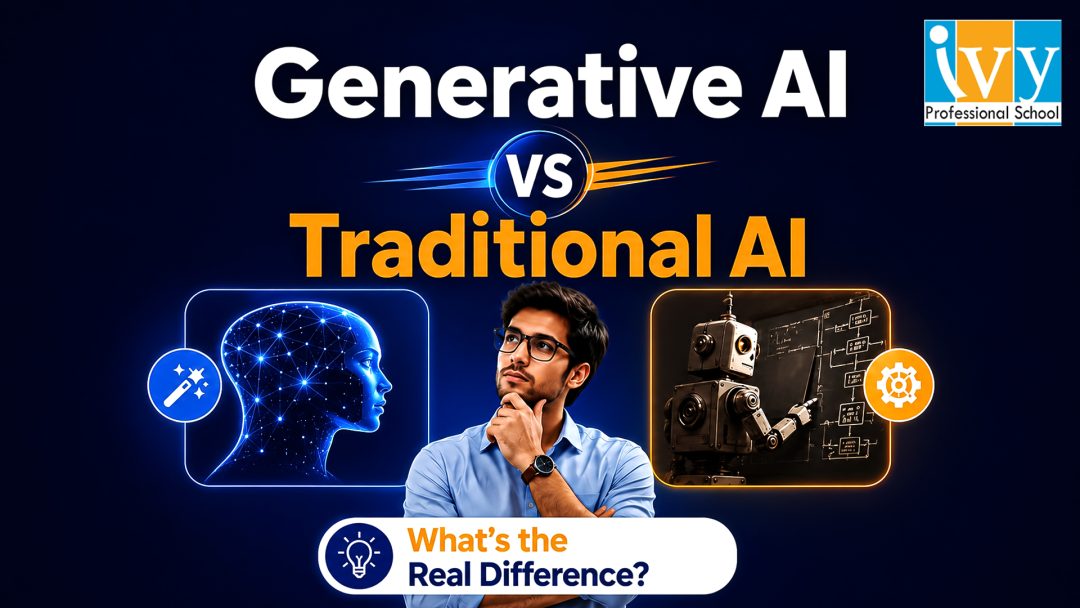
Every few years, a technology arrives that genuinely changes the rules. Not incrementally but structurally. The internet changed how information moves. Smartphones changed how people interact with technology. Generative AI is doing something of the same order: it is changing what machines can do, and by extension, what humans need to do to remain relevant in the workforce.
But there is a confusion problem. When most people say “AI,” they are collapsing two fundamentally different categories of technology into one word. Traditional AI and generative AI are not the same thing. They work differently, they do different things, they are used differently by businesses, and they require different skills to work with.
If you are trying to understand where to invest your learning time in 2026 or simply trying to make sense of the technology reshaping your industry, understanding this distinction is the place to start.
This article will explain the difference clearly, without jargon, and connect it directly to what it means for careers in data science and analytics in India today.
Traditional AI, also called conventional AI, predictive AI, or narrow AI is the form of artificial intelligence that has been powering business decisions for the last two decades. It is the AI behind your bank’s fraud detection system, the recommendation engine on a streaming platform, the credit scoring model that decides loan eligibility, and the demand forecasting tool that tells a retailer how much stock to order next month.
Traditional AI works by learning patterns from historical data and using those patterns to make predictions or decisions about new data. Feed it millions of past loan applications labelled “default” or “no default,” and it learns to predict which future applications are risky. Feed it years of sales data and it learns to forecast what sales will look like next quarter. Feed it thousands of customer profiles labelled “churned” or “retained” and it learns to identify which current customers are most likely to leave.
The key characteristics of traditional AI are:
It is trained on labelled data. Most traditional AI models require human-labelled examples to learn from. Someone or a team of someones has to tag data as spam or not spam, fraudulent or legitimate, positive sentiment or negative sentiment. This labelling process is expensive, time-consuming, and a significant bottleneck.
It is narrow by design. A traditional AI model trained to detect credit card fraud cannot suddenly also predict customer churn. Each model is built for one specific task. It is extraordinarily good at that task, often better than humans but it cannot generalise beyond its training objective.
It produces predictions and classifications, not content. The output of a traditional AI model is typically a number, a category, or a probability. A fraud detection model outputs “fraud” or “not fraud.” A demand forecasting model outputs a sales number. A churn prediction model outputs a probability score. Traditional AI tells you what is likely to happen or what category something belongs to. It does not create anything new.
It is highly interpretable in well-designed systems. Many traditional AI models, particularly decision trees, logistic regression, and gradient boosting models can be examined to understand why they made a particular prediction. This interpretability is critically important in regulated industries like banking, insurance, and healthcare, where a decision must be explainable to a regulator or a customer.
Traditional AI has delivered enormous value across industries. It is not obsolete. It is not going away. But it has a hard ceiling and generative AI operates above that ceiling.

Generative AI is a fundamentally different category of artificial intelligence. Rather than learning patterns to make predictions about existing data, generative AI learns the underlying structure of data to create entirely new data that resembles what it was trained on.
The models at the heart of generative AI large language models like GPT-4o, Claude, and Gemini, image generation models like Stable Diffusion and DALL-E, and code generation tools like GitHub Copilot are trained on vast quantities of text, images, code, and other content. Through that training, they develop a deep statistical understanding of how human-created content is structured. They learn, in essence, the grammar of language, the composition rules of images, the syntax of code.
Then, given a prompt, they use that understanding to generate new content that follows those same structural patterns. The output is not retrieved from a database. It is not assembled from templates. It is created, token by token, word by word, pixel by pixel, from the model’s learned representation of how that type of content is typically constructed.
The key characteristics of generative AI are:
It is trained on unstructured data at massive scale. Unlike traditional AI, which typically requires carefully labelled datasets of thousands or millions of examples, generative AI models are pre-trained on trillions of tokens of raw text, images, and code scraped from the internet, books, academic papers, and other sources. This pre-training gives them broad, general knowledge across an enormous range of domains.
It is general-purpose within its modality. A large language model can write a legal brief, generate Python code, summarise a financial report, translate between languages, explain a scientific concept, and draft a marketing email all with the same model. This generality is unprecedented in AI history. Traditional AI models are specialists; generative AI models are generalists.
It produces content, not just predictions. The output of a generative AI system is new content: a paragraph of text, a piece of code, an image, a structured data object, a summary, a conversation. This is fundamentally different from the numerical outputs of traditional AI. Generative AI does not tell you what will happen — it creates something that did not previously exist.
It is directed through natural language. Traditional AI systems are configured through data pipelines, feature engineering, hyperparameter tuning, and code. Generative AI systems are directed through prompts — instructions written in natural language. This dramatically lowers the technical barrier to using AI, which is one of the reasons generative AI has spread so rapidly across non-technical business functions.
It is less inherently interpretable. The internal workings of a large language model involving billions or trillions of parameters — are substantially harder to interpret than a logistic regression or decision tree. This is a genuine limitation in high-stakes, regulated environments, and an active area of research in the field of AI explainability.

If you want to remember one thing from this article, let it be this:
Traditional AI predicts. Generative AI creates.
Traditional AI takes existing data and tells you instructions like this transaction is fraudulent, this customer will churn, this image contains a cat. It reasons from data to conclusions about data.
Generative AI takes a prompt and produces something new. A document, a piece of code, an analysis, a design or an answer. It reasons from patterns learned during training to generate content that has never existed before.
This distinction has profound implications for how each type of AI is used in business, and what skills professionals need to work effectively alongside each type.
The most sophisticated AI deployments in 2026 do not use traditional AI or generative AI, they use both, in complementary ways.
Consider a bank building a loan assessment system. Traditional AI handles the quantitative prediction: given an applicant’s financial history, employment record, and credit behaviour, what is the probability of default? The traditional model is narrow, precise, trained on millions of labelled examples, and auditable by regulators.
Generative AI handles the communication and augmentation layers: it generates a plain-language explanation of why the application was declined, drafts the letter sent to the applicant, helps the underwriter by summarising the applicant’s profile from documents, and assists the compliance team by answering questions about the decision in plain English.
Or consider an e-commerce company. Traditional AI powers the recommendation engine — predicting which products a user is most likely to purchase based on browsing history and purchase patterns. Generative AI writes personalised product descriptions, drafts promotional emails tailored to individual customer segments, generates responses to customer service queries, and helps the analytics team by producing natural-language summaries of sales performance reports.
The pattern repeats across industries: traditional AI for structured prediction tasks where accuracy, auditability, and domain specificity matter; generative AI for content generation, communication, synthesis, and augmentation tasks where flexibility and natural language capability matter.
For data professionals, this means the skill set in 2026 is additive. You need to understand traditional machine learning — how to build, evaluate, and deploy predictive models — and you need to understand generative AI — how to prompt, fine-tune, integrate, and build applications with large language models. These are not competing skill sets. They are layers of the same profession.
| Dimension | Traditional AI | Generative AI |
| Primary function | Predict, classify, detect | Create, generate, synthesise |
| Training data | Labelled, domain-specific | Vast unstructured text/images/code |
| Output type | Numbers, categories, scores | Text, code, images, structured data |
| Scope | Narrow — one task per model | General — many tasks, one model |
| How you interact | Code, pipelines, APIs | Natural language prompts |
| Interpretability | Often high (some models) | Lower — active research area |
| Examples | Fraud detection, churn prediction, demand forecasting, image classification | ChatGPT, Claude, Copilot, DALL-E, Gemini |
| Business use cases | Risk scoring, quality control, personalisation, predictive maintenance | Content generation, code assistance, document summarisation, customer support |
| Key skills needed | Statistics, ML algorithms, feature engineering, model evaluation | Prompt engineering, RAG, fine-tuning, agentic frameworks |

What This Means for Data Professionals in India
The data science profession in India is at an inflection point. The skills that defined a strong data scientist in 2020 — Python, SQL, machine learning, data visualisation — remain necessary but are no longer sufficient for professionals who want to stay at the front of the field.
The professionals who are commanding the highest salaries and the most interesting roles in 2026 are those who have added generative AI capabilities to a strong traditional ML foundation. They understand not just how to build a churn prediction model — but how to wrap that model in an AI assistant that helps business users interpret and act on its outputs. They know not just how to write SQL queries — but how to build a natural language interface that lets non-technical stakeholders query a database in plain English. They can not just build a data pipeline — they can augment it with AI agents that automatically flag anomalies, generate narrative summaries, and route insights to the right decision-makers.
This combination — traditional AI for structured analytical depth, generative AI for flexibility, communication, and automation — is what the market is calling “AI-augmented data science.” And it is the skill set that Ivy Professional School’s Generative AI and Data Science program is designed to build.
If you are a data professional trying to understand where to invest your learning time, here is the honest answer.
If you are new to data science entirely, start with the fundamentals: statistics, SQL, Python, and basic machine learning. These are the non-negotiables that underpin everything else. A professional who jumps straight to prompt engineering without understanding data structures, probability, and model evaluation is building on sand. The traditional AI foundation comes first.
If you already have data analytics or data science experience, the most valuable investment in 2026 is adding generative AI to your existing toolkit. Specifically: prompt engineering (how to direct large language models effectively), retrieval-augmented generation (how to connect LLMs to proprietary data sources), agentic AI frameworks (how to build AI systems that can complete multi-step tasks autonomously), and fine-tuning (when and how to customise a foundation model for a specific business use case).
If you are a business professional — not a data specialist — who wants to understand how AI applies to your domain, the generative AI layer is the most immediately accessible entry point. Prompt engineering, AI-assisted analysis, and understanding how to work alongside AI tools in your workflow do not require a deep statistical background. They require clear thinking, domain expertise, and structured communication skills that many non-technical professionals already possess.
At Ivy Professional School, we made a deliberate curriculum decision when the generative AI wave hit in 2023: we did not replace our traditional machine learning curriculum with a generative AI curriculum. We expanded it.
Because the professionals our 500+ hiring partners are looking for in 2026 are not specialists in one category or the other. They are professionals who understand the full landscape — who know when a problem calls for a predictive model and when it calls for a generative solution, who can build both and integrate them, and who can communicate about both to business stakeholders who need to trust and act on the outputs.
Our Generative AI and Data Science program — certified by E&ICT Academy, and backed by NASSCOM and IBM — covers traditional machine learning, data analytics, and the full generative AI stack: LLM fundamentals, prompt engineering, RAG architecture, agentic AI frameworks, and responsible AI. Students do not choose between traditional and generative AI. They learn both, applied to real business problems, in a structured sequence that builds genuine job-ready capability.
Across 37,500+ alumni over eighteen years, this integrated approach has consistently produced the placement outcomes that our students come for — and that our hiring partners return for year after year.
Traditional AI and generative AI are not competitors. They are not a generational replacement — one obsoleting the other. They are complementary technologies, each with its own strengths, appropriate use cases, and required skill sets.
Traditional AI is the engine of structured prediction: precise, narrow, auditable, and extraordinarily effective at the specific tasks it is designed for. Generative AI is the engine of creation and communication: flexible, general-purpose, and capable of working with language and unstructured information in ways that traditional AI fundamentally cannot.
The professionals who understand both — who can navigate the full landscape of modern AI, choosing the right tool for the right problem — are the ones the job market in India is competing for in 2026.
Understanding the difference is not just academic. It is the foundation of a career strategy.
Ivy Professional School’s Generative AI and Data Science program is designed for exactly the professional described in this article — someone who wants to understand and work with the full spectrum of modern AI, not just a slice of it.
NASSCOM and IBM backed. Pay After Placement. Weekend batches available across Kolkata and Bangalore.
Book a free counselling session at ivyproschool.com and speak with a program advisor who can map your current background to the fastest path to a job-ready AI skill set.
Q1. Is generative AI replacing traditional AI in data science jobs?
No — generative AI is augmenting traditional AI, not replacing it. Predictive modelling, classification, clustering, and anomaly detection remain core data science competencies in 2026. What has changed is that professionals who can also work with generative AI — building LLM-powered applications, designing prompt systems, and integrating AI into data workflows — command a significant salary premium over those who cannot. The floor has not moved; the ceiling has risen.
Q2. Do I need to learn traditional machine learning before generative AI?
For data science and analytics roles, yes — the traditional ML foundation matters. Understanding statistics, model evaluation, feature engineering, and data pipelines gives you the context to use generative AI tools correctly and critically. Without that foundation, you may produce faster outputs but you will lack the judgment to know whether those outputs are correct. For business analyst and non-technical roles, generative AI skills alone can be valuable entry points without a full ML background.
Q3. What are the most in-demand generative AI skills for data professionals in India?
In 2026, the skills generating the most employer demand across India’s data job market are: prompt engineering (structured and applied), retrieval-augmented generation (RAG) for enterprise knowledge bases, agentic AI workflow design using frameworks like LangChain and CrewAI, LLM fine-tuning for domain-specific applications, and responsible AI — understanding where generative models fail, hallucinate, or introduce bias, and building systems that manage those risks.
Q4. Which industries in India are adopting generative AI fastest?
BFSI (Banking, Financial Services, Insurance) leads adoption — using generative AI for document processing, regulatory compliance, customer communication, and fraud narrative generation alongside traditional fraud detection models. E-commerce and retail follow, using GenAI for personalised content, product descriptions, and customer support automation. Healthcare is growing fast, particularly in clinical documentation, medical coding, and patient communication. IT services and consulting have the broadest adoption simply due to their scale. In every case, traditional AI and generative AI are being deployed together, not as substitutes.
Q5. What salary can I expect after learning both traditional and generative AI skills?
Professionals who combine solid traditional machine learning competencies with generative AI skills are earning ₹10–20 LPA at fresher to junior levels in India’s top product companies, GCCs, and consulting firms in 2026. Mid-level professionals with three to five years of experience who add GenAI specialisation are seeing salary increments of 30–50% within twelve to eighteen months. The salary premium for GenAI-capable candidates over traditional ML-only candidates at equivalent experience levels is currently 25–45% — a gap that reflects the supply shortage in this combined skill set.


Leave a Reply