data scientist

5 Easy And Effective Roadmap For Data Analyst

It is not surprising that Data Science is growing rapidly and is expected to reach a market worth USD 350 billion by the end of 2022. The hierarchy has been divided into many categories, such as Data Scientists, Data Analysts, Data engineers, etc., and they are monopolizing the IT sector as a result of the increasing demand and speed. This article will act as a roadmap for Data Analysts. 

As per the recent survey, it was found that the market was unsuccessful in fulfilling the demand for Data Analysts for the past couple of years and is the reason people are shifting their careers into the Data Science niche because of the major attraction that this niche offers which is growth and salary opportunities.

An Easy Roadmap For Data Analyst

These easy steps will help you in building your career in Data Science. Data Science is no rocket, you just need to follow a few steps and be dedicated to achieving what you wish. Then becoming a Data Analyst is just a matter of a few months. So without any further delay let us begin with the roadmap for Data Analyst.

roadmap-for-data-analyst
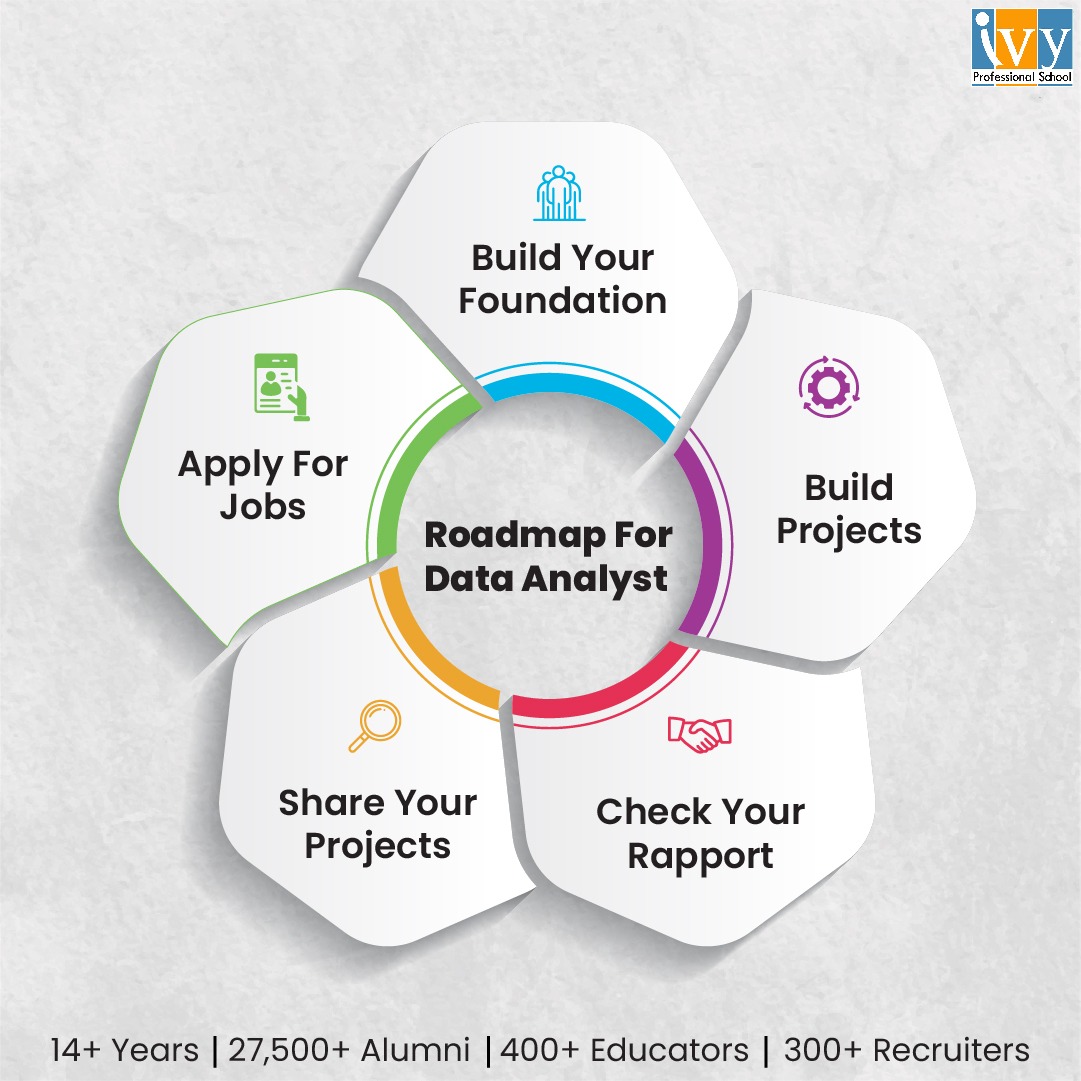
Roadmap For Data Analyst

1. Build Your Foundation

It is very crucial to have your basics ready. The Data Science industry is all about understanding and if you have that, you are almost there. To create a solid foundation, the first step you will have to take is to enroll in a good data analytics course. Learning the basics will help you a lot in your career. Along with this if you get the chance to practice on some real-life industry-level projects then that will help you more. In this respect, we would take some time to tell you about Ivy Professional School. This is a data analytics institute that offers industry-relevant courses along with real-life projects and placement assistance. Ivy understands the importance and scope of Data Science in the present market scenario and creates its courses accordingly. Their courses are led by industry experts and help a lot in enriching your resume with real-life projects.            

2. Build Projects

This is one of the most crucial steps in this roadmap for Data Analyst. As stated above, working on real-life projects will increase the weightage of your resume and will also help you in building confidence. There are a few ways to work on real-life projects:

  • Decide a use case
  • Get your hands on the dataset from Kaggle or any other relevant website. 
  • Apply all your practical learning from the course. 

Here are some of the examples that you can consider in creating your project. 

  • Data cleaning and data wrangling messy data using Python. 
  • Write a SQL query for extracting the data. 
  • Create a dashboard in Tableau with 2-3 views. 

3. Check Your Rapport

Connect and network with like-minded people on Twitter, LinkedIn, or any other social media site you want. For instance, building relationships in this way should be your strategy if you want to improve as an analyst. 

  • Make a list of the companies you want to work for and keep up with them.
  • Make connections with people whose titles match what you’re seeking. Data Analysts, Business Intelligence Analysts, etc.            are a few examples.
  • Make contact with key leaders like VP-Analytics, Director-Analysis, and Senior Data Analyst.
  • Connect with hiring managers and HR staff.

4. Share Your Projects

Let the Data Science industry know you. Showcase your projects on various social media handles. There are a few points to keep in mind while you share your projects. 

  • Include a picture of the dashboard or code.. 
  • Write a few sentences about it to provide background and discuss the motivation behind the endeavor.
  • Share the URL to your GitHub repository or other project storage location.

5. Apply For Jobs

When you have the above-mentioned steps, you can start to apply for jobs. The best thing about the Data Science field is that you can apply for jobs based on specific tools. So suppose you opt for Data Science With Vizualization certification course at Ivy, you can apply for the tools like Excel, or Power BI once they are completed individually. So this is the benefit that this industry offers. 

There are various portals from where you can apply such as LinkedIn, Naukri, Indeed, and many more. But the best among them is LinkedIn. It offers wide exposure to all the spheres of recruitment. Here are some ways by which you can look for jobs in the Data Science domain:

  • Look for startups and MNCs, and inquire as to whether they have any positions that might be suitable.
  • Try websites like Hirect, Cutshort, etc., where business owners may recruit directly.
  • Keep an eye on these leaders’ posts that you have linked with. They frequently immediately share chances through posts.

With this, your roadmap for Data Analyst ends. Follow these steps with determination and smart work to achieve optimum results.

Wrapping Up

Today, billions of businesses produce data every day and use it to inform important business choices. It aids in determining their long-term objectives and establishing new benchmarks. In today’s world, data is the new fuel, and every industry needs Data Analysts to make it useful. The market share of Data Analysts is expected to increase by USD 650+ billion at a CAGR of around 13%, making it one of the most sought-after professions in the world. The more data, the greater the need. So if you are planning to make your career in data analytics then it is indeed the best choice. Hope this roadmap for Data Analyst helped you. You can also get free 1:1 career counseling to clear all your doubts regarding this industry. For.. more details visit Ivy’s official website.

8 In-Demand Data Engineering Skills

data engineering skills
What are the most important data engineering skills?

Guess how much data engineers earn? An average salary of ₹7,44,500 per year in India. And senior data engineers earn between ₹11 lakhs to ₹24 lakhs per year.

And if you search for data engineering jobs on Indeed or LinkedIn, you will find over 20,000 vacancies in India alone. But why am I telling you all this? 

Because I want to show how in-demand data engineers are in the market. With more and more companies relying on data to make smart decisions, data engineering has become a necessity.

Now, if you want to start a career in data engineering, you have to learn some technical and soft skills. In this post, I will tell you what those essential data engineering skills are and how you can start your career in this field. 

Table of Contents
    Add a header to begin generating the table of contents

    What Does a Data Engineer Do?

    You can think of data engineers as the architects of the data world. They build and maintain systems and architecture to collect, store, and manage data.

    For example, they work with ETL (extract, transform, load) processes to combine data from multiple sources into a central repository. Similarly, they build data pipelines, work with databases, and manage data warehouses.

    They basically prepare the raw data for analysis so that data analysts and data scientists can do their jobs. This way, they work together to help the company find valuable insights and make decisions that lead to business growth. 


    Data Engineering Skills You Must Learn

    To perform all those tasks, data engineers need to gain expertise in various processes, tools, and technologies. They also need soft skills to work together as a team and communicate effectively. Here are all the skills you would need to become a pro data engineer:


    1. Programming

    Aspiring data engineers often ask me, “Is coding important?” And I always tell them that coding is one of the most important skills for data engineers. It is what will help you optimize and automate data workflows as well as improve data quality and reliability. Here are some programming languages often used in data engineering:

    Python: It’s good for handling big data, automating tasks, and working with different data formats. It has a range of libraries that make data processing easier and faster.

    SQL: It helps manage and query large databases. It’s also needed for data handling tasks like extracting, organizing, and updating data stored in databases.

    Java: This language helps you build scalable, high-performance data pipelines. It helps you develop large, reliable systems that handle big data processing efficiently.

    Scala: It helps you work with distributed data systems like Apache Spark. It’s specifically designed to handle large datasets while maintaining performance.

    R: It helps in data analysis and statistical tasks. You will need it to perform complex data manipulation and generate insights from data sets.

    You can go through this data engineering syllabus to learn more about technical skills that are valued in the present market.


    2. Data Warehousing

    One of the most important roles of data engineers is to store and organize raw data in data warehouses. Data warehouses are simply central repositories that allow access to real-time data for analysis and decision-making. 

    Without this skill, you won’t be able to manage the high volume and complex data most companies handle today. So, you need to know about data warehousing solutions like Panopoly or Amazon Redshift. This way, you can make data storage, retrieval, and processing more efficient.


    3. Operating Systems

    Knowing programming languages isn’t enough. You also need an understanding of operating systems to design, develop, and troubleshoot systems. As a data engineer, you will work with operating systems like Linux, UNIX, macOS, and Windows because data infrastructure often runs on these platforms. For example, Linux is widely used in data engineering because of its stability, flexibility, and performance. 


    4. Database Management

    This data engineering skill helps you design, maintain, and optimize databases. SQL is the most widely used language for managing relational databases, allowing you to query, update, and manipulate data efficiently. You also need to learn NoSQL databases like Cassandra or Bigtable, which are better suited for handling unstructured data.

    You can learn basic SQL queries, cleaning and modifying data, aggregating and analyzing data, working with multiple data tables, troubleshooting and error handling, advanced filters in SQL, data definition language, data manipulation language, using subqueries, creating user-defined functions, etc. 


    5. Big Data Engineering

    This is an important data engineering skill because you will often have to work with big datasets that traditional databases can’t handle. It will make you an expert at managing and processing data on a large scale.

    For this, you can learn Hadoop, which includes topics like MapReduce, YARN, HDFS, data spilling, data replication, Daemons, etc. You have to learn Apache Hive to query large datasets using HiveQL. You also need to know Apache Spark, how to optimize it, and how to process data in real time. A good understanding of real-time data processing with Kafka and its integration with Spark is also important.


    6. Azure Cloud Engineering

    Microsoft Azure is a cloud platform that provides scalable, secure, and cost-effective data storage and processing solutions. So, this skill helps you build and maintain data pipelines, store data, and run large-scale analytics in the cloud. 

    Here, you will learn about Azure services like virtual machines, storage, and database services. Next, you can understand advanced data engineering with Azure and real-time data streaming and processing. Learning hybrid cloud scenarios, governance, and compliance is also necessary.


    7. Critical Thinking

    This data engineering skill helps you better analyze and evaluate a situation. You need this to identify problems related to data collection, storage, or analysis and then develop effective solutions. You have to come up with innovative solutions to improve the performance of the systems and the quality of the data. This is where critical thinking helps you. 


    8. Communication

    As a data engineer, you will collaborate with other team members and business leaders with and without any technical expertise. So, better communication skills help you explain data processes and systems and share updates without any misunderstandings. For example, you may have to work with data scientists or analysts and share findings and suggestions. And you know, this skill not only helps you in data engineering but also in your entire life. 


    How to Become a Data Engineer

    Now, let’s understand how to become a data engineer:

    1. Complete Your Education

    Even though formal education may not be that important these days, most employers need data engineers to hold at least a bachelor’s degree. You should hold a degree in something like computer science, computer engineering,  information technology, software engineering, applied math, statistics, physics, or a related area. 


    2. Learn Industry-Relevant Skills

    You just saw the important data engineering skills in the above section. You need to master them. And one of the best ways to do it is to take a comprehensive course.

    For example, Ivy Professional School’s IIT-certified Data Engineering Certification course helps you learn all the in-demand skills like SQL for data engineering, Python essentials for data, Big data processing, and Azure cloud engineering. 

    This 45-week live online course will make you an expert at building a complete ETL data pipeline on the cloud with tools like Azure, Hive, MongoDB, Spark, Hadoop, etc. The really interesting thing about this program is that you will learn from IIT Guwahati professors and expert professionals at Amazon, Google, Microsoft, etc.


    3. Gain Experience and Build Your Portfolio

    Just gaining theoretical knowledge isn’t enough. You also need to know how to implement your knowledge and solve real business problems. And you can do this by working on data engineering projects and doing internships. 

    Again, Ivy Professional School’s Data Engineering Certification course helps you work on 30+ real-life projects. This way, you not only gain practical experience but also build an effective portfolio that showcases your skills. Besides, you will earn a valuable certificate from E&ICT Academy, IIT Guwahati, after completing the course. This way, you can become a credible data engineer. 

    Related: 6 Best Data Engineering Courses


    Summing Up

    The demand for data engineer roles has increased astronomically. Organizations are actively searching for data engineers to enhance their data processes and ultimately make smart business decisions. The above data engineering skills are in demand, and those who can master these skills will have a good chance of earning high salaries. The question is, will you be one of those?

    Prateek Agrawal

    Prateek Agrawal is the founder and director of Ivy Professional School. He is ranked among the top 20 analytics and data science academicians in India. With over 16 years of experience in consulting and analytics, Prateek has advised more than 50 leading companies worldwide and taught over 7,000 students from top universities like IIT Kharagpur, IIM Kolkata, IIT Delhi, and others.

    Loan Application Case Study | Data Science Bootcamp | Tableau | Ivy Professional School

    Today, we are going to learn about one of the most interesting and exclusive concepts that apply everywhere in business applications: Case Studies.  A case study is an important and useful way to learn about the practical applications of business using science models. These science models are usually those which help us apply logic to business scenarios. Our very t

    Website Adclick Case Study with Logistic Regression in Python

    Overview

    • Logistic Regression is a popular classification algorithm used to predict a binary outcome.
    • In this case study, get an introduction to logistic regression without relying on Python’s sci-kit libr

    Analyticshala | In discussion with Mr. Shekhar Awasthi | Lead Data Scientist, Statlabs


    Analyticshala In discussion with Shekhar Awasthi

    Data Analytics leads to taking better decisio

    Data Science Job in 2021


    Data Science JobTips to Land a Data Science Job in 2021


    Data Science is the new engine of all organisational decisions an

    Data Science Success Story of Pranjal Biyani


    pranjal biyani

    Undoubtedly, data science has taken down most industries, making data scientists the most sought job of the 21st ce

    Guide to Business Analytics Job Roles 2020


    Guide to business analytics job roles

    Business Analytics is often misunderstood with Data Analytics and the sole reason for this article is to bust this myth and educate our avid read

    Tips to prepare for Facebook Data Science Jobs

    Tips to prepare for Facebook Fata Science jobs

    Introduction –

    Would not that be surprising if someone says he or she is not aware of

    Paste your AdWords Remarketing code here
    0
    0
    0
    0
    0
    0
    0