ChatGPT

Generative AI Jobs in India: Roles, Salaries, Skills and How to Get Hired in 2026

Table of Contents

Add a header to begin generating the table of contents

Generative AI jobs in India are among the fastest-growing opportunities in the country’s job market, and the demand is no longer limited to big tech companies. Banks, retailers, hospitals, media houses, startups and education companies are all hiring

Best AI Tools for Small Business Owners in 2026: The Complete Guide

Table of Contents
    Add a header to begin generating the table of contents

    Running a small business has never been easy. But in 2026, the playing field has fundamentally changed. The best AI tools for small business owners are no longer expensive enterprise software that requires a dedicated IT team to implement. They are accessible, affordable, and in many cases free — and they are quietly helping lean, resource-constrained teams do the work of companies ten times their size.

    The numbers tell the story. AI adoption among small businesses surged 41% in 2025, with current usage jumping from 39% in 2024 to 55% — and a staggering 96% of small business owners plan to adopt emerging technologies including AI in the near future. The average small business now uses a median of five AI tools, combining assistants, marketing platforms, and automation tools.

    The question is no longer whether to use AI. The question is: which tools are actually worth your time? This guide cuts through the noise and gives you a practical, category-by-category breakdown of the best AI tools for small business owners in 2026 — covering everything from content creation and customer support to operations, finance, and sales automation.

    Why Small Business Owners Need AI Tools Right Now

    Before we get into the tools themselves, it’s worth understanding what’s actually at stake.

    Artificial intelligence serves as a force multiplier for small teams. It handles repetitive tasks, analyses complex data, and creates personalised customer experiences at scale. Business leaders who integrate these intelligent solutions find themselves with more time to focus on strategy and relationship building.

    That last part is what matters most for small business owners. You didn’t start your business to spend your evenings writing social media captions, following up on unpaid invoices, or manually entering data into spreadsheets. You started it to build something. As a small business owner in 2026, you’re wearing too many hats. Between managing operations, handling customer service, and trying to grow your business, there simply aren’t enough hours in the day.

    The best AI tools for small business owners don’t replace you. They free you.

    Key insights on AI adoption include rapid growth, with 89% of small businesses using AI for automation, and significant benefits including 29–72% productivity boosts and 20% revenue increases, with 85% anticipating returns.

    Those are not small gains. A 20% revenue increase and up to 72% productivity boost — from tools that most small businesses can access for free or at minimal cost — is the kind of ROI that should make every business owner sit up and pay attention.

     

    How to Choose the Right AI Tools

    Before listing the best AI tools for small business owners, here’s a practical framework for evaluation. The most common mistakes small business owners make include trying to use everything at once — tool overload is real — and not customising default settings, since most AI tools give generic outputs until you tell them about your business.

    Start with two or three tools in your highest-pain area. Get real, measurable results. Then expand. That’s the approach that separates businesses seeing compounding AI gains from those drowning in subscriptions they never fully use.

    Also, choose tools that work together. The goal of AI is to make your work easier, not to create new silos where information gets lost. Pick tools that can integrate.

    With that foundation in place, here is the definitive list of the best AI tools for small business owners in 2026, organised by business function.

    1. Content & Marketing: Create Like an Agency on a Solo Budget

    Marketing is where most small business owners feel the pinch most acutely. Keeping up with social media, writing blog posts, creating ad copy, designing graphics — each of these alone could be a full-time job.

    ChatGPT (OpenAI)

    Best for: Content creation, ideation, email drafting, customer communication

    ChatGPT remains the most widely used AI tool among small business owners for good reason. It writes, edits, brainstorms, summarises, and responds in natural language across virtually any task. For small businesses, the most valuable use cases are writing product descriptions, drafting email sequences, generating social media content calendars, and answering customer queries at scale.

    • Free tier: Yes — GPT-4o available on the free plan
    • Paid: $20/month for ChatGPT Plus

    Claude (Anthropic)

    Best for: Long-form writing, document analysis, nuanced customer communication

    Claude excels at tasks requiring depth, nuance, and long-context understanding. For small business owners dealing with complex documents, lengthy email threads, or detailed content requirements, Claude is often the better choice. Claude shines for its long-form writing and legal analysis capabilities, as well as its ability to carry out enterprise-grade tasks.

    • Free tier: Yes
    • Paid: From $20/month

    Canva AI (Magic Studio)

    Best for: Visual content, social media graphics, presentations, brand assets

    Canva’s AI suite has transformed what small teams can produce visually. Canva’s AI suite boosts creativity — generate copy, layouts, edits, animations, and branding assets in minutes. For entrepreneurs who aren’t designers, this is one of the most immediately impactful best AI tools for small business owners on the list.

    • Free tier: Yes — robust free version available
    • Paid: Pro plan around $12.99/month

    Jasper AI

    Best for: Marketing copywriting, SEO content, brand-consistent writing

    Jasper has established itself as the go-to AI writing assistant for small businesses looking to scale their content creation. From blog posts and social media updates to email campaigns and product descriptions, Jasper can generate high-quality, brand-aligned content in minutes.

    • Free tier: 7-day trial
    • Paid: From $49/month

    2. Customer Support: Give Every Customer a 24/7 Experience

    Customer support is one of the most resource-intensive functions for small businesses. Hiring support staff is expensive. Letting queries go unanswered is worse. AI tools bridge this gap effectively.

    Zendesk AI

    Best for: Ticket routing, automated responses, customer service at scale

    Zendesk AI uses machine learning to assist with customer service operations such as ticket routing, suggesting help articles, and real-time agent response recommendations. For small businesses dealing with significant customer query volume, this is one of the best AI tools for small business owners looking to maintain quality support without a large team.

    • Free tier: No — starts at $55/agent/month
    • Best for: Businesses with 50+ customer interactions per day

    WhatsApp AI Agents (Custom Built)

    Best for: Customer-facing businesses, product queries, order tracking, support

    For Indian small business owners specifically, WhatsApp AI agents represent one of the highest-ROI implementations available. A custom AI agent trained on your product catalogue, pricing, and FAQs can handle the majority of customer queries automatically — 24 hours a day, seven days a week — at a fraction of the cost of a support team.

    Unlike AI calling, which still faces adoption resistance from customers, WhatsApp messaging automation has consistently delivered strong results across retail, manufacturing, fashion, and service businesses. Customers get instant, accurate answers. Business owners get their evenings back.

    3. Operations & Automation: Stop Managing. Start Owning.

    Operations is where the compounding gains of AI are most significant. The businesses seeing the highest AI ROI are not using AI for one thing — they’re automating the entire lead-to-customer journey: lead capture, qualification, follow-up, booking, and review collection. This is the “compound automation” effect: each automated step makes the next step more efficient.

    Zapier with AI

    Best for: Connecting apps, automating workflows, eliminating manual data transfer

    Zapier remains the backbone of small business automation. Its AI layer adds intelligence to what were previously rigid if-this-then-that workflows — allowing conditional logic, natural language triggers, and smarter routing between the apps your business already uses.

    Common use cases: automatically routing new leads from a contact form to your CRM, triggering follow-up emails when a payment is received, syncing inventory data between platforms without manual export.

    • Free tier: Yes — limited automations
    • Paid: From $19.99/month

    Notion AI

    Best for: Documentation, SOPs, knowledge management, team collaboration

    For small businesses trying to systemise their operations, Notion AI is one of the best AI tools for small business owners at this stage. It helps write SOPs, summarise meeting notes, generate project templates, and answer questions from your internal knowledge base — making it easier for teams to stay aligned and for new hires to get up to speed quickly.

    • Free tier: Yes
    • Paid: AI add-on from $10/month per member

    Make (formerly Integromat)

    Best for: Advanced workflow automation, multi-step processes, API connections

    Where Zapier handles simpler automations, Make handles complex, multi-step workflows with conditional logic, data transformation, and connections to virtually any platform. For businesses with more sophisticated operational needs — automated invoice processing, multi-channel order management, supplier communication workflows — Make is the more powerful choice.

    • Free tier: Yes — 1,000 operations/month
    • Paid: From $9/month

    4. Finance & Accounts: From Trial Balance to Insight in Minutes

    Financial management is a chronic pain point for small business owners. Month-end closing, invoice chasing, P&L generation — these tasks eat time that should be going toward growth.

    Fathom

    Best for: Meeting summaries, action items, follow-up automation

    Fathom offers a robust free version that automatically records, transcribes, and summarises meetings — generating action items and follow-up tasks without any manual note-taking. For business owners who spend significant time in client calls and internal meetings, this alone saves hours every week.

    • Free tier: Yes — generous free plan
    • Paid: From $19/month

    AI Financial Agents (Custom Built)

    Best for: P&L automation, trial balance processing, financial reporting

    One of the most powerful but underutilised applications among the best AI tools for small business owners is custom AI financial agents. A well-built agent can take a trial balance as input and output a complete set of financial statements — income statement, balance sheet, cash flow, and ratio analysis with plain-language commentary — in 15 to 30 minutes.

    What previously took an accounting team four to five days of month-end work now runs in under half an hour. For businesses doing this manually, the ROI of building this once is effectively permanent.

    Zoho Zia

    Best for: CRM insights, sales predictions, anomaly detection

    Zoho Zia provides small business CRM insights including sales predictions, deal prioritisation, and automatic anomaly detection in your business data. For businesses already using the Zoho ecosystem, Zia adds a meaningful intelligence layer at no additional cost.

    • Included: With Zoho CRM plans from $14/user/month

    5. Research & Competitive Intelligence: Know Your Market Better Than Your Competitors

    Perplexity AI

    Best for: Business research, competitor analysis, market intelligence

    Perplexity is a search engine powered by AI that gives cited, sourced answers instead of a list of links to click through. It’s built for research — finding competitor pricing, industry trends, regulatory updates, supplier comparisons. The “Spaces” feature lets you create a persistent research workspace for a specific topic — like monitoring a competitor or tracking an industry.

    For small business owners who need to stay on top of market trends without spending hours reading through search results, Perplexity is one of the most time-efficient best AI tools for small business owners available today.

    • Free tier: Yes — covers most use cases
    • Paid: Pro plan at $20/month

    6. Productivity & Meetings: Get Your Hours Back

    Otter.ai

    Best for: Meeting transcription, searchable meeting records, action item extraction

    Otter.ai handles transcribing meetings automatically — giving you a searchable, shareable record of every conversation without lifting a pen. For client-facing businesses where accurate record-keeping matters, this is invaluable.

    • Free tier: Yes — 300 minutes/month
    • Paid: From $16.99/month

    GrammarlyGO

    Best for: Business writing, email polish, tone adjustment

    GrammarlyGO handles editing and checking grammar but goes far beyond spell-checking — it rewrites sentences for clarity, adjusts tone for different audiences, and generates drafts from bullet points. For business owners writing proposals, client emails, or marketing copy, this raises the quality of every written communication without hiring a copywriter.

    • Free tier: Yes
    • Paid: From $12/month

    The Tool Stack Most Small Business Owners Actually Need

    Rather than overwhelming you with subscriptions, here’s the lean, high-impact stack that covers the core needs of most small businesses:

    FunctionToolMonthly Cost
    Content & WritingChatGPT or ClaudeFree / $20
    Visual DesignCanva AIFree / $13
    Workflow AutomationZapier or MakeFree / $10–20
    Customer SupportWhatsApp AI AgentLow / Custom
    ResearchPerplexity AIFree
    MeetingsFathomFree
    Writing PolishGrammarlyGOFree / $12

    Total monthly cost for the core stack: ₹0 to ~₹5,000 — depending on which paid tiers you need. This is a fraction of what a single part-time hire would cost, with productivity gains that far exceed what one additional employee could deliver.

    The Implementation Gap — And How to Close It

    Here’s the uncomfortable truth about the best AI tools for small business owners: most businesses that adopt them don’t use them well.

    Approximately 68% of small businesses now use AI in some capacity. Most of these businesses are using ChatGPT or a similar tool for ad hoc tasks — drafting an email, brainstorming marketing copy, summarising a document. Very few have a strategy. Even fewer have a policy.

    Knowing which tools exist is step one. Actually implementing them as consistent, automated processes inside your specific business is where most people stop — and where all the real value is created.

    A phased roadmap beats big-bang adoption: the most successful small businesses start with one high-impact department, measure results for 90 days, then expand — rather than rolling out AI across the organisation simultaneously.

    This is exactly the philosophy behind structured AI implementation programmes for entrepreneurs: pick the highest-pain use case, build a working solution, prove the ROI, then scale.

    The Competitive Advantage Window Is Closing

    Small businesses that implement AI systems now will be significantly harder to compete with by 2027. AI creates compounding advantages: more data, better-trained systems, and stronger customer relationships over time. The best time to start is now — the second-best time is still soon.

    The best AI tools for small business owners are only as valuable as the strategy behind them. A tool without implementation is just another subscription. A tool embedded into your daily operations — running automatically, saving hours, reducing costs — is a competitive moat.

    The businesses pulling ahead right now are not necessarily the biggest or the best-funded. They are the ones who took the time to understand which best AI tools for small business owners fit their specific context, implemented them systematically, and are now operating at a level of efficiency their competitors cannot match without making the same investment.

    Ready to Go Beyond the Tools?

    Knowing the best AI tools for small business owners is one thing. Building the skills to implement them, customise them, and create automated workflows inside your business is another — and it’s where the real transformation happens.

    We have built two programmes specifically for entrepreneurs and business owners at this stage:

    • 🚀 AI for Entrepreneurs Course — A practical, implementation-first programme where you identify real use cases inside your business and build working AI solutions across marketing, operations, sales, and finance — with full tech support throughout.
    • 🎓 Gen AI Course — For professionals and team leads who want hands-on AI skills they can apply immediately across any business function.

    Explore our courses →

    Frequently Asked Questions

    Q: What are the best free AI tools for small business owners? The best free options include ChatGPT (content and writing), Canva AI (design and visuals), Fathom (meeting summaries), Perplexity AI (research), and the free tiers of Zapier (workflow automation) and GrammarlyGO (writing polish). Together these cover the core needs of most small businesses at zero cost.

    Q: How many AI tools should a small business use? Start with two to three tools focused on your highest-pain area. The average small business uses five AI tools, but tool overload is a real risk. Get measurable results from a small stack before expanding.

    Q: Do I need technical skills to use AI tools for my business? No. Most modern AI tools are designed for non-technical users. They feature intuitive interfaces and often use natural language processing. The most important skill is knowing your business well enough to identify where AI can add value.

    Q: Which business function should I automate with AI first? Start with whatever is consuming the most time right now. For most small business owners, that’s either marketing content creation or a specific operational bottleneck like invoice processing, follow-up emails, or customer queries.

    Q: Are AI tools for small business owners actually affordable? Yes. The core stack covering content, design, automation, research, and productivity can be assembled for under ₹5,000 per month — often significantly less using free tiers. The ROI in time saved and productivity gained typically far exceeds this cost within the first month.

    Q: How do I know which AI tools are right for my specific business? The best approach is to map your business functions, identify the top three time drains, and find tools that directly address those. If you want structured guidance on doing this with support from AI experts, our AI for Entrepreneurs Course walks through this process with real implementation support.

    Prateek Agrawal

    Prateek Agrawal is the founder and director of Ivy Professional School. He is ranked among the top 20 analytics and data science academicians in India. With over 16 years of experience in consulting and analytics, Prateek has advised more than 50 leading companies worldwide and taught over 7,000 students from top universities like IIT Kharagpur, IIM Kolkata, IIT Delhi, and others.

    AI for Entrepreneurs: How Business Owners Can Use AI to Grow Faster

    Table of Contents
      Add a header to begin generating the table of contents

      There’s a moment every entrepreneur recognises. You’re sitting at your desk at 10 PM, still working through a task that should have taken an hour but has somehow eaten your entire evening. Maybe it’s chasing invoices. Maybe it’s writing product descriptions for 200 SKUs. Maybe it’s following up with leads who haven’t responded in a week. You’re doing the work but you’re not building the business.

      This is the gap that AI for entrepreneurs was made to close. And in 2025, AI for entrepreneurs is no longer a future concept. It is a present-day competitive advantage.

      Not the AI of science fiction. Not the AI of enterprise IT departments with million-dollar budgets and six-month implementation timelines. The AI that’s available right now, on a laptop, to any business owner willing to invest a few weeks learning how to use it properly.

      The numbers back this up. According to SBE Council’s 2026 Small Business Tech Use Survey, 82% of small business employers have already invested in AI tools, and they are rapidly being embedded across daily functions and workflows. The entrepreneurs who are pulling ahead aren’t necessarily the ones with the biggest teams or the deepest pockets. They’re the ones who figured out how to make AI work inside their specific business and started doing it early.

      This blog is about exactly that.

      Why Most Entrepreneurs Get Stuck with AI

      Before we talk about what’s possible, let’s talk about what’s common.

      Almost every entrepreneur has tried ChatGPT, Claude, or Gemini at some point. They’ve asked it a few questions, maybe drafted an email, and thought okay, that’s useful but not exactly life-changing. And then they went back to doing everything the way they always had.

      The problem isn’t the technology. The problem is that most people never go beyond the chat interface.

      Using AI only for chat is like buying a Swiss Army knife and only ever using it to open letters. The real power, the part that actually transforms how a business operates comes when you move from prompting to implementing. When you stop asking AI questions and start building consistent, automated processes with it across your marketing, operations, accounts, and sales.

      AI business automation uses artificial intelligence to complete tasks and make decisions with little input learning from data patterns and adapting to new situations, making it valuable for businesses seeking to scale without increasing headcount. That last part is especially important for entrepreneurs: scale without headcount. More output, same team.

      The entrepreneurs who are seeing real ROI from AI aren’t just using it as a smarter Google. They’re building systems. And that shift from user to builder is where everything changes. That is the true promise of AI for entrepreneurs: not a smarter chatbot, but a smarter business.

      The Real ROI: What AI Is Doing for Business Owners Right Now

      Let’s get specific, because vague promises about “AI transforming your business” are not useful to anyone.

      Here are real examples of what AI for entrepreneurs looks like in practice:

      Monthly Accounts in 15 Minutes. A business owner who used to spend four to five days every month closing accounts and generating P&L statements automated the entire process using an AI financial agent. What once required days of back-and-forth between spreadsheets and accountants now runs in 15 to 30 minutes, with the AI generating income statements, balance sheets, cash flow summaries, and ratio commentary from a trial balance input.

      ₹2.5 Lakh Saved Per Season on Photography. A kids’ wear brand that previously paid ₹1,000–₹1,200 per product shoot in Mumbai — sending physical products to a studio and waiting days for results — now uses AI-generated product photography. The quality is comparable. The cost is effectively zero. Across two seasons a year, that’s over ₹2.5 lakh in direct savings, not counting the time and logistics saved.

      40 Hours of Work Completed in Under 4 Hours A co-founder at a growing company described how a task that used to take an entire work week — research, analysis, compilation — now gets done in a few hours using generative AI. In some cases, the same task now takes 15 to 20 minutes.

      Invoice Verification on Autopilot A business receiving daily supplier invoices over email built an AI agent that automatically extracts invoice data at 6:30 PM every evening, cross-references prices against a master Google Sheet, and flags any discrepancies — without any human involvement in the process.

      These are not edge cases. These are outcomes that business owners across manufacturing, fashion, retail, exports, and finance have implemented in weeks — often in the first month of learning.

      The 5 Core Areas Where AI Transforms Entrepreneurial Businesses

      AI for entrepreneurs is not one thing. It’s a set of capabilities that cut across every major business function. Here’s where the impact is largest:

      1. Marketing: Create Like a Full Agency, Spend Like a Solo Founder

      Marketing is the #1 use case for AI among small businesses, with owners reporting improved customer reach, engagement, and revenue generation.

      For entrepreneurs, this is where AI delivers the most immediate visible wins. With the right tools and process, a solo founder or small team can produce:

      • Professional product photography without a studio or photographer
      • AI avatar founder videos for Instagram, LinkedIn, and brand introductions
      • Ad copy, reel scripts, and social media content at scale
      • Complete brand collateral — from banners to emailers — without a design agency

      One carpet exporter created a fully AI-generated video invitation for an international trade exhibition in Shanghai — complete with his likeness, voice, product imagery, and event details — using only a photograph as the starting point. The entire video was produced without a production team, studio visit, or significant budget.

      This is what modern AI for entrepreneurs looks like in marketing: founder-driven, brand-consistent, and almost entirely automated once the system is set up.

      2. Operations: Stop Running Your Business. Start Owning It.

      Operations is where most entrepreneurs spend the majority of their time — and where AI delivers the most transformative ROI.

      The goal is straightforward: build systems where AI monitors, tracks, and reports on your business so that you spend five minutes reviewing rather than five hours managing.

      AI can safely automate up to three hours of business processes per day — freeing time from routine work and letting business owners focus on creative work and innovation.

      Practical operational use cases include:

      • Automated task management with AI agents that follow up with team members over email and messaging platforms, track completion, score performance, and surface bottlenecks without the founder having to chase anyone
      • Production flow management — tracking orders, supplier timelines, and inventory through an AI-powered application rather than manual spreadsheet updates
      • Invoice and payment automation — from extraction to verification to collection reminders, entirely handled by scheduled AI agents
      • Web scraping and market monitoring — AI agents that browse competitor pricing, market trends, or industry news and deliver structured weekly reports directly to your inbox

      For a fashion entrepreneur needing to track European and Asian market trends, this meant building an agent that delivers a curated weekly briefing every Monday morning — replacing hours of manual research with a five-minute read.

      3. Sales: Build a Pipeline That Works While You Sleep

      Sales follow-up is one of the highest-value, most neglected functions in small businesses. Leads go cold not because the product isn’t right but because nobody followed up at the right time with the right message.

      AI changes this completely. With the right setup:

      • Leads can be automatically qualified based on responses and behaviour
      • Personalised follow-up sequences can run across email and WhatsApp without manual intervention
      • Payment reminders and collection workflows can be automated with contextual, personalised messaging
      • Sales performance data can be tracked and surfaced through an AI dashboard that tells you exactly where deals are stalling

      Sales teams use AI to qualify leads and schedule follow-up calls, while AI automations assist in screening and shortlisting — all with minimal human oversight. For entrepreneurs without dedicated sales teams, this levels the playing field significantly.

      One important note on AI calling vs. messaging: the evidence strongly favours WhatsApp and email automation over AI voice calling. Customers respond better to contextual, well-timed messages than to automated calls. The conversion rates are higher, the costs are lower, and the friction is significantly reduced.

      4. Accounts & Finance: From Trial Balance to Boardroom Insight in Minutes

      Financial reporting is traditionally one of the most time-consuming and error-prone functions in any small business. Month-end closing, P&L generation, variance analysis — these tasks consume days of the accounting team’s time and often delay critical business decisions.

      AI agents can now handle the full chain: from ingesting raw trial balance data to generating formatted income statements, balance sheets, cash flow statements, and ratio analysis with plain-language commentary explaining what the numbers mean.

      For business owners who want to go further, AI-powered dashboards can replace static PowerBI reports with live, conversational interfaces. Instead of reading charts, you ask the dashboard a question — “What was our gross margin last month compared to the same period last year?” — and get an immediate, accurate answer.

      Add a scheduled alert system on top of that, and your financial operations can notify you automatically when key metrics cross thresholds — before problems become crises.

      5. Custom AI Agents & Applications: Build Tools for Your Exact Business

      This is the area that surprises most entrepreneurs the most — and where the long-term competitive advantage lies.

      Small and medium-sized businesses are now able to enjoy AI capabilities that were, until recently, the preserve of large enterprises, due to the emergence of generative AI.

      With the right guidance, entrepreneurs without any coding background are building:

      • Custom WhatsApp AI agents that answer customer questions about products, pricing, shipping, and support — 24/7, without human involvement
      • Try-on and visualisation apps for physical products (bags, furnishings, clothing) that let customers see products in their own space before buying
      • Supplier-to-customer order tracking applications that replace manual coordination entirely
      • Internal knowledge bases where employees can ask questions and get instant answers based on your SOPs, pricing, and product information

      A designer bag exporter built a product visualisation app in under two days that lets customers see how a bag looks in their living room, change handle colours, and swap patterns — all on an iPad at a trade exhibition. His competitor had built something similar. He matched it in 48 hours.

      The 90-Day AI Roadmap: How AI for Entrepreneurs Actually Works in Practice

      Learning about AI is not the same as implementing it. The entrepreneurs who get real results treat the first 90 days as a structured implementation sprint, not a training programme.

      The framework looks like this:

      Days 1–30: Quick Wins Identify two or three high-frequency, time-consuming tasks in your business. Build AI solutions for them. The goal is early ROI — something you can point to within the first month that makes the investment feel immediately worthwhile. Most entrepreneurs find their first meaningful win within the first two weeks.

      Days 31–60: Build and Automate Take the systems that worked and make them robust. Add AI agents, automate triggers, connect tools. This is where one-off solutions become repeatable processes.

      Days 61–90: Scale and Measure Measure the time saved, the cost reduced, and the output increased. Identify the next set of use cases. Build toward a business where AI is running the routine so you can focus on the strategic.

      The key principle throughout: implementation over learning. The goal is not to understand AI theoretically. The goal is to have a use case running in your business by the end of week two.

      Who Is AI for Entrepreneurs Actually For?

      One of the most common misconceptions is that AI for entrepreneurs is only relevant for tech companies or digitally native brands. The evidence says otherwise.

      Entrepreneurs who have successfully implemented AI in their businesses in recent cohorts include kids’ wear manufacturers, carpet exporters, home furnishing brands, real estate treasury managers, packaging companies, construction firms, investment advisors, healthcare clinic owners, and senior government officials.

      The common thread is not industry or technical background. It is the willingness to invest time in learning the system, identify the right use cases, and commit to implementation with support.

      AI has become essential to competitiveness and growth, with small business owners signalling they will continue to invest in tools over the next twelve months. The question is no longer whether to adopt AI. It is how quickly you can build the skills to implement it effectively.

      Ready to Build Your AI-Powered Business?

      The gap between entrepreneurs who use AI casually and those who build with it is widening every month. The ones who figure it out now will have a structural advantage that compounds over time — in costs saved, hours reclaimed, and competitive capability built.

      We’ve designed two programmes specifically for this moment:

      •  AI for Entrepreneurs Course — A practical, implementation-focused programme for business owners who want to automate operations, marketing, sales, and finance using AI. Built by entrepreneurs, for entrepreneurs. No fluff, no theory — just use cases you implement inside your own business.
      •  Gen AI Course — For professionals, managers, and team leads who want to build hands-on AI skills they can apply immediately at work.

      The next batch starts soon. Explore the courses →

      Frequently Asked Questions

      Q: Do I need a technical background to use AI in my business? Not at all. The majority of AI tools available today are designed for non-technical users. The most important skill is not coding — it is knowing your business well enough to identify where AI can save time or create value. Support teams can handle the technical implementation side.

      Q: How quickly can I see results? Most entrepreneurs implementing AI with structured support see their first meaningful result — a working automation, a time-saving tool, a cost reduction — within the first two weeks. Significant operational transformation typically takes 60 to 90 days.

      Q: Which business functions should I automate first? Start with whatever is consuming the most time or creating the most bottlenecks right now. For most entrepreneurs, that’s either operations (task management, invoicing, reporting) or marketing (content creation, product photography, social media). Both areas have well-established AI solutions with fast implementation timelines.

      Q: Is AI for entrepreneurs only relevant for digital or tech businesses? No. Some of the most compelling results have come from traditional businesses — manufacturing, fashion, exports, construction, and retail. If your business has repetitive processes, data, customer interactions, or content needs, AI can make a meaningful difference.

      Q: What’s the difference between using ChatGPT and actually implementing AI in my business? Using ChatGPT for occasional tasks is the equivalent of using a calculator for basic arithmetic. Implementing AI in your business means building systems — agents, automations, and workflows — that run consistently without your involvement. The gap between the two is significant, and crossing it requires structured learning and implementation support.

      Q: What’s the best first step for AI for entrepreneurs who are just getting started? The best first step for any AI for entrepreneurs journey is identifying one specific, time-consuming task in your business and solving just that. Don’t try to automate everything at once. Pick one problem, build one solution, and let that early win build your confidence and momentum for what comes next. You don’t need to track every development. You need to build a foundation of understanding that lets you evaluate new tools quickly and a community of peers and experts who can alert you to what actually matters. That combination — practical knowledge plus the right network — is what makes AI adoption sustainable rather than overwhelming.

      Prateek Agrawal

      Prateek Agrawal is the founder and director of Ivy Professional School. He is ranked among the top 20 analytics and data science academicians in India. With over 16 years of experience in consulting and analytics, Prateek has advised more than 50 leading companies worldwide and taught over 7,000 students from top universities like IIT Kharagpur, IIM Kolkata, IIT Delhi, and others.

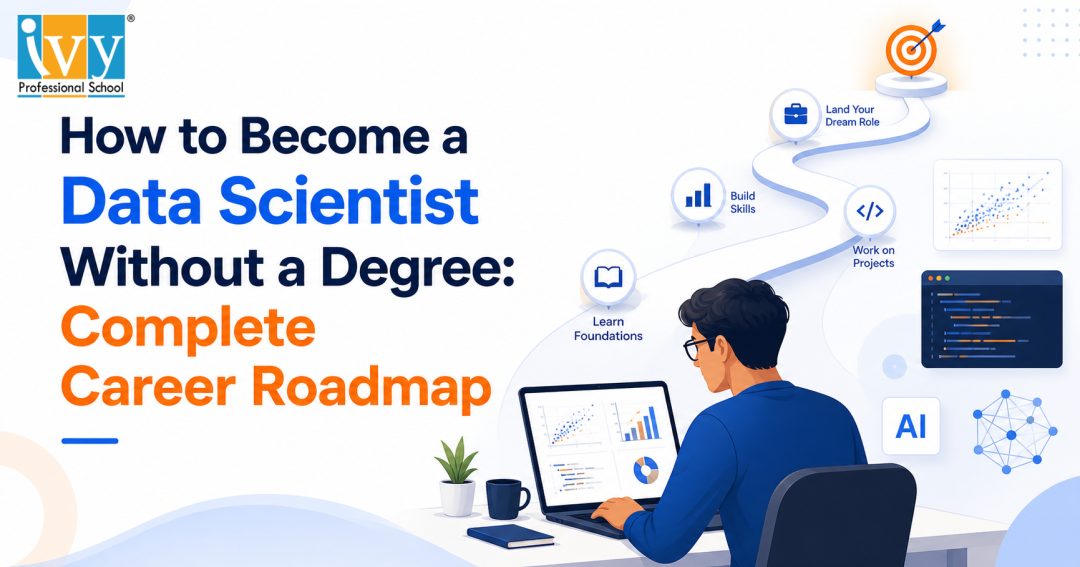
      How to Become a Data Scientist Without a Degree: Complete Career Roadmap 

      Prompt Engineering in 2026: The Skill Every Data Professional Must Have

      Prompt Engineering in 2026
      Table of Contents
        Add a header to begin generating the table of contents
        If 2023–2024 was about learning AI tools, and 2025 was about using them, then 2026 is about mastering how to think with them. That shift has made one skill stand above the rest: Prompt Engineering. Not as a buzzword. Not as a hack. But as a core professional capability that determines whether you get average outputs… or business-defining insights. For data professionals—analysts, scientists, BI developers, and even decision-makers—Prompt Engineering is no longer optional. It is the bridge between data and decisions in an AI-first world.

        What is Prompt Engineering?

        Most people still define Prompt Engineering as “writing better prompts.” That definition is outdated. In 2026, Prompt Engineering = structured thinking + instruction design + AI orchestration. It involves:
        • Framing the right problem
        • Structuring context properly
        • Guiding AI step-by-step
        • Controlling output format
        • Iterating toward business-grade results
        In short, Prompt Engineering is about getting AI to think the way you want it to think.

        Why Prompt Engineering Became Critical in 2026

        1. AI is Everywhere in Data Workflows

        Tools like ChatGPT, Claude, and Google Gemini are now deeply embedded in:
        • Data cleaning
        • SQL generation
        • Dashboard design
        • Insight extraction
        • Reporting automation
        But here’s the catch: Same tool + different prompt = completely different output quality That’s where Prompt Engineering becomes the differentiator.

        2. Data Volume Has Exploded Beyond Human Processing

        Data professionals are no longer struggling with access to data. They are struggling with:
        • Interpreting massive datasets
        • Connecting patterns
        • Generating insights quickly
        Prompt Engineering helps you:
        • Ask better analytical questions
        • Break down complex datasets
        • Extract insights faster

        3. Businesses Want Decisions, Not Dashboards

        The role of data professionals has shifted:
        • From reporting → to decision support
        • From analysis → to recommendation
        AI can help bridge this gap—but only if guided correctly. A poorly written prompt gives you: “Here is a summary of the data…” A well-engineered prompt gives you: “Here are 3 actionable business decisions based on this data, with impact estimation.” That’s a career-defining difference.

        Where Prompt Engineering Fits in the Data Workflow

        Let’s map this practically.

        1. Data Cleaning & Preparation

        Instead of writing long scripts, you can prompt AI: “Identify missing values, suggest imputation techniques, and explain why.” Result:
        • Faster preprocessing
        • Better decision-making on data quality

        2. SQL Query Generation

        Prompt Engineering enables:
        • Natural language → SQL conversion
        • Query optimization
        • Complex joins without manual effort
        Example: “Write an optimized SQL query to find top 5 customers by revenue in the last 3 months with repeat purchase behavior.”

        3. Data Analysis & Insight Generation

        This is where Prompt Engineering shines. Bad prompt: “Analyze this dataset.” Good prompt: “Act as a business analyst. Identify trends, anomalies, and 3 actionable insights impacting revenue growth.”

        4. Dashboard & Visualization Design

        AI can now suggest:
        • Best chart types
        • Layout improvements
        • Storytelling structure
        With proper prompts, you can go from:
        • Raw data → executive dashboard in minutes

        5. Automated Reporting

        Prompt Engineering enables:
        • Daily report generation
        • Email summaries
        • Stakeholder-ready insights
        Example: “Summarize today’s sales data in 5 bullet points for leadership with key risks and opportunities.”

        The Core Components of Effective Prompt Engineering

        To truly master Prompt Engineering, you need a structured approach.

        1. Role Definition

        Tell the AI who it is. Example: “You are a senior data analyst in a retail company…” This changes:
        • Depth of analysis
        • Tone
        • Relevance

        2. Clear Instruction

        Avoid vague requests. Weak: “Analyze this.” Strong: “Identify trends, anomalies, and root causes in the dataset.”

        3. Context Injection

        Provide:
        • Business background
        • Data description
        • Objectives
        Without context, AI guesses. With context, AI performs.

        4. Output Formatting

        Define how the answer should look. Example:
        • Bullet points
        • Tables
        • Executive summary
        This ensures usable output, not raw text.

        5. Iteration

        Prompt Engineering is not one-shot. Top professionals:
        • Refine prompts
        • Add constraints
        • Improve outputs step-by-step

        Advanced Prompt Engineering Techniques (2026)

        1. Chain-of-Thought Prompting

        Break the problem into steps: “First analyze trends, then identify causes, then recommend actions.”

        2. Few-Shot Prompting

        Provide examples: “Here’s a sample analysis. Follow this format.”

        3. Structured Output Prompts

        Force AI to respond in a format: Example:
        • Insight
        • Impact
        • Recommendation

        4. Multi-Step Prompting

        Use AI like a workflow:
        1. Clean data
        2. Analyze
        3. Generate insights
        4. Create report

        5. Tool-Augmented Prompting

        Combine AI with tools:
        • Excel
        • Power BI
        • Python
        • APIs
        Prompt Engineering becomes the control layer across tools.

        Real-World Use Cases for Data Professionals

        1. Marketing Analytics

        • Customer segmentation
        • Campaign performance insights
        • ROI optimization
        Prompt Example: “Identify customer segments and suggest targeted marketing strategies.”

        2. Finance & Risk Analysis

        • Cash flow predictions
        • Risk identification
        • Cost optimization

        3. Supply Chain Optimization

        • Demand forecasting
        • Inventory analysis
        • Delay predictions

        4. HR Analytics

        • Attrition prediction
        • Performance insights
        • Hiring optimization

        5. Operations & Manufacturing

        • Defect analysis
        • Process improvement
        • Efficiency tracking

        Common Mistakes in Prompt Engineering

        1. Being Too Vague

        AI cannot read your mind.

        2. Ignoring Context

        No context = generic output

        3. Not Defining Output

        Leads to messy, unusable responses

        4. Expecting Perfection in One Prompt

        Prompt Engineering is iterative

        5. Treating AI as Google

        AI is not for search It is for reasoning

        How Prompt Engineering Impacts Your Career

        Let’s be blunt. Two data analysts:
        • Same tools
        • Same data
        • Same experience
        The one with better Prompt Engineering skills will:
        • Deliver faster insights
        • Impress stakeholders
        • Automate more work
        • Earn more
        Because they are not just analyzing data. They are leveraging intelligence at scale.

        The Future of Prompt Engineering

        Looking ahead, Prompt Engineering will evolve into:

        1. AI Workflow Design

        Building complete AI-driven pipelines

        2. AI Agents

        Automated systems executing tasks end-to-end

        3. Domain-Specific Prompting

        Finance, healthcare, manufacturing-specific frameworks

        4. Human + AI Collaboration

        Where humans guide strategy, AI executes

        How to Start Learning Prompt Engineering Today

        If you want to stay relevant in 2026, here’s the practical path:

        Step 1: Start Using AI Daily

        Use tools like:
        • ChatGPT
        • Claude
        • Google Gemini

        Step 2: Practice Structured Prompts

        Follow a framework:
        • Role
        • Instruction
        • Context
        • Format

        Step 3: Apply on Real Data

        Use:
        • Excel datasets
        • SQL databases
        • Power BI dashboards

        Step 4: Build Mini Projects

        Examples:
        • AI-powered report generator
        • Text-to-SQL tool
        • Automated dashboard insights

        Step 5: Learn Advanced Techniques

        • Prompt chaining
        • AI workflows
        • Agent-based systems

        Final Thoughts

        In 2026, Prompt Engineering is not just a skill—it is a competitive advantage. Data professionals who master it will:
        • Work faster
        • Think sharper
        • Deliver better results
        Those who ignore it will:
        • Fall behind
        • Struggle with efficiency
        • Lose relevance in an AI-driven ecosystem
        The real question is not: “Should I learn Prompt Engineering?” The real question is: How fast can I master it before it becomes the baseline expectation?

        FAQs

        What is Prompt Engineering in simple terms?

        It is the process of designing inputs (prompts) to get accurate and useful outputs from AI systems.

        Is Prompt Engineering only for AI professionals?

        No. It is essential for anyone working with data, analytics, or decision-making.

        Do I need coding to learn Prompt Engineering?

        No. It is primarily a thinking and structuring skill.

        How long does it take to learn?

        Basic skills can be learned in days. Mastery takes continuous practice.

        Why is Prompt Engineering important in 2026?

        Because AI is everywhere, and the quality of output depends on how well you instruct it.
        Prateek Agrawal

        Prateek Agrawal is the founder and director of Ivy Professional School. He is ranked among the top 20 analytics and data science academicians in India. With over 16 years of experience in consulting and analytics, Prateek has advised more than 50 leading companies worldwide and taught over 7,000 students from top universities like IIT Kharagpur, IIM Kolkata, IIT Delhi, and others.

        Data Analyst Salary in 2026: Complete Guide for India and Global Markets

        Data Analyst Salary 2026
        Table of Contents
          Add a header to begin generating the table of contents

          Understanding the data analyst salary landscape has become critical for anyone planning a career in analytics, switching domains, or hiring talent. With organizations across industries relying heavily on data-driven decision-making, demand for skilled analysts continues to grow rapidly—directly impacting compensation trends.

          This guide breaks down everything you need to know about data analyst salaries in 2026, including India-specific insights, global benchmarks, experience-wise breakdowns, and strategies to maximize your earning potential.

          Why Data Analyst Salary Is Rising Rapidly

          The rise in data analyst salary is not accidental—it is driven by structural changes in how businesses operate.

          Companies today depend on data for:

          • Customer behavior analysis
          • Revenue forecasting
          • Operational efficiency
          • Risk management
          • AI and automation initiatives

          As a result, data analysts are no longer “support roles.” They are now core business enablers.

          This shift has directly pushed salaries upward, especially for professionals who combine technical skills with business understanding.

          Average Data Analyst Salary in India (2026)

          The data analyst salary in India varies based on experience, city, industry, and skill set. However, the following ranges give a realistic benchmark:

          Entry-Level (0–2 Years)

          • ₹3.5 LPA to ₹6 LPA
          • Fresh graduates or early career professionals
          • Skills expected: Excel, basic SQL, visualization tools

          Mid-Level (2–5 Years)

          • ₹6 LPA to ₹12 LPA
          • Professionals handling business reporting and insights
          • Skills expected: SQL, Python, Power BI/Tableau

          Senior-Level (5–10 Years)

          • ₹12 LPA to ₹25 LPA
          • Ownership of dashboards, stakeholder management
          • Skills expected: Advanced analytics, forecasting, domain expertise

          Lead / Manager Level (10+ Years)

          • ₹25 LPA to ₹50 LPA+
          • Strategic roles with decision-making responsibilities

          The key takeaway: data analyst salary grows exponentially with skill depth and business impact.

          Data Analyst Salary by City in India

          Location plays a significant role in determining compensation.

          Bangalore

          • ₹6 LPA to ₹20 LPA
          • Highest demand due to tech ecosystem

          Mumbai

          • ₹5 LPA to ₹18 LPA
          • Strong presence of BFSI and consulting firms

          Delhi NCR

          • ₹5 LPA to ₹15 LPA
          • Mix of startups, corporates, and analytics firms

          Hyderabad

          • ₹5 LPA to ₹16 LPA
          • Growing IT and analytics hub

          Kolkata / Tier 2 Cities

          • ₹3 LPA to ₹10 LPA
          • Growing demand but lower average salary

          However, remote work is gradually reducing location-based salary differences.

          Data Analyst Salary Globally

          If you are targeting international roles, here’s how data analyst salary compares globally:

          United States

          • $70,000 to $120,000 per year

          United Kingdom

          • £30,000 to £60,000 per year

          Canada

          • CAD 55,000 to CAD 95,000

          Australia

          • AUD 65,000 to AUD 110,000

          The gap exists primarily due to:

          • Cost of living
          • Market maturity
          • Skill demand

          But with remote opportunities, Indian professionals can increasingly tap into global salary levels.

          Data Analyst Salary by Industry

          Not all industries pay the same. The data analyst salary differs significantly depending on domain.

          High-Paying Industries

          • Banking & Financial Services (BFSI)
          • E-commerce
          • Consulting
          • SaaS / Tech

          Moderate-Paying Industries

          • Manufacturing
          • Logistics
          • Retail

          Emerging High-Pay Sectors

          • AI & Machine Learning companies
          • HealthTech
          • FinTech

          Domain knowledge can increase your salary by 20–40% compared to generic roles.

          Skills That Impact Data Analyst Salary

          Your salary is directly linked to your skill stack. Here’s how different skills affect earning potential:

          Core Skills (Mandatory)

          • Excel
          • SQL
          • Data Cleaning
          • Data Visualization

          High-Impact Skills (Salary Boosters)

          Premium Skills (Top Salary Tier)

          Professionals with advanced skills often command 2x–3x higher data analyst salary than beginners.

          Data Analyst Salary Based on Tools

          Certain tools significantly influence salary levels:

          Tool / SkillSalary Impact
          ExcelBase level
          SQL+20%
          Power BI / Tableau+30%
          Python+40%
          Machine Learning+60%+

          Employers pay more for analysts who can move beyond reporting into insight generation and prediction.

          Freshers vs Experienced: Salary Comparison

          One of the most common questions is how data analyst salary evolves over time.

          • Freshers: ₹3–5 LPA
          • After 2 years: ₹6–8 LPA
          • After 5 years: ₹10–18 LPA
          • After 8+ years: ₹20 LPA+

          The growth is not linear—it depends heavily on:

          • Skill upgrades
          • Job switches
          • Industry exposure

          Freelance and Remote Data Analyst Salary

          Freelancing has opened new income streams.

          Freelance Earnings

          • ₹500 to ₹2,500 per hour
          • ₹20,000 to ₹1,00,000 per project

          Remote International Roles

          • ₹15 LPA to ₹40 LPA (India-based professionals working globally)

          Freelancers with niche expertise can earn more than full-time employees.

          Factors That Influence Data Analyst Salary

          Several variables impact compensation:

          1. Education

          • Engineering, Statistics, or Economics backgrounds often get higher starting salaries

          2. Certifications

          • Data analytics certifications can boost credibility

          3. Portfolio

          • Real-world projects significantly increase hiring chances

          4. Communication Skills

          • Analysts who can explain insights to business leaders earn more

          5. Domain Expertise

          • Finance, marketing, or supply chain specialization adds value

          How to Increase Your Data Analyst Salary

          If your goal is to maximize your data analyst salary, focus on these strategies:

          1. Move Beyond Excel

          Excel is essential, but not sufficient. Learn SQL and visualization tools.

          2. Build Real Projects

          Employers value practical experience over theoretical knowledge.

          3. Learn Business Thinking

          Understanding revenue, cost, and KPIs sets you apart.

          4. Switch Jobs Strategically

          Salary jumps often happen during job transitions.

          5. Learn AI and Automation

          AI is reshaping analytics roles, early adopters will earn more.

          Future Trends in Data Analyst Salary

          The future of data analyst salary is closely tied to AI and automation.

          Key trends:

          • Analysts evolving into “decision scientists”
          • Integration of AI tools like ChatGPT, Power BI Copilot
          • Demand for real-time analytics skills
          • Higher salaries for hybrid roles (Analytics + Business + AI)

          Entry-level roles may become more competitive, but skilled professionals will continue to command premium salaries.

          Is Data Analyst a High-Paying Career?

          Yes—but only if approached correctly.

          A data analyst role can be:

          • A stable career with consistent growth
          • A stepping stone to data science or analytics leadership
          • A high-paying profession with global opportunities

          However, success depends on continuous learning and skill upgrades.

          Final Thoughts

          The data analyst salary in 2026 reflects the growing importance of data in business decision-making. While entry-level salaries may seem modest, the growth potential is significant for those who invest in the right skills.

          If you focus on:

          • Strong technical foundations
          • Business understanding
          • Real-world application

          You can quickly move into higher salary brackets and even access global opportunities.

          Frequently Asked Questions (FAQs)

          What is the starting data analyst salary in India?

          Typically between ₹3.5 LPA to ₹6 LPA for freshers.

          Which city pays the highest data analyst salary?

          Bangalore offers the highest average salaries in India.

          Can a fresher get a high data analyst salary?

          Yes, with strong skills and projects, freshers can earn ₹6–8 LPA.

          Is data analyst a good career in 2026?

          Yes, due to high demand and strong salary growth potential.

          If you’re planning to enter or grow in this field, now is the right time—the demand is strong, and the earning potential is only going higher.

          Prateek Agrawal

          Prateek Agrawal is the founder and director of Ivy Professional School. He is ranked among the top 20 analytics and data science academicians in India. With over 16 years of experience in consulting and analytics, Prateek has advised more than 50 leading companies worldwide and taught over 7,000 students from top universities like IIT Kharagpur, IIM Kolkata, IIT Delhi, and others.

          Finally GPT4 is Here!

          Finally, GPT-4 is here – It can now take images, videos, and text inputs and generate responses.

          The wait for the much anticipated GPT-4 is over.

          Microsoft-backed OpenAI has revealed the launch of its highly anticipated GPT-4 model. It is being hailed as the company’s most advanced system yet, promising safer and more useful responses to its users. Fo

          Can The New YouChat AI Bot Replace ChatGPT?

          The world has been captivated by ChatGPT, a sizable language model. Its possibilities appear limitless to many. The AI develops games, codes write poetry, and even offers relationship advice. An alternative to ChatGPT appeared: YouChat AI Bot. In this article, we will learn more about this bot. 

          Following ChatGPT, users and academics alike have started to speculate about what highly developed, generative AI would entail for search in the future. According to Rob Toews from Forbes,

          “Why enter a query and get back a long list of links (the current Google experience) if you could instead have a dynamic conversation with an AI agent in order to find what you are looking for?”

          Toews and other experts claim that the obstacle is the huge language models’ susceptibility to inaccurate data. Many are concerned that the confident erroneous responses provided by tools like ChatGPT could amp up propaganda and misinformation.

          That changes today. 

          Citations and real-time data have been added to You.com’s extensive language model, enhancing its relevance and precision. It enables you to find answers to complicated questions and also unlocks operations that were never seen before in a search engine.

          What Is YouChat AI Bot?

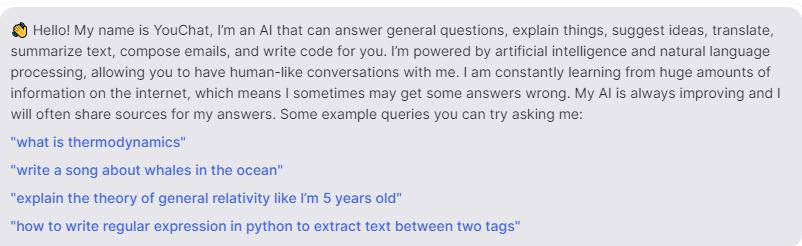
          You may chat with YouChat AI Bot, an AI search assistant that is similar to ChatGPT, directly from the search results page. You can trust that its responses are accurate because it keeps up with the news and cites its sources. Additionally, YouChat becomes better the more you use it. 

          For using it, you will have to simply make a query at You.com

          what-is-youchat
          What Is YouChat

          How Can YouChat AI Bot Help You?

          With the help of the YouChat AI Bot, you may communicate with your search engine in a way that is human-like and quickly find the answers you need. When you ask it to perform different duties, it answers. It may, for instance, give sources, summarise books, develop code, simplify complicated ideas, and produce material in any language. Some of our favorite use cases are listed below:

          Learn About Recent Events

          The first significant language model that can respond to inquiries about recent occurrences is YouChat AI Bot.

          recent-events
          Recent Events

          Respond to inquiries that conventional search engines can't

          This AI bot helps you to get answers to all types of questions that our traditional search engines cannot answer.

          responding-to-enquiries
          Responding To Inquries

          Utilize rationality to solve issues

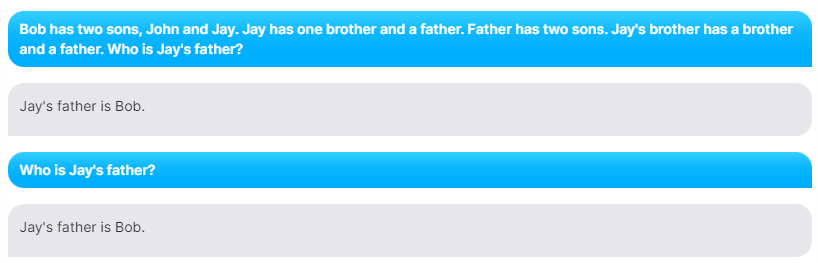
          YouChat is better than ChatGPT at logic games. Take a look at this:

          utilize-rationality-to-solve-issues
          Utilize Rationality To Solve Issues

          Solve mathematical equations

          Step-by-step solutions and explanations are included immediately in the search results to assist students in learning.

          solve-mathematical-equations
          Solve Mathematical Equations

          Summarise the data using reliable sources

          Curious about someone or something? Ask YouChat anything.

          summarise-the-data-using-reliable-sources
          Summarise The Data Using Reliable Sources

          Limitations of YouChat

          YouChat also shows old images and links that are both pertinent and out-of-date for a variety of themes, much like other AI models. Additionally, YouChat is significantly more upfront in that regard and provides extensive instruction for inquiries with obviously hostile purposes, whereas ChatGPT has been trained to refuse to answer any potentially destructive questions. It’s okay to be forgiving, though, as this is just YouChat’s initial release.

          Can YouChat Replace ChatGPT?

          Before we draw any conclusions on whether YouChat can replace ChatGPT or not, here is a brief description of what is ChatGPT and its limitations as well.

          About ChatGPT

          ChatGPT is an AI-powered automated program that uses machine learning and deep learning to respond to user questions. It answers all fact-based questions from users in a professional manner. It also excels at generating original and imaginative responses.

          In order to create answers that are optimized based on previous user responses, ChatGPT can remember what users have previously said in the chat. 

          The chatbot helps the users by suggesting them follow-up edits and supporting them in having a comprehensive comprehension of the topic they are chatting about, which is another fantastic feature.

          As some users might manipulate the chatbots into making inappropriate requests, which could lead to major crimes, ChatGPT is good at spotting hazardous things.

          Limitations Of ChatGPT

          Everything has its pros and cons. Now that you know what ChatGPT is, let us also look at its limitations. 

          • A computer model that can converse with users is called ChatGPT. However, there are numerous chances that errors will be made during the dialogue given that OpenAI has indicated they are open to user criticism.
          • Every program has various limitations or shortcomings. With chatGPT, the same is true. Here are a few limitations of how the ChatGPT chatbot works.
          • Sometimes ChatGPT will make statements that sound plausible when read in their context despite being irrational.
          • ChatGPT takes sentence and phrase structure into account. It might not respond well to your query on the first try, but if you rephrase it, it might respond well on the second try.
          • Its topic might need more efficient language communication, and some of its terminologies are overused.

          Verdict

          Given that YouChat is extremely new and will inevitably have restrictions in the future, ChatGPT has more constraints than YouChat. Although each of them has advantages of its own, analysts predict that YouChat will surpass ChatGPT given its restrictions.

          Conclusion

          YouChat AI Bot is the first major language model enhanced for improved relevance and accuracy. We will keep working hard to reduce and limit the spread of false information, even though biases and AI traps are still a problem. 

          If you want to know more about how ChatGPT or similar AI bots operate, here is a Sentiment Analysis of ChatGPT using Webscraping in Python from Ivy Professional School’s special bootcamp session. 

          Ivy Professional School is one of the leading Data Science institutes in India. It offers great courses in data science, data engineering, and Machine Learning that you can enroll in. They offer expert-led courses along with complete placement assistance. Join Ivy and get to work on real-life Machine Learning projects to make your resume more reachable to recruiters. For more details visit their website.

          Paste your AdWords Remarketing code here
          0
          0
          0
          0
          0
          0
          0