
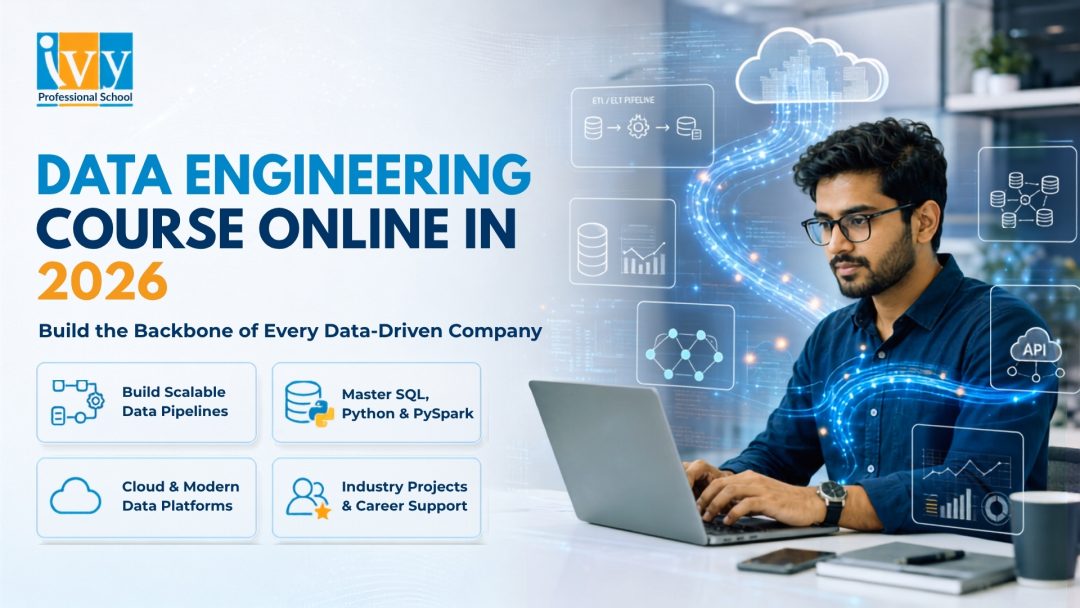
The demand for skilled data engineers has never been stronger, and finding the right data engineering course online in 2026 is the smartest first step you can take toward this high-paying, high-growth career. India alone is projected to need over 11 lakh data professionals by 2026, and data engineers sit at the very top of that hiring list. Whether you are a fresh graduate, a software developer looking to pivot, or a data analyst ready to level up, a data engineering course online in 2026 gives you the flexibility to build industry-relevant skills without pausing your life. This guide covers everything, what data engineering actually is, what to learn, which tools matter, and how to land your first role.
Before choosing a data engineering course online in 2026, it helps to understand what the job actually involves. Data engineers are the architects of the data world. They design, build, and maintain the pipelines, systems, and infrastructure that move data from where it originates to where it can be analysed and used.
Think of it this way: a data scientist cannot build a machine learning model without clean, well-structured data. A business analyst cannot generate accurate reports without reliable pipelines feeding the right numbers into the right dashboards. Data engineers are the professionals who make all of that possible.
In 2026, the role has expanded significantly. Modern data engineers are not just writing SQL queries and building ETL pipelines — they are deploying real-time streaming systems, managing cloud data warehouses at petabyte scale, orchestrating complex workflows, and increasingly working alongside AI systems that demand consistent, high-quality data inputs.
The average salary for a data engineer in India ranges from ₹8 LPA at the entry level to ₹30 LPA or more for experienced professionals — making it one of the most financially rewarding technical careers available to Indian graduates today.
Not all programmes are equal. A strong data engineering course online in 2026 should go well beyond the basics and prepare you for the tools and workflows that real employers are actually using. Here is what to look for:
Every credible data engineering course online in 2026 begins with Python and SQL — the two languages that form the foundation of all data engineering work.
Python is used for writing data pipelines, automating workflows, interacting with APIs, and building ETL (Extract, Transform, Load) scripts. Key libraries to learn include:
SQL remains the lingua franca of data. You should be comfortable with:
Building pipelines is the core of data engineering work. A solid data engineering course online in 2026 will teach you how to design and implement pipelines that extract data from multiple sources, transform it into usable formats, and load it into target systems reliably and efficiently.
You should learn both batch processing (scheduled jobs that run at set intervals) and real-time streaming (continuous data flows that process events as they happen). Tools covered should include:

In 2026, virtually all enterprise data infrastructure runs on the cloud. A data engineering course online in 2026 that does not cover cloud platforms is leaving you underprepared for the job market. The three major clouds you should understand are:
You do not need to master all three. Most programmes recommend starting with one cloud platform deeply and developing familiarity with the others. AWS and GCP are the most in-demand in India’s data engineering job market in 2026.
Modern data infrastructure has evolved beyond traditional data warehouses. A high-quality data engineering course online in 2026 will teach you about:
Understanding when to use each architecture — and how to design data models that serve both operational and analytical needs — is a critical skill that separates strong data engineers from average ones.
Good data engineering is not just about moving data — it is about structuring it intelligently. A rigorous data engineering course online in 2026 covers:
A data engineering course online in 2026 should give you hands-on experience with pipeline orchestration — the practice of scheduling, monitoring, and managing complex multi-step workflows. Apache Airflow is the industry standard, but in 2026 you should also be aware of:
Professional data engineers do not work in isolation. They collaborate using the same software engineering practices as developers. A well-rounded data engineering course online in 2026 includes:
One of the fastest-growing areas in data engineering is real-time data processing. Consumer apps, financial systems, logistics platforms, and IoT devices all generate continuous streams of data that must be processed instantly. A forward-looking data engineering course online in 2026 will cover:

With dozens of platforms and hundreds of programmes available, selecting the right data engineering course online in 2026 requires careful evaluation. Here is what to assess:
The tools in data engineering evolve rapidly. Check that the data engineering course online in 2026 you are considering covers current tools — dbt, Delta Lake, Kafka, modern cloud services — not legacy technologies from five years ago. Ask the provider when the curriculum was last updated.
A data engineering course online in 2026 should be project-heavy. Look for programmes that have you building end-to-end pipelines on real datasets — ingesting raw data from APIs or databases, processing it through transformation layers, loading it into a cloud data warehouse, and orchestrating the workflow with Airflow. Employers want to see working pipelines in your portfolio, not just certificate screenshots.
Online learning can feel isolating without the right support structure. The best data engineering course online in 2026 will include live doubt-clearing sessions, peer cohorts, code review from experienced data engineers, and access to an alumni community that can refer you to job openings.
Look for programmes that offer resume reviews, mock technical interviews, and direct connections to hiring partners. The ideal data engineering course online in 2026 treats placement as a core deliverable — not an afterthought — because completing the course is only valuable if it translates into a job offer.
A serious data engineering course online in 2026 typically runs 6–10 months for working professionals studying part-time. Accelerated bootcamps can cover the material in 3–4 months with full-time commitment. Be realistic about your available hours per week before enrolling.

Completing the right data engineering course online in 2026 opens doors to several well-defined and well-compensated roles:
After completing a data engineering course online in 2026, you will find demand across virtually every sector:
Certificates from a data engineering course online in 2026 matter far less than the proof you can actually do the work. Here are portfolio projects that will impress interviewers:
Each project should be documented on GitHub with a clear architecture diagram, README, and notes on design decisions. A well-presented portfolio from a data engineering course online in 2026 can outweigh a postgraduate degree in data-related hiring decisions.
Supplement your primary programme with these high-quality free resources:
Skipping the fundamentals. Many learners jump straight to Spark and Kafka without mastering Python and SQL first. Every strong data engineering course online in 2026 is built on these foundations — do not rush past them.
Learning tools instead of concepts. Tools change; architectural thinking does not. Understand why you use a data lake versus a warehouse, why you choose streaming over batch — not just how to configure a specific tool.
Not building in public. Share your projects on LinkedIn and GitHub as you build them. The data engineering community in India is active and supportive, and visibility often leads directly to interview opportunities.
Ignoring data quality. Real pipelines break, data arrives late, schemas change unexpectedly. A serious data engineering course online in 2026 will teach you data validation, monitoring, and alerting — skills that separate production-ready engineers from hobbyists.
Underestimating soft skills. Data engineers collaborate closely with data scientists, analysts, product managers, and infrastructure teams. Communication, documentation, and the ability to translate technical decisions into business language are essential alongside technical proficiency.
Data engineering is the backbone of the modern data economy, and 2026 is an exceptional time to enter the field. The right data engineering course online in 2026 gives you the skills, tools, portfolio, and industry connections to compete for roles that pay well, grow fast, and sit at the heart of every data-driven organisation.
Be intentional about your choice. Look for a data engineering course online in 2026 that is current, hands-on, mentor-supported, and placement-focused. Build real pipelines. Document your work. Engage with the data engineering community. And remember — the best data engineers are not just technical experts; they are problem-solvers who understand that their job is to make data work reliably for the people who depend on it.
Your data engineering journey starts with one decision. Make it the right one.


Leave a Reply