Prateek Agrawal Aug 29, 2026 No Comments
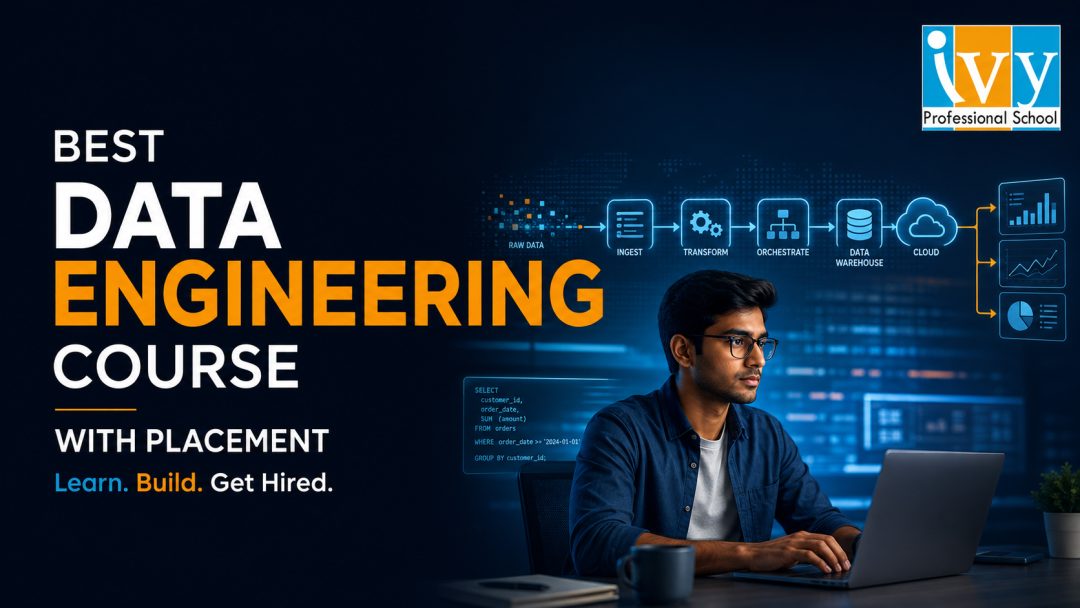
If you have been researching data careers, chances are you have typed “best data engineering course with placement” into Google more than once. That is a good instinct, data engineering has quietly become one of the highest-paying, most stable roles in the Indian tech industry, and picking the right program can make or break how quickly you land your first job in the field. In this guide, we will break down exactly what to look for, what a strong curriculum should include, and how a placement-focused program can take you from beginner to hired data engineer.
Data engineers build and maintain the pipelines, warehouses, and infrastructure that allow organizations to collect, clean, and use data at scale. Every dashboard a business analyst opens, every machine learning model a data scientist trains, and every recommendation engine an e-commerce site runs depends on a data engineer having built reliable systems behind the scenes.
As Indian companies — from fintech startups to global capability centers — accelerate their adoption of cloud computing, real-time analytics, and generative AI, the demand for skilled data engineers has surged well beyond the supply of qualified professionals. Job portals consistently list data engineering among the fastest-growing tech roles, and salaries have risen accordingly. This gap between demand and skilled supply is precisely why so many career switchers and freshers are now searching for the best data engineering course with placement rather than trying to piece together skills through scattered YouTube tutorials.
The catch is that data engineering is not a “watch a few videos and you’re job-ready” kind of field. It requires structured learning across programming, databases, distributed systems, cloud platforms, and orchestration tools — which is exactly why a well-designed, mentor-led course with genuine placement support matters so much.
Not every course that advertises “placement assistance” delivers on it. Before enrolling, evaluate a program against these criteria:
When you filter your shortlist using these six criteria, you naturally narrow down to programs that can genuinely call themselves the best data engineering course with placement — as opposed to marketing copy dressed up as a guarantee.

A placement-ready data engineering curriculum should be built in layers, moving from fundamentals to production-grade systems:
A course missing several of these layers is unlikely to prepare you for real interviews, regardless of how it markets itself. This is the benchmark to hold any program to when you’re comparing options for the best data engineering course with placement.
At Ivy Pro School, the data engineering program is designed around exactly the curriculum layers above, taught by practitioners rather than purely academic instructors. A few things set the program apart:
Combine institutional pedigree with a genuine placement engine, and you get a program that doesn’t just teach data engineering concepts — it engineers outcomes. That combination of curriculum depth, mentorship, and accountability is what makes this the best data engineering course with placement for learners who are serious about breaking into the field, whether they’re fresh graduates or working professionals pivoting from adjacent roles like software development, QA, or business analytics.

The phrase “placement assistance” gets used loosely across the ed-tech industry, so it’s worth understanding what genuine placement support actually looks like:
This is the layer that separates a course from a career transition. Plenty of programs teach Spark and Airflow reasonably well; far fewer put in the structural work to get you hired afterward. Spend as much time scrutinizing this section of a program as you do the technical syllabus, since it is usually the deciding factor between a completed certificate and an actual job offer.
Even motivated learners waste months and money by making avoidable mistakes during the selection process:
Avoiding these pitfalls up front saves both time and tuition, and it usually points you straight toward programs with a genuine track record of outcomes rather than marketing promises.

Data engineering offers several career trajectories once you have foundational skills in place:
Salaries in this field have grown steadily as demand has outpaced the supply of trained professionals, with entry-level data engineers in India commanding competitive packages compared to many other tech roles, and experienced engineers with cloud and big data expertise commanding significantly higher compensation. This growth trajectory is a major reason so many professionals are actively pursuing structured training instead of relying on self-study alone — the field rewards demonstrable, hands-on expertise, and employers pay a premium for candidates who can prove it through real pipeline projects and credible certification rather than a list of watched tutorials.
Beyond base salary, data engineers often see faster promotion cycles than adjacent roles, since the skill set transfers directly into senior positions like data architect, platform lead, or engineering manager for data infrastructure teams. Companies also increasingly value data engineers who understand the basics of machine learning workflows, since MLOps and AI infrastructure roles are growing out of traditional data engineering teams as generative AI adoption accelerates across industries.
Both formats can lead to the same outcome, but they suit different learners:
Classroom or hybrid learning works well if you value in-person mentorship, peer accountability, and a structured daily routine — which is why Ivy Pro School maintains physical centers in Kolkata, Bangalore, and Delhi alongside its online offering.
Live online learning works well for working professionals who need flexibility around existing job commitments but still want real-time instructor interaction rather than pre-recorded, self-paced content.
What matters more than the format is whether the program includes live doubt-clearing sessions, project reviews, and direct placement support — self-paced, pre-recorded courses with no human accountability structure rarely deliver strong placement outcomes, regardless of how comprehensive the video library looks on paper.
Recruiters screening resumes for data engineering roles tend to look for a specific, recognizable toolkit, and a strong course should give you working proficiency — not just theoretical familiarity — across most of the following:
A program that only teaches two or three items from this list will leave graduates under-prepared for technical interviews, where hiring managers routinely test candidates on how these tools interact rather than testing each one in isolation. This is also why capstone projects matter so much — they force learners to combine several of these tools into a single working pipeline, which is a far closer approximation of real job responsibilities than isolated exercises ever could be.
Q: How long does it take to complete a data engineering course with placement? Most structured programs run between 6 and 9 months, depending on whether you’re studying full-time or alongside a job, with placement support typically continuing for several months after course completion.
Q: Do I need a coding background to enroll? No. A good program builds programming and SQL skills from the ground up, though basic logical reasoning and comfort with computers will help you move faster through the early modules.
Q: Is data engineering harder to break into than data science? Not necessarily — it’s a different skill set, more focused on systems, pipelines, and infrastructure than statistics and modeling. Many learners find the more engineering-oriented, less mathematically heavy curriculum easier to grasp.
Q: What makes Pay After Placement different from a regular fee structure? It shifts financial risk away from the learner and ties the institute’s revenue directly to your getting placed, which tends to correlate with stronger, more hands-on placement support.
Q: Can working professionals switch careers into data engineering? Yes — professionals from software development, QA, database administration, and even business analytics backgrounds frequently transition into data engineering roles, often bringing relevant domain knowledge that strengthens their candidacy.
Q: Which cloud platform should I learn first for data engineering? Most learners start with AWS, since it has the largest market share in India’s hiring landscape, though a strong program will expose you to the core concepts of Azure and GCP as well, since many enterprises run multi-cloud environments.
Q: Does Ivy Pro School offer both classroom and online batches for data engineering? Yes — the program runs at physical centers in Kolkata, Bangalore, and Delhi, alongside live online batches for learners who need remote flexibility while keeping real-time instructor interaction and doubt-clearing support.
Choosing the best data engineering course with placement comes down to three things: a curriculum that genuinely covers the tools employers use, instructors who have worked with those tools in production, and a placement system that goes far beyond a vague promise in the brochure. Ivy Pro School’s data engineering program combines all three — an 18-year institutional track record, NASSCOM and IBM industry partnerships, and a Pay After Placement model designed to keep the institute accountable for your outcome, not just your attendance.
If you’re serious about building a career in data engineering, it’s worth attending a free career counseling session at Ivy Pro School’s Kolkata, Bangalore, or Delhi centers, or joining a live online orientation, to see the curriculum, meet instructors, and understand exactly how the placement process works before you commit.
Prateek Agrawal May 20, 2026 No Comments

If you have searched “best GenAI course India 2026” and landed here, you are already ahead of most people. You have recognised that generative AI is not a passing trend, it is a structural shift in how businesses operate, how products are built, and how careers are valued. The question you are trying to answer is not whether to learn it. It is who to learn it from.
That is the harder question. And it deserves a more honest answer than most institutes will give you.
The Indian online education market has exploded with GenAI courses over the last eighteen months. Every platform, every institute, and every coaching centre now has a “best GenAI course” badge on their homepage. Some of them are excellent. Many of them are recycled machine learning content with “generative AI” added to the title. A few are genuinely misleading, promising skills and placements they cannot deliver.
This article will not just tell you which is the best GenAI course to pick. It will give you the framework to evaluate any GenAI course yourself, so that whatever you decide, you make the decision with clear eyes.
Generative AI moved from experimental to operational faster than almost anyone predicted. In 2023, enterprises were running pilots. In 2024, they were integrating. By 2025, GenAI tools were embedded in workflows across BFSI, e-commerce, healthcare, consulting, and manufacturing. In 2026, they are table stakes — and the professionals who cannot work alongside, direct, and build with these tools are visibly falling behind.
The demand for GenAI skills in the Indian job market reflects this shift. According to LinkedIn’s 2025 Jobs on the Rise report for India, roles requiring generative AI skills grew by over 300% year-on-year. Salaries for GenAI-capable professionals, engineers, analysts, and product managers alike, command a 25–45% premium over peers with equivalent experience but no GenAI proficiency.
The supply side has not kept pace. Most professionals who want to build these skills are overwhelmed by the noise of competing course offerings and uncertain about which credentials employers actually respect. That gap between high demand and uncertain supply is where the opportunity sits for anyone who acts decisively in 2026.
This is precisely why finding the best GenAI course in India matters more in 2026 than it did in any previous year. The wrong course wastes six to twelve months of your time and produces a certificate that does not move hiring managers. The right course changes your career trajectory permanently.

This is the section most best-GenAI-course comparison articles skip. They list courses and star ratings without explaining what the curriculum should actually contain. Here is what separates a job-ready generative AI program from a certificate factory.
Large Language Model fundamentals — at the right depth. You do not need to understand the mathematics of transformer architectures to use GenAI professionally. But you do need to understand how LLMs process context, why they hallucinate, how temperature and sampling affect outputs, and what the difference is between a foundation model and a fine-tuned one. The best GenAI course will dedicate at least two to three weeks to this conceptual layer — because it is the foundation on which every practical skill is built. A course that skips this produces professionals who can use ChatGPT but cannot diagnose why it fails or make principled decisions about when to use AI versus when not to.
Prompt engineering — structured and applied. Zero-shot, few-shot, chain-of-thought, role-based prompting, and structured output generation are core skills. Any generative AI course worth enrolling in should spend significant time on these techniques with hands-on exercises on real business problems not just toy examples. If the prompt engineering module is a two-hour video lecture with no applied practice, it is not sufficient for a job-ready outcome.
Retrieval-Augmented Generation (RAG) – This is the architecture that makes GenAI practically useful for enterprise applications. RAG systems connect LLMs to proprietary databases, documents, and knowledge bases — allowing businesses to build AI tools that answer questions using their own data rather than generic training data. In 2026, RAG is not an advanced topic. It is a core skill for anyone building or working with enterprise AI applications. The best GenAI course in India will cover RAG as a mandatory module — not an optional advanced add-on. A program that does not cover RAG is teaching 2023 GenAI.
Agentic AI and multi-agent frameworks. AI agents — Systems where a model can autonomously plan, use tools, search the web, write and run code, and chain multiple tasks together — are the frontier of practical GenAI in 2026. LangChain, LlamaIndex, AutoGen, and CrewAI are the tools being deployed in production environments at progressive companies. Any course claiming to be the best GenAI course in 2026 without covering agentic frameworks is leaving students unprepared for where the field is moving fastest.
Fine-tuning and model customisation – Understanding when and how to fine-tune a foundation model for a specific use case — versus prompting a general model — is an increasingly important decision in enterprise AI deployment. This does not require deep ML engineering expertise, but it does require conceptual clarity about the tradeoffs involved. A best-in-class generative AI course will cover this distinction clearly with real use case examples.
Responsible AI and hallucination management – GenAI systems fail in specific, predictable ways. Hallucination, bias amplification, privacy leakage through prompts, and adversarial manipulation are real risks in production deployments. A course that does not cover these failure modes is producing professionals who will cause expensive mistakes at their employers. Responsible AI is not a compliance checkbox — it is a professional competency.
GenAI for data workflows. For data professionals specifically, the best GenAI course in India should cover how to integrate large language models into data pipelines — using AI to assist with data cleaning, EDA, SQL generation, visualisation narration, and automated reporting. This applied layer is what makes GenAI training immediately relevant to a working data professional’s day job.
Curriculum is necessary but not sufficient. When evaluating which is the best GenAI course for your specific situation, these four additional dimensions matter as much as the syllabus.
Faculty with current industry experience. The GenAI landscape in 2026 is not the same as it was in 2024. A faculty member whose knowledge of LLMs is based on what was current two years ago is not equipped to teach what employers need now. When evaluating any generative AI course, ask: when did your core GenAI faculty last work on a production AI deployment? If the answer is vague or deflected, that is important information. The best GenAI courses in India are taught by practitioners who are using these tools in real enterprise environments right now — not academics teaching from papers published eighteen months ago.
Institutional backing that employers recognise. The Indian job market uses institutional affiliation as a quality signal when evaluating candidates at scale. A GenAI certificate backed by NASSCOM, or IBM carries weight in a hiring conversation that a certificate from an unknown platform does not. This is not about prestige for its own sake — it is about whether your credential functions as a trust signal to employers who do not have time to evaluate every portfolio individually. The best GenAI course in India will carry institutional partnerships that your future employer has heard of.
Hands-on project work on real problems. The gap between watching someone build a RAG pipeline on video and building one yourself on a real business dataset is enormous. Any best generative AI course worth the fee should require you to complete end-to-end projects — an AI-powered document Q&A system, a customer support automation agent, a data analysis co-pilot — that you can deploy, demonstrate, and discuss in an interview. Portfolio depth is the single biggest determinant of interview outcomes for GenAI roles in 2026.
Placement support with verifiable outcomes. GenAI is a new enough field that placement records are the most honest signal of whether a program actually produces job-ready graduates. Before enrolling in any course claiming to be the best GenAI course in India, ask for specific company names, role titles, and salary ranges from the last twelve months of placements — not aggregate historical numbers. Institutes that cannot or will not provide this data are telling you something important about the gap between their marketing and their outcomes.
Understanding what employers want is the clearest guide to what the best GenAI course in India should teach. Based on active hiring patterns across India’s leading technology, consulting, and product companies in 2026, these are the roles generating the most demand.
GenAI Application Developer — Builds end-to-end AI applications using LLM APIs, RAG architectures, and agentic frameworks. Requires Python, LangChain or equivalent, and cloud platform familiarity. Starting salary: ₹10–18 LPA.
AI/ML Engineer with GenAI specialisation — Extends traditional ML engineering skills to include LLM fine-tuning, deployment, and MLOps for generative models. Starting salary: ₹12–20 LPA.
Prompt Engineer — Designs and optimises prompt systems for enterprise AI deployments. Increasingly specialised role at companies running large-scale GenAI operations. Starting salary: ₹9–15 LPA.
Data Analyst with AI augmentation skills — Uses GenAI tools to accelerate analytical workflows — generating SQL, building automated reports, and creating narrative summaries of data findings. The most accessible entry point for professionals transitioning from traditional analytics. Starting salary: ₹7–12 LPA.
AI Product Manager — Defines the product strategy for AI-powered features and products. Requires understanding of GenAI capabilities and limitations at a conceptual depth sufficient to make informed build/buy/partner decisions. Starting salary: ₹14–25 LPA.
The best GenAI course in India in 2026 should prepare you for at least one of these role categories specifically — not just give you a generic exposure to AI concepts that leaves you unable to articulate which role you are targeting or why you are qualified for it.

Ivy Professional School has been in the data education business since 2007 — long before generative AI existed as a field. That eighteen-year track record means we have watched multiple waves of technological change reshape the profession, and we have developed institutional muscle for keeping curriculum current as the tools evolve. We do not claim to offer the best GenAI course in India lightly — we have the placement data and alumni outcomes to back it up.
Our Generative AI and Data Science program — certified by E&ICT Academy, and backed by NASSCOM and IBM, is built around every curriculum requirement described above. LLM fundamentals, prompt engineering, RAG architecture, agentic AI frameworks, fine-tuning, responsible AI, and GenAI for data workflows are all core modules, not optional add-ons. The curriculum is reviewed and updated quarterly in partnership with our industry advisory board, practitioners from our 500+ hiring partner network who tell us in real time what skills they cannot find in candidates.
Faculty are working practitioners. Every core module is taught by someone who has deployed GenAI solutions in production environments — not academics teaching from papers, and not instructors whose industry experience ended before LLMs became the dominant paradigm.
Projects are real and portfolio-ready. Students build a functional RAG-based document intelligence system, a multi-agent workflow for automated data analysis, and a prompt engineering toolkit for a business use case of their own choosing. These are not tutorial completions — they are deployable assets that demonstrate genuine capability to every employer who evaluates them.
Our 37,500+ alumni network spans 500+ companies across India. When an Ivy Pro student enters the job market after completing what we believe is the best GenAI course available in India today, they have access to placement relationships built and maintained over eighteen years, direct introductions to hiring managers, not resume submissions to job portals.
And our Pay After Placement model removes the financial risk entirely. You complete the program, build your portfolio, and pay only after you have secured a role that meets a defined salary threshold. We carry the risk because eighteen years of data tells us our outcomes justify the confidence.
Before we get to the checklist, it is worth naming the red flags that disqualify a program from being considered the best GenAI course in India, regardless of how it is marketed.
No RAG or agentic AI in the core syllabus. If a course does not cover these in 2026, it is teaching yesterday’s GenAI. Walk away.
Vague placement claims without verifiable data. “95% placement rate” without company names, roles, and salaries is a marketing number, not an outcome. The best GenAI course will show you evidence, not assertions.
All video, no live instruction or mentorship. Self-paced platforms have a role in learning, but they are not sufficient for a career transition. If there is no live interaction, no mentorship, and no accountability structure, the dropout rate is high and the job-readiness outcome is low.
Faculty with no recent industry experience. Teaching GenAI from textbooks in 2026 is like teaching driving from a manual without ever sitting in a car. The field moves too fast for academic-only instruction.
No hands-on projects on real datasets. Exercises on toy datasets teach syntax, not thinking. The best GenAI course in India will challenge you with messy, real-world data problems where the answer is not already known.
Before you make a final decision on which is the best GenAI course for your situation, ask these five questions to every institute on your shortlist — including us.
One: Does your curriculum cover RAG, agentic AI, and fine-tuning as core modules, or are these optional additions?
Two: Who teaches the GenAI modules, and when did they last work on a production GenAI deployment?
Three: What institutional certification does the program carry, and is it recognised by major Indian and multinational employers?
Four: Can you share verified placement data from the last twelve months — company names, role titles, and salary ranges?
Five: What does placement support actually look like — direct hiring manager introductions, or access to a job portal?
The best GenAI course in India in 2026 is not the one with the most recognisable brand name or the lowest fee. It is the one that answers all five of these questions with evidence, not promises. Any institute that deflects, generalises, or avoids specifics on any of these five points is telling you what you need to know.

If you are serious about building a career in generative AI in 2026, the most expensive decision you can make is to delay. The professionals enrolling in the best GenAI courses in India right now are building portfolios, developing placement-ready skills, and entering a job market where their competition is still watching YouTube tutorials and calling it upskilling.
Ivy Professional School’s Generative AI and Data Science program — E&ICT Academy certified, NASSCOM and IBM backed, with a Pay After Placement model — is open for enrollment now. Weekend and weekday batches available across Kolkata and Bangalore, with online options for outstation learners.
Book your free counselling session at ivyproschool.com. A program advisor will evaluate your background, your target role, and your realistic salary range — and tell you honestly whether our program is the best GenAI course match for your specific situation.
Q1. Who is eligible for the best GenAI course in India — do I need a technical background?
No technical background is required to enrol in a quality GenAI course, but a basic familiarity with data concepts helps. At Ivy Professional School, we accept students from all academic backgrounds — engineering, commerce, arts, and management. The program is designed to bring a motivated learner from foundational concepts to job-ready GenAI proficiency, regardless of where they start. If you can think analytically and communicate clearly, you have the two most important prerequisites for succeeding in the best GenAI course available.
Q2. What is the difference between a GenAI course and a machine learning course?
Machine learning focuses on building predictive models from structured data — classification, regression, clustering, and forecasting using algorithms like decision trees, random forests, and neural networks. Generative AI focuses on models that create new content — text, code, images, and structured outputs — using large language models and diffusion architectures. In 2026, the best GenAI course in India covers both: ML for predictive analytics and GenAI for content generation, automation, and AI application development. They are complementary, not competing disciplines.
Q3. How long does it take to complete a GenAI course and become job-ready?
For a working professional studying part-time, approximately eight to ten hours per week, the best GenAI course structured for career outcomes takes nine to twelve months to complete. Freshers or students who can dedicate more time can compress this to six to nine months. The key variable is not just course completion but portfolio development: you become genuinely job-ready when you have two to three real projects you can demonstrate in an interview, not when you receive a certificate.
Q4. What jobs can I get after completing a GenAI course in India?
The most in-demand roles for GenAI-trained professionals in India in 2026 include: AI/ML Engineer, GenAI Application Developer, Prompt Engineer, Data Scientist (AI-augmented), NLP Engineer, AI Product Manager, and Data Analyst with GenAI specialisation. Salary ranges for these roles at fresher to junior level run from ₹8 LPA to ₹18 LPA depending on company type, city, and portfolio depth. The best GenAI course will prepare you specifically for one or more of these role categories, not just give you generic AI exposure.
Q5. Is a GenAI course worth it compared to free online resources?
Free resources such as YouTube, Coursera, Hugging Face documentation are valuable for self-directed learning. But they have three significant gaps for professionals trying to transition careers. First, they provide no structured path: you can spend months learning things in the wrong order. Second, they provide no mentorship: when you are stuck at 10 PM, there is no one to help you move forward. Third, they provide no placement support. The best GenAI course in India, backed by industry partners, addresses all three gaps. The question is not whether free resources are good, they are. The question is whether they are sufficient for a career transition on a defined timeline.
Q6. What is the fee structure for Ivy Pro’s GenAI course, and is there a Pay After Placement option?
Ivy Professional School offers a Pay After Placement model for eligible candidates you complete the full program and pay only after securing a job offer that meets a defined salary threshold. This removes upfront financial risk entirely. No-cost EMI options are also available. Contact our admissions team at ivyproschool.com for current fee details. If you are looking for the best GenAI course in India with the lowest financial risk, Pay After Placement is the model that makes that possible.
Q7. How is Ivy Pro’s GenAI course different from what platforms like Coursera or Udemy offer?
Online platforms like Coursera and Udemy offer self-paced video content useful for concept exposure but limited in applied depth, mentorship, and placement outcomes. The best GenAI course differs in four key ways: live instruction from practitioners with current industry experience, hands-on capstone projects on real business datasets, one-on-one mentorship throughout the program, and active placement support with direct hiring manager introductions at 500+ partner companies. Platform certificates are credentials you earn by watching. Ivy Pro’s NASSCOM certification is a credential employers recognise and respect.
Q8. Can I learn GenAI while working full-time?
Yes and the majority of students in Ivy Pro’s best GenAI course are working professionals doing exactly this. Our weekend batch model is specifically designed for full-time professionals: live classes on Saturday and Sunday, structured weekday assignments of one to two hours per evening, and bi-weekly mentorship sessions scheduled around professional availability. The total weekly time commitment is eight to ten hours compatible with a demanding job if you protect that time consistently.
