
Team Jan 11, 2023 No Comments
The world has been captivated by ChatGPT, a sizable language model. Its possibilities appear limitless to many. The AI develops games, codes write poetry, and even offers relationship advice. An alternative to ChatGPT appeared: YouChat AI Bot. In this article, we will learn more about this bot.
Following ChatGPT, users and academics alike have started to speculate about what highly developed, generative AI would entail for search in the future. According to Rob Toews from Forbes,
“Why enter a query and get back a long list of links (the current Google experience) if you could instead have a dynamic conversation with an AI agent in order to find what you are looking for?”
Toews and other experts claim that the obstacle is the huge language models’ susceptibility to inaccurate data. Many are concerned that the confident erroneous responses provided by tools like ChatGPT could amp up propaganda and misinformation.
That changes today.
Citations and real-time data have been added to You.com’s extensive language model, enhancing its relevance and precision. It enables you to find answers to complicated questions and also unlocks operations that were never seen before in a search engine.
You may chat with YouChat AI Bot, an AI search assistant that is similar to ChatGPT, directly from the search results page. You can trust that its responses are accurate because it keeps up with the news and cites its sources. Additionally, YouChat becomes better the more you use it.
For using it, you will have to simply make a query at You.com
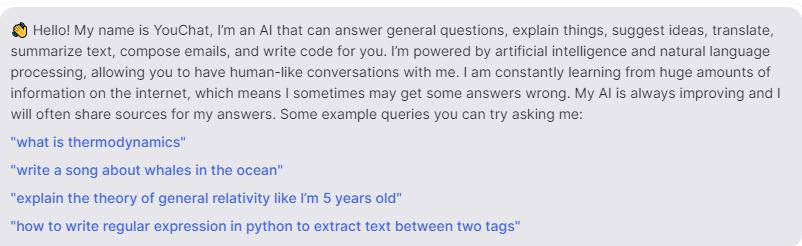
With the help of the YouChat AI Bot, you may communicate with your search engine in a way that is human-like and quickly find the answers you need. When you ask it to perform different duties, it answers. It may, for instance, give sources, summarise books, develop code, simplify complicated ideas, and produce material in any language. Some of our favorite use cases are listed below:
The first significant language model that can respond to inquiries about recent occurrences is YouChat AI Bot.
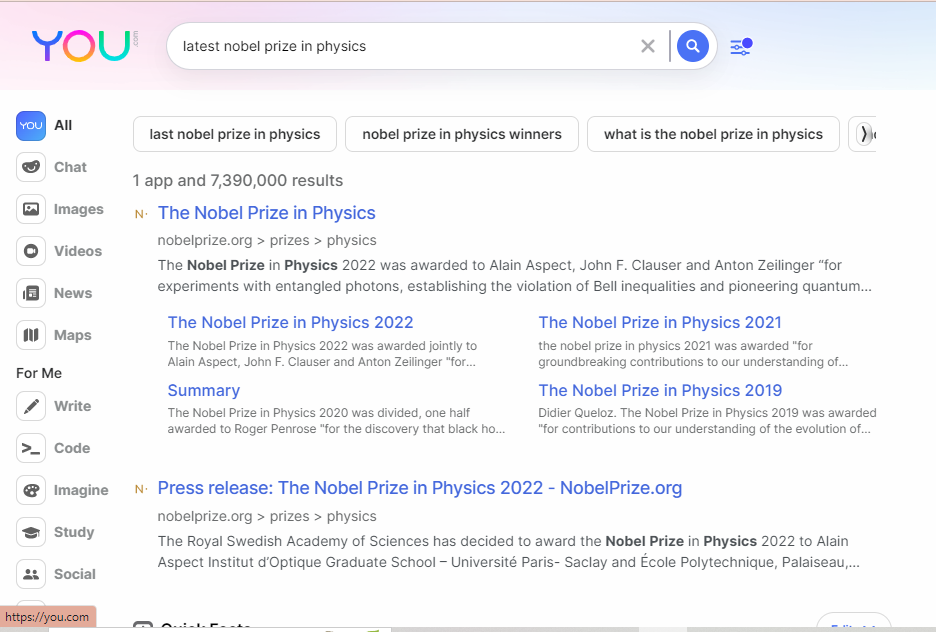
This AI bot helps you to get answers to all types of questions that our traditional search engines cannot answer.

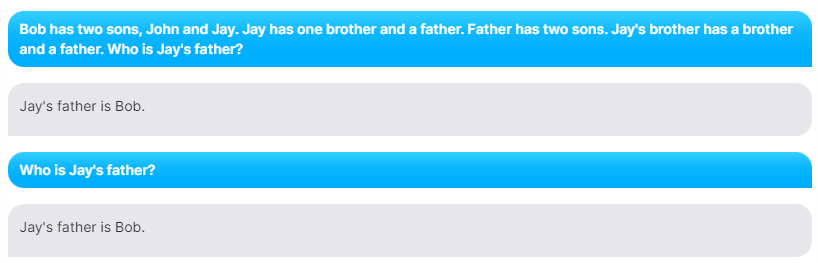
YouChat is better than ChatGPT at logic games. Take a look at this:
Step-by-step solutions and explanations are included immediately in the search results to assist students in learning.

Curious about someone or something? Ask YouChat anything.

YouChat also shows old images and links that are both pertinent and out-of-date for a variety of themes, much like other AI models. Additionally, YouChat is significantly more upfront in that regard and provides extensive instruction for inquiries with obviously hostile purposes, whereas ChatGPT has been trained to refuse to answer any potentially destructive questions. It’s okay to be forgiving, though, as this is just YouChat’s initial release.
Before we draw any conclusions on whether YouChat can replace ChatGPT or not, here is a brief description of what is ChatGPT and its limitations as well.
ChatGPT is an AI-powered automated program that uses machine learning and deep learning to respond to user questions. It answers all fact-based questions from users in a professional manner. It also excels at generating original and imaginative responses.
In order to create answers that are optimized based on previous user responses, ChatGPT can remember what users have previously said in the chat.
The chatbot helps the users by suggesting them follow-up edits and supporting them in having a comprehensive comprehension of the topic they are chatting about, which is another fantastic feature.
As some users might manipulate the chatbots into making inappropriate requests, which could lead to major crimes, ChatGPT is good at spotting hazardous things.
Everything has its pros and cons. Now that you know what ChatGPT is, let us also look at its limitations.
Given that YouChat is extremely new and will inevitably have restrictions in the future, ChatGPT has more constraints than YouChat. Although each of them has advantages of its own, analysts predict that YouChat will surpass ChatGPT given its restrictions.
YouChat AI Bot is the first major language model enhanced for improved relevance and accuracy. We will keep working hard to reduce and limit the spread of false information, even though biases and AI traps are still a problem.
If you want to know more about how ChatGPT or similar AI bots operate, here is a Sentiment Analysis of ChatGPT using Webscraping in Python from Ivy Professional School’s special bootcamp session.
Ivy Professional School is one of the leading Data Science institutes in India. It offers great courses in data science, data engineering, and Machine Learning that you can enroll in. They offer expert-led courses along with complete placement assistance. Join Ivy and get to work on real-life Machine Learning projects to make your resume more reachable to recruiters. For more details visit their website.
Team Sep 17, 2022 No Comments
Keras is an easy-to-use, strong, free open-source Python library for evaluating and developing deep learning frameworks. This is a part of the TensorFlow library and enables you to illustrate and train neural network structures in just some lines of code. In this article, we will be talking about what is Keras and TensorFlow.
Let us start this Keras tutorial. Keras was formulated to be quite user-friendly, easy to extend, modular, and to work with Python. The API was “designed for human beings, not machines” and “follows best practices for reducing cognitive load.”
Neural layers, optimizers, cost operations, activation operations, initialization schemes, and regularization schemes are all standalone structures that one can combine to formulate a new module. New modules are easy to add, as new functions and classes. Models are illustrated in Python code, not different structure configuration models.
In this article on what is Keras in Python, let us have a look at the key features of Keras:
Being a high-level library and is a convenient interface, Kears certainly boosts as one of the deep learning libraries that is available. There are several features of itself, which makes it more convenient to use and also offers more features.
– If Keras is compared with and Theano, it tries to offer a better “user Experience” and this zones Keras above the other two libraries.
– As this is a Python library, it is more available to the general public because of the inherent simplicity of the Python programming language.
– Lasagne is a library that is very similar to Kears. But using both the libraries I can say Keras is much more convenient.
Now that you know the advantages of using the Keras library, you should also be aware of the disadvantages of Kears.
– Since this Python library has its dependency on low-level languages such as TensorFlow and Theano, so this performs as a double-edged sword for Keras. This is the primary reason why Keras cannot move beyond the realms of these libraries. For instance, both TensorFlow and Theano presently do not support GPUs except Nvidia. That is the reason Keras also does not have the corresponding support.
– Similar to Lasagne, eras also wholly abstract the low, level languages. So this is less flexible when it comes to creating custom functions.
– The final point is that this is new in this niche. Its very first version was launched in late 2015, and it has gone through various alterations since then. Then even though Keras is already used in the process of production, one should always think twice before they deploy Keras models for production.
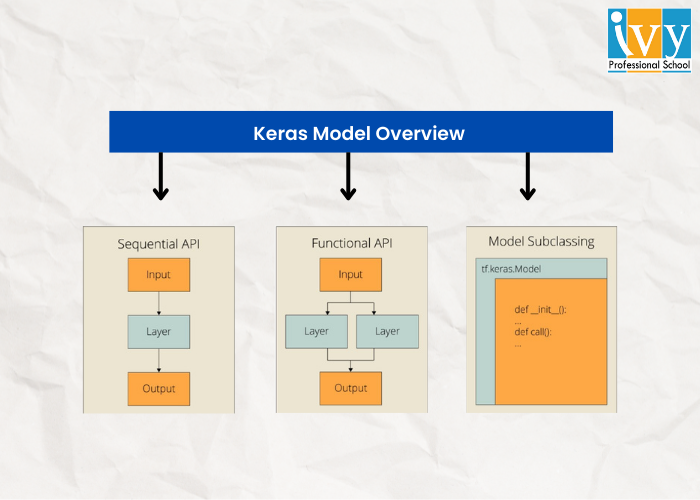
Models are the primary entity one will be working with when using Keras. The structures are used in defining TensorFlow neural networks by mentioning the attributes, operations, and layers you wish.
Keras provides a range of APIs you can employ to illustrate your neural network, involving:
– Sequential API allows one to formulate a model structure by structure for most issues. It is straightforward but restricted to single-input, single-output stacks of layers.
– Functional API is mainly a full-feature API that supports arbitrary framework architecture. It is more complicated and flexible in comparison to the sequential API.
– Model Subclassing allows one to enact everything from scratch. Ideal for research and highly complicated use scenarios, but it is hardly used in practice.
ML (Machine Learning) algorithms use a special form of an algorithm that is known as a Neural Network. Same as every machine learning algorithm, it also abides by the general ML workflow of data preprocessing and model evaluation. For ease of use, here are some of the to-dos on how to approach a Neural Network problem.
– See if there are issues where a neural network offers you an uplift over traditional algorithms.
– Conduct a survey for which neural network architecture is the most ideal required issue.
– Illustrate neural network architecture via language or library as per your choice.
– Change data into the ideal format and divide it into varied batches.
– As per your requirements, pre-process the data.
– Augmented data is utilized to magnify size and make better-trained frameworks.
– Batches are nourished by the neural network.
– Track alterations in training and validation data sets, and also train them.
– Test your frameworks.
After this article on what is Keras model, you come to know about how this is useful in the area of deep learning along with its benefits and also limitations. We have also seen how this Python library depends on low-level languages such as Theanos and TensorFlow. Also if you were wondering what is Keras vs TensorFlow, then you must have got your answer.
Career prospects in data science and data analytics have increased over time and this has become a much-acclaimed niche presently. If you wish to start your career in data science then there can be no better place than Ivy Professional School. It offers a complete course on data science conducted by industry experts. For more details, you can visit their website.
Team Sep 13, 2022 No Comments

Updated in May, 2024
Do you know Netflix and Spotify use the Scikit-learn library for content recommendations?
Scikit-learn is a powerful machine learning library in Python that’s primarily used for predictive analytics tasks such as classification and regression.
If you are a Python programmer or aspiring data scientist, you must master this library in depth. It will help you with projects like building content-based recommendation systems, predicting stock prices, analyzing customer behavior, etc.
In this blog post, we will explain what is Scikit-learn and what it is used for. So, let’s get started…
Scikit-learn is an open-source library in Python that helps us implement machine learning models. This library provides a collection of handy tools like regression and classification to simplify complex machine learning problems.
For programmers, AI professionals, and data scientists, Scikit-learn is a lifesaver. The library has a range of algorithms for different tasks, so you can easily find the right tool for your problem.
Now, there is often a slight confusion between “Sklearn” and “Scikit-learn.” Remember, both terms refer to the same thing: an efficient Python library.
Although Scikit-learn is specifically designed to build machine learning models, it’s not the best choice for tasks like data manipulation, reading, or summary generation.
Scikit-learn is built on the following Python libraries:
Scikit-learn was developed with real-world problems in mind. It’s user-friendly with a simple and intuitive interface. It improves your code quality, making it more robust and optimizing the speed.
Besides, the Scikit-learn community is supportive. With a massive user base and great documentation, you can learn from others and get help when you need it. You can discuss code, ask questions, and collaborate with developers.
Scikit-learn was created by David Cournapeau as a “Google Summer Of Code” project in 2007. It quickly caught the attention of the Python scientific computing community, with others joining to build the framework.
Since it was one of many extensions built on top of the core SciPy library, it was called “scikits.learn.”
Matthieu Brucher joined the project later, and he began to use it as a part of his own thesis work.
Then, in 2010, INRIA stepped in for a major turning point. They took the lead and released the first public version of Scikit-learn.
Since then, its popularity has exploded. A dedicated international community drives its development, with frequent new releases that improve functionality and add cutting-edge algorithms.
Scikit-learn development and maintenance is currently supported by major organizations like Microsoft, Nvidia, INRIA foundation, Chanel, etc.
The Scikit-learn library has become the de facto standard for ML (Machine Learning) implementations thanks to its comparatively easy-to-use API and supportive community. Here are some of the primary uses of Scikit-learn:
Here’s a small example of how Scikit-learn is used in Python for Logistic Regression:
from sklearn.linear_model import LogisticRegression; model = LogisticRegression().fit(X_train, y_train)
Explanation:
Now, you must have understood what is Scikit-learn in Python and what it is used for. Scikit-learn is a versatile Python library that is widely used for various machine learning tasks. Its simplicity and efficiency make it a valuable tool for beginners and professionals.
If you want to learn machine learning with the Scikit-learn library, you can join Ivy’s Data Science with Machine Learning and AI certification course.
This online course teaches everything from data analytics, data visualization, and machine learning to Gen AI in 45 weeks with 50+ real-life projects.
The course is made in partnership with E&ICT Academy IIT Guwahati, IBM, and NASSCOM to create effective and up-to-date learning programs.
Since 2008, Ivy has trained over 29,000+ students who are currently working in over 400 organizations, driving the technology revolution. If you want to be the next one, visit this page to learn more about Ivy’s Data Science with ML and AI Certification course.