
Team Apr 10, 2026 No Comments
The demand for data engineers in India has exploded, and Data Engineer Salary in India 2026 is now one of the hottest topics among job seekers and professionals looking to switch careers. As companies double down on data-driven decision-making, the role of a data engineer has become critical to business success.
But how much do data engineers actually earn in 2026? And what factors truly influence these salaries?
Let’s break it down in a practical, no-fluff way.
India’s data ecosystem is maturing rapidly. Organizations are no longer just experimenting with data, they are building entire products, platforms, and strategies around it. This shift is directly impacting Data Engineer Salary in India 2026, pushing compensation higher across industries.
Here’s what’s driving this growth:
In simple terms: companies have data, but they desperately need experts who can make it usable.
Let’s get straight to the numbers. The Data Engineer Salary in India 2026 varies significantly based on experience.
| Experience Level | Average Salary (₹ per annum) |
| 0–2 years (Fresher) | ₹5 – ₹10 LPA |
| 2–5 years | ₹10 – ₹20 LPA |
| 5–8 years | ₹20 – ₹35 LPA |
| 8–12 years | ₹35 – ₹60 LPA |
| 12+ years | ₹60 LPA – ₹1 Cr+ |
These figures reflect realistic market trends across startups, mid-sized firms, and large enterprises.
One key insight: the jump from mid-level to senior roles is where salaries accelerate sharply. This is where skills and real-world impact start to matter more than just experience.
Not all companies pay equally, even for similar roles. The variation in Data Engineer Salary in India 2026 is heavily influenced by the type of organization.
If your goal is to maximize your Data Engineer Salary in India 2026, moving toward product-based companies or high-growth startups is often the smartest move.
When analyzing Data Engineer Salary in India 2026, one thing becomes clear: tools alone don’t drive salary—your ability to solve real problems does.
That said, certain skills consistently command higher pay.
Professionals who combine 2–3 of these capabilities often see a significant jump in their Data Engineer Salary in India 2026.
Location still plays a role in determining salaries, although remote work is gradually reducing these differences.
While metro cities dominate high-paying roles, remote opportunities are allowing professionals from smaller cities to access better compensation.
To better understand Data Engineer Salary in India 2026, let’s look at practical scenarios.
A professional transitioning from a non-tech role may start at ₹6–10 LPA. With consistent upskilling, they can reach ₹15–20 LPA within 2–3 years.
With 3–5 years of experience, salaries range from ₹18–30 LPA in product companies. Adding cloud and big data skills can push this beyond ₹25 LPA.
Highly skilled engineers working on large-scale systems earn between ₹40 LPA and ₹1 Cr+. These roles demand strong system design and deep technical expertise.
Many professionals make the mistake of focusing only on tools instead of impact. If you want to grow your Data Engineer Salary in India 2026, you need to think differently.
Here’s what actually works:
The market rewards those who can deliver business outcomes, not just technical knowledge.
The short answer is yes and it’s getting even better.
However, the role is evolving rapidly, which will continue to influence Data Engineer Salary in India 2026 and beyond.
If you stay at a basic skill level, your salary growth will plateau. But if you evolve with AI, cloud, and distributed systems, you will move into the top earning bracket.
Data engineering in India in 2026 is no longer just a “good career option” it’s a strategic, high-income career path.
The gap in Data Engineer Salary in India 2026 between average and top professionals is massive. And that gap is driven by one key factor: the ability to create real business impact through data.
If you are entering this field or looking to grow, focus less on certifications and more on building systems that companies actually need.
Because in today’s market, skills get you hired but impact gets you paid.
Prateek Agrawal is the founder and director of Ivy Professional School. He is ranked among the top 20 analytics and data science academicians in India. With over 16 years of experience in consulting and analytics, Prateek has advised more than 50 leading companies worldwide and taught over 7,000 students from top universities like IIT Kharagpur, IIM Kolkata, IIT Delhi, and others.
This is a

Prateek Agrawal is the founder and director of Ivy Professional School. He is ranked among the top 20 analytics and data science academicians in India. With over 16 years of experience in consulting and analytics, Prateek has advised more than 50 leading companies worldwide and taught over 7,000 students from top universities like IIT Kharagpur, IIM Kolkata, IIT Delhi, and others.
Team Jan 08, 2023 No Comments
The Data Science industry is anticipated to grow by 26% according to a report by Forbes, but Data Science as a niche is still unknown to many. The Data Science team everywhere helps in managing, organizing, and tackling the regular data. This is a multidisciplinary field that needs skills in math, statistics, computer science, and many more. In the last few years, the Data Science filed has witnessed immense growth in all sectors including education. In this article, we will have a look at the various applications of Data Science in education industry.
Numerous potentials for data scientists to find cutting-edge uses of Data Science in education have arisen as a result of the abundance of educational data. Additionally, by comprehending the various student types, the analysis of big data may aid the education sector in finding solutions to their challenges.
There is a tonne of student data that schools, colleges, and universities must manage, including academic records, outcomes, grades, personal interests, cultural interests, etc. They can discover cutting-edge strategies to improve student learning with the aid of the examination of this data.
The education industry can benefit greatly from modern Data Science technologies. For this, a variety of machine learning techniques are utilized, including Random Forest, Logistic Regression, Decision Trees, Support Vector Machines, etc. Data Science applications in education, however, are still few and far between.
However, there are still a lot of untapped use cases for Data Science that might help the education sector succeed. A few applications of Data Science in education are listed below.
Now that we are aware of the benefits Data Science is bringing to the sector of education. Let’s look at many ways that Data Science in education might be applied. These can also be termed as the various advantages of Data Science in education.
There are many distinct types of students being taught simultaneously by one teacher in a classroom. It happens frequently that some students excel in class while others struggle to grasp the material.
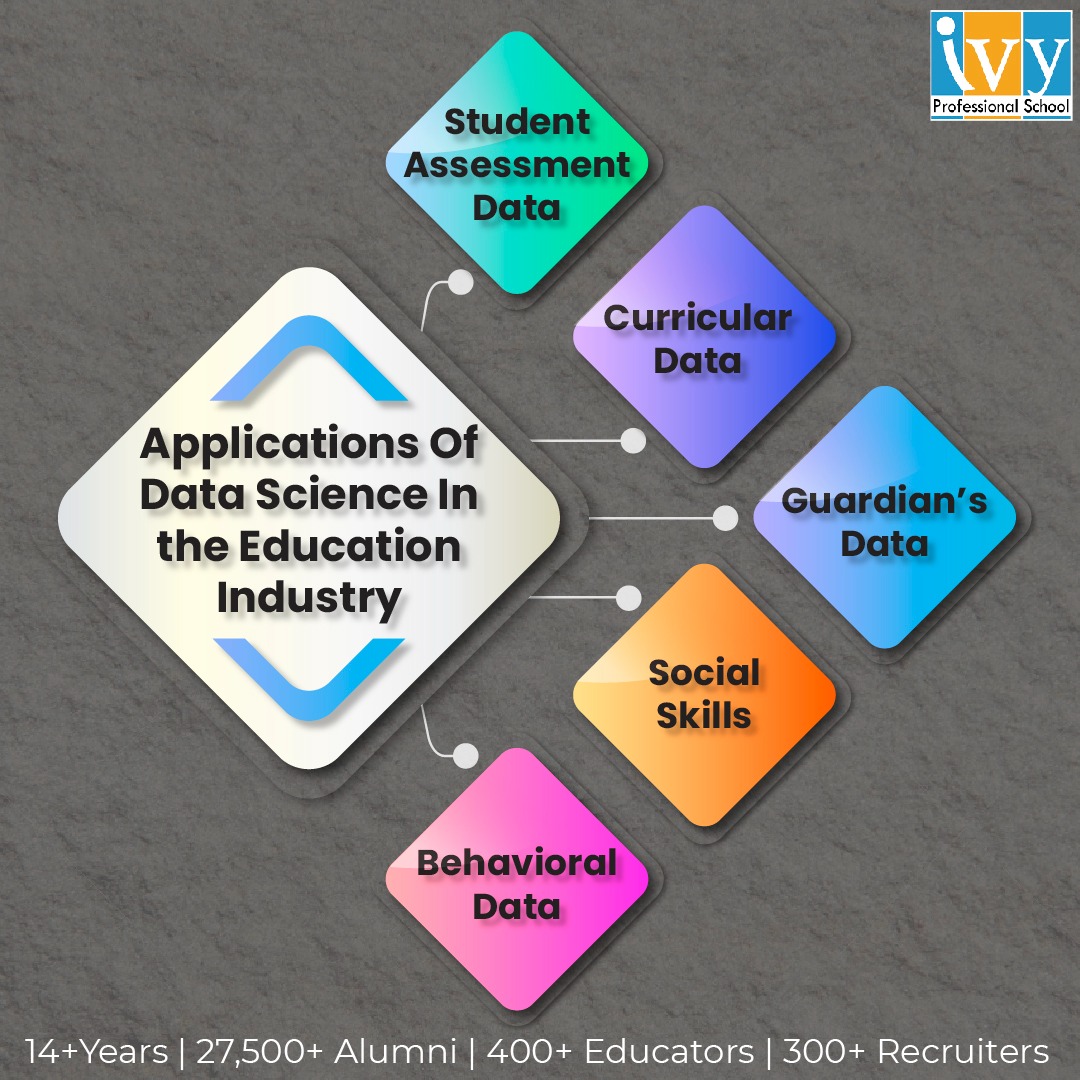
Data from assessments can be used by teachers to assess students’ comprehension and change their pedagogical approaches moving forward.
Before, evaluation methods were not real-time, but as Big Data Analytics developed, it became possible for teachers to have a real-time understanding of their students’ needs by observing their performance.
With the use of multiple-choice questions and systems like ZipGrade, evaluations can be completed more quickly. Although helpful, this method can be a little tiresome and time-consuming.
Any student must have strong social skills because they are crucial to both their academic and professional lives. A student cannot connect or communicate with his or her peers without social or emotional abilities, and as a result, fails to form relationships with his environment.
The advancement of social-emotional abilities requires the help of educational institutions. This is an illustration of a non-academic talent that significantly affects students’ learning abilities.
Although there have previously been statistical surveys that could evaluate these abilities, modern Data Science tools can aid in a more accurate assessment. Using formalized knowledge discovery models in Data Science and Data Mining techniques, it is possible to capture such enormous amounts of data and integrate them with modern technologies to get superior outcomes.
Additionally, data scientists can utilize the gathered data to run a variety of predictive analytical algorithms to help teachers understand why their students are motivated to take the course in question.
Parents and other guardians are crucial to children’s education. Due to parents’ carelessness, many disturbed adolescents achieve below average in school. Therefore, it becomes crucial for teachers to have regular parent-teacher conferences with the guardians of all pupils.
Data Science can be utilized to guarantee the greatest possible participation at those gatherings. In order to analyze the history or similarities between all the families with such behavior, it is utilized to weed out the students whose parents failed to appear. Instead of regularly sending generic emails or messages to all the parents, this can let the teachers speak with those parents directly.
Schools and colleges must stay current with industry expectations in order to provide their students with relevant and enhanced courses as the level of competition in the field of education rises.
Colleges are having a difficult time keeping up with the growth of the industry, so to address this issue, they are implementing Data Science technologies to analyze market trends.
By utilizing various statistical measurements and monitoring techniques, Data Science may be useful for analyzing industry trends and helping course designers incorporate pertinent subjects. Predictive analytics may also be used by institutions to assess the need for new skill sets and design courses to satisfy those needs.
There are several instances of student disobedience or indiscipline in educational settings. A designated staff person is expected to log an entry into the system each time anything similar occurs.
Since each action should result in a different punishment, the course of action for each occurrence can be decided by evaluating the severity of the action. For the staff, analyzing all the records to assess the severity and avoid unfair punishment can be a time-consuming task. Natural language processing might help in this situation.
In a school that has been in operation for a while, there should be a large enough pool of log entries to draw from when building a severity-level classifier. The entire procedure will become automated if the teachers and disciplinary staff can see it as well, which will save them time.
The various applications of Data Science in education help us to evaluate that like many other industries. Data Science for students is also helping this sector attain new heights. Various advanced Data Science tools will help the institutions to enhance the learning outcomes, monitor all students along with improving the performance of the students.
So if you are planning to enter the Data Science industry then this is the best time as people have started to understand the importance of this sector now and the market is not yet saturated. But before you land your dream job in the Data Science niche, you will first need to understand the concepts and have a grip on the tools that are used in this industry. The ideal place to learn Data Science is Ivy Professional School. It offers great courses in Data Science and data engineering that you can enroll in. They offer expert-led courses along with complete placement assistance. Join Ivy and get to work on real-life Data Science in education case studies to make your resume more reachable to recruiters. For more details visit their website.