
Team Sep 24, 2022 No Comments
Before a model is created, before the existing data is cleaned and made ready for exploration, even before the responsibilities of a data scientist start – this is where data engineers come into the frame. In this article, we are going to have a look at what is data engineering.
Every data-driven business requires a framework in place for the flow of data science, otherwise, it is a setup for failure. Most people enter the data science niche with the focus of becoming a data scientist, without ever knowing what is data engineering and analytics are and what the role of a data engineer is. They are crucial parts of any data science venture and their demand in the sector is evolving exponentially in the present data-rich scenario.
There is presently no coherent or official path available for data engineers. Most people in this role reach there by learning on the job, rather than abiding by a detailed avenue.
A data engineer is responsible for constructing and maintaining the data frame of a data science project. These engineers have to make sure that there is an uninterrupted flow of data between applications and servers. Some of the responsibilities of a data engineer involve enhancing data foundational procedures, including the latest data management technologies and also software into the prevailing mechanism, and constructing data collection pipelines among various other things.
One of the most crucial skills in data engineering is the potential to design and construct data warehouses. This is where all the raw data is collected, kept, and retrieved. Without data warehouses, all the activities that a data scientist does will become either too pricey or too big to scale.
Extract, Transform, and Load (ETL) are the steps that are followed by a data engineer to construct the data pipelines. ETL is crucially a blueprint for how the assembled data is processed and changed into data ready for the purpose of analysis.
Data engineers usually have an engineering background. Unlike data scientists, there is not much scientific or academic evaluation needed for this role. Engineers or developers who are interested in constructing large-scale frameworks and architecture are ideal for this role.
It is crucial to know the difference between these 2 roles. Broadly speaking, a data scientist formulates models using a combination of statistics, machine learning, mathematics, and domain-based knowledge. He or she has to code and construct these structures using similar tools or languages and also structures that the team supports.
A data engineer on the contrary has to maintain and build data frameworks and architectures for the purpose of data ingestion, processing, and deploying of large-scale data-heavy applications. Construct a pipeline for data storage and collection, funnel the data to the data scientist, to put the structure into production – these are just some of the activities a data engineer has to do.

Now that you know what is data engineering, let us have a look at the roles of a data engineer.

Here are some of the skills that every data engineer should be well versed in.
After this guide on what is data engineering, you must have known that becoming a data engineer is not an easy job. It needs a deep evaluation of tools, technologies, and a solid work ethic to become one. This data engineering job role is presently in huge demand in the industry because of the recent data boom and will prevail to be a rewarding career choice for anyone who is willing to adopt it.
Team Sep 18, 2022 No Comments
Everywhere we read, we see the power of data science. Data science is changing the world we are living in. Everyone is concerned about data. Businesses are keen on evaluating how data can help them to cut off expenses and enhance their bottom line. Businesses from every niche are now interested in data science and the stock market is no different. In this article, we will have a look at stock market data analytics and how it boosts the graphs of the stock market.
Data science is typically portrayed in numbers. But these numbers should imply anything that ranges from the number of users who buy a product to the amount of inventory that is sold. Of course, these numbers should also portray cash.
Now coming to stock market data analytics. Here we can either sell, buy, or hold. The aim is to make the biggest profit possible. The question that many are aiming to answer is about the role that data science plays in helping us conduct trades in the stock market. Trading platforms have become very famous in the last two decades, but each platform provides varied options, fees, tools, and many more. Despite the evolving trend, there are many nations that have still not been able to access zero trading commission platforms. This article is based on stock market data analytics India.
There are numerous phrases that are used in data science that a person would be required to be a scientist to understand. At its most primary level, data science is mathematics that is carved with an understanding of statistics and programming.
There are various concepts in data science that are applied when analysing the market. In this respect, we are employing the term “analyze” to evaluate whether it is worth it to make investment in it. There are some primary data science ideas that are ideal to be familiar with.
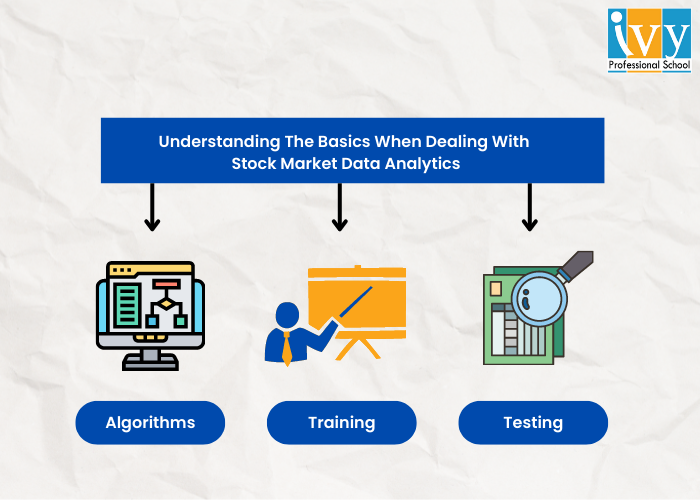
Algorithms are utilized extensively in data science. Basically an algorithm is a group of regulation required to perform a task. You have mostly heard about algorithms being used when purchased and selling stocks. Algorithmic trading is where algorithms fix rules for things such as when to purchase a stock or when to sell a stock.
For instance, an algorithm could be created to buy a stock once it drops by 8% in the entire day or to sell the stocks if it loses 10% of its value in comparison to when it was bought initially. Algorithms are formed to operate without human intervention. You might have heard about them referred to as bots. Like robots, they make calculated decisions that are devoid of emotions.
We are not discussing preparing to operate a 50 metre race. In ML (Machine learning) and also data science, training is where data is utilized in training a machine on how to revert back. We can formulate a learning structure. This machine learning framework makes it possible for a computer to offer accurate predictions that are based on the data it learned from the past. If you wish to teach a machine to anticipate the future of the values of stocks, it would require a structure of the stock prices of the last year to utilise as a base to anticipate what will occur.
Let us start with a stock market data analysis project. We have the real data for stock values from the previous year. The training set would be the real data from January to October. Then the data from November to December can be used for any testing set. Our machines should have understood by assessing how the stocks operated from January through October. Now, we will ask our machines to anticipate what should have occurred in November and December of that year. The predictions that will be made by the machine will be then compared to real values. The amount of variation seen in the prediction of the model and the real data are what we are aiming to discard as we adjust our training framework.
Data science depends heavily on structuring. This is a strategy that uses mathematics to examine previous behaviours with the aim of forecasting upcoming results. In the stock market, a time series model is employed.
A time series is basically data which in this scenario refers to the value of a stock that is indexed over a span of time. This span of time could be divided on an hourly, daily, monthly, or even minute basis. A time series module is formulated by using machine learning or deep learning models to fit the time data. The data requires to be analyzed and then fitted to match the structure. This is why it is effective to anticipate future values of stocks over a fixed timetable.
A second form of modeling that is employed in data science and machine learning is termed as a classification structure. These structures are offered data points and they aim to anticipate or classify what is portrayed by those data points.
When talking about the stock market or even stocks in general, a ML framework can be given financial data such as the P/E ratio, volume, total debt, and many more and then evaluate if you are making a sound investment. Depending on the basic financials we offer, a model can evaluate if now is the time to hold, sell, or purchase a stock.
A model could anticipate something with so many complications that it overlooks the relationship between the feature and the target variable. This is termed as overfitting. Underfitting is where a framework does not sufficiently cater to the data, so the outcomes are anticipations that are very simple.
Overfitting is an issue in stock market data analytics if the model finds it hard to identify stock market trends, so it cannot adapt to future incidents. It is where a structure anticipates the simple average price that is based on the complete history of the stocks. Both overfitting & underfitting lead to poor anticipations and forecasts.
We have barely scratched the surface when talking about the connection between machine learning ideas and stock market investments. However, it is crucial to evaluate the primary concepts we have discussed previously as they cater as a basis for comprehending how ML is employed to anticipate what the stock market can do. There are more ideas that can be learned by those who wish to receive the nitty-gritty stock market data analytics.
Team Sep 17, 2022 No Comments
Keras is an easy-to-use, strong, free open-source Python library for evaluating and developing deep learning frameworks. This is a part of the TensorFlow library and enables you to illustrate and train neural network structures in just some lines of code. In this article, we will be talking about what is Keras and TensorFlow.
Let us start this Keras tutorial. Keras was formulated to be quite user-friendly, easy to extend, modular, and to work with Python. The API was “designed for human beings, not machines” and “follows best practices for reducing cognitive load.”
Neural layers, optimizers, cost operations, activation operations, initialization schemes, and regularization schemes are all standalone structures that one can combine to formulate a new module. New modules are easy to add, as new functions and classes. Models are illustrated in Python code, not different structure configuration models.
In this article on what is Keras in Python, let us have a look at the key features of Keras:
Being a high-level library and is a convenient interface, Kears certainly boosts as one of the deep learning libraries that is available. There are several features of itself, which makes it more convenient to use and also offers more features.
– If Keras is compared with and Theano, it tries to offer a better “user Experience” and this zones Keras above the other two libraries.
– As this is a Python library, it is more available to the general public because of the inherent simplicity of the Python programming language.
– Lasagne is a library that is very similar to Kears. But using both the libraries I can say Keras is much more convenient.
Now that you know the advantages of using the Keras library, you should also be aware of the disadvantages of Kears.
– Since this Python library has its dependency on low-level languages such as TensorFlow and Theano, so this performs as a double-edged sword for Keras. This is the primary reason why Keras cannot move beyond the realms of these libraries. For instance, both TensorFlow and Theano presently do not support GPUs except Nvidia. That is the reason Keras also does not have the corresponding support.
– Similar to Lasagne, eras also wholly abstract the low, level languages. So this is less flexible when it comes to creating custom functions.
– The final point is that this is new in this niche. Its very first version was launched in late 2015, and it has gone through various alterations since then. Then even though Keras is already used in the process of production, one should always think twice before they deploy Keras models for production.
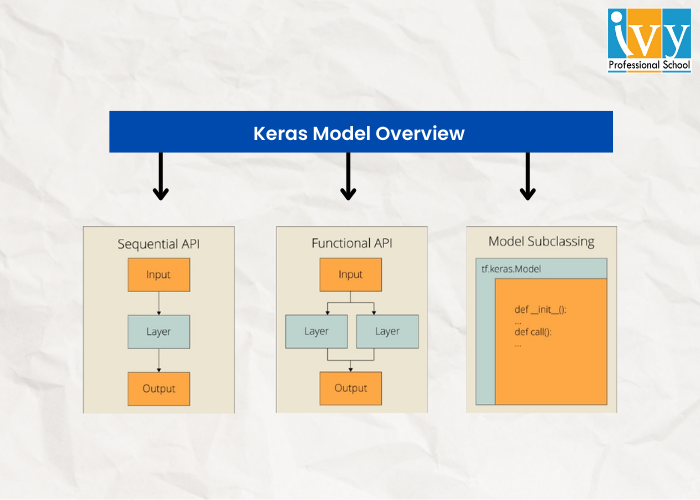
Models are the primary entity one will be working with when using Keras. The structures are used in defining TensorFlow neural networks by mentioning the attributes, operations, and layers you wish.
Keras provides a range of APIs you can employ to illustrate your neural network, involving:
– Sequential API allows one to formulate a model structure by structure for most issues. It is straightforward but restricted to single-input, single-output stacks of layers.
– Functional API is mainly a full-feature API that supports arbitrary framework architecture. It is more complicated and flexible in comparison to the sequential API.
– Model Subclassing allows one to enact everything from scratch. Ideal for research and highly complicated use scenarios, but it is hardly used in practice.
ML (Machine Learning) algorithms use a special form of an algorithm that is known as a Neural Network. Same as every machine learning algorithm, it also abides by the general ML workflow of data preprocessing and model evaluation. For ease of use, here are some of the to-dos on how to approach a Neural Network problem.
– See if there are issues where a neural network offers you an uplift over traditional algorithms.
– Conduct a survey for which neural network architecture is the most ideal required issue.
– Illustrate neural network architecture via language or library as per your choice.
– Change data into the ideal format and divide it into varied batches.
– As per your requirements, pre-process the data.
– Augmented data is utilized to magnify size and make better-trained frameworks.
– Batches are nourished by the neural network.
– Track alterations in training and validation data sets, and also train them.
– Test your frameworks.
After this article on what is Keras model, you come to know about how this is useful in the area of deep learning along with its benefits and also limitations. We have also seen how this Python library depends on low-level languages such as Theanos and TensorFlow. Also if you were wondering what is Keras vs TensorFlow, then you must have got your answer.
Career prospects in data science and data analytics have increased over time and this has become a much-acclaimed niche presently. If you wish to start your career in data science then there can be no better place than Ivy Professional School. It offers a complete course on data science conducted by industry experts. For more details, you can visit their website.
Team Sep 01, 2022 No Comments
In the present scenario, data is the basis of virtually every association. Companies in the current market scenario produced a prominent quantity of the 79 zettabytes of big data anticipated by Statista and hence are responsible for the big share of its usage, storage, and processing. Data analytics frameworks are crucial to all large-scale data management and optimization efforts.
These frameworks combine effective processes with cutting-edge data technologies to formulate insight and effective strategies for the operations of the companies. Traditional models did not look at the requirements of the companies as a whole, hence playing with data and creating roadblocks to efficiency. Evaluating modern data analytics frameworks and imposing them successfully will be important for any business aiming to move ahead of the graph.
The data analytics framework in data analytics is a concrete mechanism for handling data analytics effectively and efficiently. But the term itself is used in various ways. At times, these illustrate data analytics frameworks. Will be talking about the whole process and also the best practices for handling data analytics. Major data analytics framework examples include, Sample, Model, and Assess (SEMMA), Explore, Modify, process, and the Cross-Industry Standard Process Data Mining (CRISP-DM) guidelines. In other scenarios, the phrase is used in connection with data analytics solutions such as Teradata Vantage, as well as burgeoning data trends like the data mesh design pattern.
In the case of practicals, think of data analytics frameworks as an amalgamation of technologies and processes. The prominent guidelines and also the solutions used will differ often broadly among companies. But the fundamental aim of data analytics frameworks is consistent and that is to help enterprises utilize analytics in a way that derives the the greatest possible value from the data. The scarcity of such a framework, and taking a piecemeal, disorganised strategy of data analysis is a choice in the present-day business world.

Companies typically base their data analytics frameworks on a clearly defined purpose. The aim of the basic data analytics framework can be initially something like “What business outcomes do we hope to achieve for our enterprise with data analytics?”. From there data teams are divided into different branches for more prominent operations.
This is among the most commonly used scenarios for analytics and the frameworks supporting them. Companies are required to be consistently cognizant of everything that impacts their bottom line and gathering KPI (key performance indicators) and evaluating them is how they maintain awareness.
A data analytics framework offers data teams processes and also tools for broad-ranging performance assessment. For example profitability across varied business units along with its narrower operations such as keeping track of customer facing applications regulating users, engagement, and also new user adoption.
Presently, it is impossible to develop a new item in a vacuum. Development must be informed by data that include historical sales figures, KPIs related to the success or failure of the competitor with a similar product or service, demand analysis, projections of potential product failures, and many more.
The ability of various modern devices ranging from smartphones and medical wearables to modern cars to collect consumer behaviour data adds another dimension of insight developers can draw upon. Data analytics frameworks assure that product teams can take advantage of the last mistakes and determine better product design strategies for the future.
With this framework in place, manufacturers and other heavy industrial businesses can evaluate machine health, anticipate the likelihood of failure, and schedule priority repairs when required. This helps to minimize equipment downtime and keep production schedules on track. These frameworks of data analytics offer the structure analysts need to gather all the information crucial to making these anticipations such as a number of previous repairs, equipment age, indicators to wear and tear overall effectiveness, and many more.
To attain optimal results by using any data analysis framework, support cutting-edge technologies and also solutions:
1. Given that modern enterprise data management is predominantly driven by cloud trends, your framework should already be cloud-ready but without sacrificing your on-premise data infrastructure.
2. The hybrid multi-cloud deployment will offer you the most flexibility in this respect, specifically if the analytic requirements of your organisation include real-time stream processing.
3. Also, data integration from all relevant sources is very crucial and the solution and also the tools you utilize as a part of your structure should support this.
4. An analytics channel with warehousing potential, for instance, can offer an effective foundation for integration.
5. Utilizing object storage infrastructure to formulate a data lake that operates along with a data warehouse assures that all structured, unstructured, and semi-structured data can be categorized and formatted properly for later analysis and processing.
With that let us have a look at some of the best frameworks for data analytics for this year.
This is an end-to-end ML (Machine Learning) platform that features a comprehensive, flexible framework of elements and also libraries along with community resources, allowing one to construct applications that are powered by ML more conveniently. It also makes it more convenient to integrate data such as graphs, SQL tables, images all together. This was first formulated by Google Brain Team and to this day this remains completely open-source.
Scikit-learn is an open-source ML library that is used in the Python programming language, featuring several classifications, clustering, and regression algorithms. It is created for incorporating numericals and scientific libraries such as NumPy and SciPy, both of which are used and developed in Python.
Keras is a famous open source software library that has the potential to operate atop other libraries such as TensorFlow, CNTK, and Theano. With ample data, you can paddle in AI and Deep Learning over this framework.
A data manipulation and analysis language that is written in Python and for Python provides operations and data structures for manipulating NumPy based time series and dates. It is employed to normalise messy and incomplete data with features of slicing, shaping, merging, and dicing datasets.
A library with avid support for Java, Python, Scala, and R, this data analytics framework can be utilised on Hadoop, Kubernetes, Apache Mesos, over cloud services that deal with several data sources.
If you successfully deploy a data analytics framework based on sound principles of data science and are supported by reliable, agile technologies, your company has the ability to identify various advantages. Here are some of the most notable advantages of data analytics frameworks.
A cloud-centric analytics framework enables the coexistence of multiple types of data and permits several methods of analytics. Together, it helps prominently speed up the integration and efficient use of data, cutting down on time to evaluate and minimizing performance bottlenecks.
Hence, less time is spent on preparing, processing, and also reconfiguring data implying more time can be devoted to using data in innovative ways. The speed of integration and use also enables real-time data processing. This can enhance customer service, boost more efficient internal collaboration and innovation, and facilitate operational efficiency.
Using a cutting-edge, cloud-based data analytics framework offers your company the potential to store, access, and utilize all your data without reformatting, duplicating, or moving it around. Instead of having data spread out and in various incompatible formats, you can enter straight into analytics, innovations, and applications. This finally, will support an end-to-end view of the business and formulate an SSOT (Single Source Of Truth).
In an unpredictable business scenario when the customer demands and the requirements of the organization can alter immediately, a data analytics framework that enables you to boost on a dime is invaluable. That is exactly what you get with a cloud framework. This scalability can also boost cost savings. The tools that are utilized in more traditional analytics frameworks can be quite expensive and include rigid pricing structures, but cloud analytics solutions enable you to pay only for what you see.
There are various strategies for business analytics and numerous tools that support them, and the industry will evolve wider in the near future. Instances of key trends to watch include:
1. The sector for self-servicing reporting prevails to expand as more business users grow their inclination towards taking advantage of analytics without requiring the expertise of a data scientist, engineer, or analyst.
2. Deep learning, which is the advanced form of ML (Machine Learning) based on a multi-layer neural network, will slowly increase as more companies attain the resources required to support their computations.
3. Researchers anticipate the adoption of data fabric ideas to increase because of rising interest in real-time streaming analytics.
Data teams should keep a track of these and other developments and evaluate whether they should adopt their data analytics frameworks and architectures to accommodate them.
Data analytics frameworks are crucial to all large-scale data management and optimization efforts. These frameworks combine effective processes with cutting-edge data technologies to formulate insight and effective strategies for the operations of the companies.
The 5 types of data analytics include Descriptive Analytics, Diagnostic Analytics, Predictive Analytics, Prescriptive Analytics, and Cognitive Analytics.
The top 3 best data analytics framework types include TensorFlow, Scikit-learn, and Keras.
Team Jul 27, 2022 No Comments
The lives of individuals, businesses, and industries have been devastated by Covid-19. The world came to a halt in 2020 and has started to resurrect itself in a completely new dimension. The Covid-19 pandemic shows the vital necessity for fast and reliable data sources that are both individualized and population-wide to generate data-driven insights into disease surveillance and control, because of its tremendous consequences on global health and economics. This is where data science comes in. The impact of data science post covid is huge.
Every company benefits from data science post covid With the increasing complexities and shifting needs of customers, data is becoming increasingly important. Data Science combines programming, mathematics, and statistics ability to develop data-driven insights using statistical figures, patterns, and trends. Because they are unable to function according to their initial business goals, the present Covid-19 situation has added to the complications for businesses.
Covid-19 has broken the historical analytics paradigm so significantly, according to McKinsey, that pre-Covid data must be viewed in a separate historical context. The quick breakout of the pandemic compelled organizations to make a sudden jump to accommodate the changing requirements of the moment. However, other businesses and sectors adapted successfully to the circumstance by developing new data science procedures that could be implemented much more quickly. As entire operations had to be moved to a completely remote and wireless platform, the following trends were expected to be observed in Data Science trends.
• More technology-driven research.
• More connected infrastructure.
• Brands attempting to keep up with the fast-paced digital maturity required to stay relevant and competitive.
Data science volume utilizes large volumes of data to make an informed decision regarding business. It is basically a study to formulate new products. Typically, data analysts analyze data and find new insights. They support companies in making progress with gathered data. Modern data analysts can be called part mathematicians, part computer scientists, and also part trend spotters. They operate in advanced ML (Machine Learning) frameworks and are aware of the technicalities to anticipate future customers or market behavior dependent on previous trends.
The goal of businesses from data analysts is to make decisions that are data-driven for a powerful business impact. Demand for data scientists is relatively high with great opportunities to evolve. However, with the latest coronavirus pandemic, there was a bit of flattening out of the demand. Currently, after two years of the pandemic, there are no indications of a decrease in the demand for data scientists and a slowing down of data science.
With evolving data, the requirement for data analysis and making sense of the assembled data is also rising. Hence, there is no such thing as data science post covid. There is a sky-high pay and evolving demand for data scientists in several companies. It has resulted in a serious upward career arc.
The role of Data Science has become all the more important after the Covid-19 crisis. For example, industries that have incurred losses will adopt more aggressive business approaches to improve sales and better understand the needs of the customers. Economic and everyday life disturbances can force any company to make considerable changes in order to stay competitive. And that is what has happened with the pandemic. Companies started using Data Science to their advantage in the following ways.
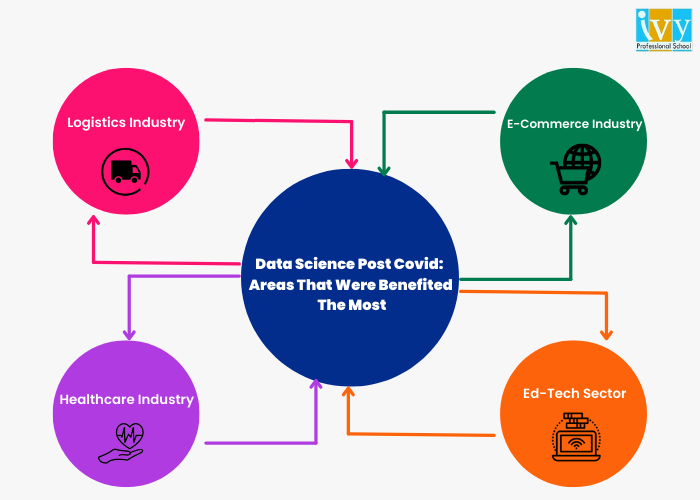
The key areas where data science has gained paramount importance post-Covid 19 are as follows.
The logistics industry went through a massive change post-Covid and Data Science has a significant role to play in it.
The AI model data helps companies understand different kinds of scenarios and limitations such as geographical restrictions that may be in effect due to rising Covid-19 cases.
Predictive analytics is a significant application of Data Science in healthcare. The predictive model examines and learns from historical data, identifying trends and making predictions based on them.
Individuals use the digital space in healthcare to explore better services and delivery because the risk of visiting a hospital during Covid-19 is very high. In healthcare, data science assists hospitals in identifying many symptom connections among a group of users on health portals. By creating records, hospitals can improve special care. They can also improve supply chain efficiency to improve patient outreach.
People used to go to malls to shop and eat at restaurants a few years ago. Customers began to shop from online platforms at their leisure after the Covid 19 outbreak, avoiding the risk of contracting the virus.
People are now able to purchase products of their choice from the comfort of their own homes, and artificial intelligence is presenting them with an experience akin to that of a physical visit. Customers of online shopping platforms receive a customized experience based on their data profiles.
The industry shifted most of the world into emergency remote learning settings after Covid-19 hit the world and led to the temporary closure of schools and educational institutes. Educational Institutions around the world shifted to video conferencing capabilities, online learning management software, and other digital alternatives.
The use of software and data science in the education industry to predict the use and effectiveness of delivery systems is still improving. Data science aids in determining the total impact of existing tools and software, as well as maximizing the use of technology to enhance the learning experience.
The effect of AI (Artificial Intelligence) on the economy and on our lives has been quite astonishing. There are countless instances and applications of AI. Expectations from AI are human-like and the artificial intelligence technologies are categorized into sense, comprehend, and act. The machine must perceive and sense the data via audio-visual processing. It must identify the pattern and evaluate the data as a pattern or context. AI must allow the machine to obtain potential insights that can support actions.
One of the prominent challenges in adopting AI is privacy. AI operates on a huge volume of confidential data. The data is seldom sensitive and personal. Unclear security, privacy, and ethical regulations formulate a plethora of challenges. In some nations, the General Data Protection Regulations (GDPR) act adds further obstacles to the adoption of AI. Along with that, AI requires highly trained and skilled professionals. Scarcity of awareness of the adoption of AI in businesses, technology, infrastructure, and research poses further issues. However, entities and businesses are aggressively adopting AI and aiming at diversifying it.
As a result, the post-COVID-19 age presents a chance for the next generation of data scientists. Data science post covid witnessed immense popularity and significance. However, data scientists must drastically improve their skills to advance to the next level. There are various opportunities to upskill and make a career in the field of Data Science. When it comes to Data Science, one institute that deserves a special mention is Ivy Pro School.
Since 2008, Ivy Professional School has continuously ranked among the top data science and analytics training institutions. Ivy has well-accomplished faculty with more than ten years of industry experience. It aims to provide specific learning experiences that organizations are looking for in their prospective data science candidates.
Team Jul 22, 2022 No Comments
How do you think you get product recommendations on an E-commerce site or how do you think taxi booking services monitor traffic conditions and adjust prices accordingly? The answer is “Data Science”. With technological advancements and growing changes in the world of business, Data has become of paramount importance to industries, corporate houses, and government sectors. This is where the science behind data comes in. Here is an easy data science guide for you.
In simple words, Data Science is the field of study that deals with huge volumes of data using new-age techniques and tools. It finds patterns and derives meaningful insights from the vast amount of unstructured data and helps businesses make informed decisions. The data that is analyzed comes from various sources and is presented in different kinds of formats. Data Science comprises various tools, machine learning principles, and algorithms that assist in discovering hidden patterns from the available raw data.
Earlier, the data that we had was mostly structured and very small in size and therefore it was easier and simpler to analyze it. In recent times, the data generated from various sources is mostly unstructured or semi-structured. This cannot be analyzed or processed with simple BI tools. To analyze and draw insights from these data obtained from text files, multimedia forms, financial logs, and instruments, more complex and advanced analytical tools are required. This is the reason why Data Science is gaining so much popularity these days.
The usability of data science is huge. It is used in almost all sectors and is given utmost importance. Especially, in post covid era, the use of data science has increased. This infographic will give you a gifted idea of the areas where data science is sued.
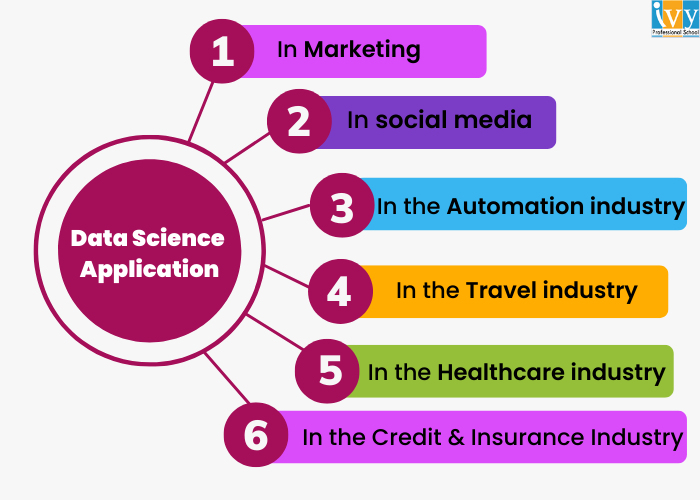
Let us now examine how Data Science is being used beneficially across multiple fields and sectors.
• In Marketing, Data Science is used for getting valuable customer insights, real-time interactions, customer segmentation, targeting, cross-selling, and predicting the lifetime value of a customer.
• In Sales, Data Science is used for future sales prediction, discount offers, etc.
• In social media, Data Science is used for measuring marketing performance KPIs, monitoring the effectiveness of campaigns, creating personalized ads, sentiment analysis, and much more.
• In the Automation industry, Data Science is used for self-driven cars.
• In the Travel industry, Data Science is applied to predicting flight delays and dynamic pricing.
• In the Healthcare industry, Data Science is applied for medication effectiveness and the prediction of diseases.
• In the Credit & Insurance Industry, Data Science detects fraud and risks and is also used for claims prediction.
In this data science guide, it is crucial that we look into the job profile of a data scientist. Data Scientists are those who crack complicated data issues along with the strong expertise in several scientific disciplines. They operate with various elements associated with mathematics, computer science, statistics, and many more. They make a lot of utilization of the latest technologies in finding solutions and attaining conclusions that are important for the development and growth of an organization. Data scientists offer the data in a much more effective and useful format in comparison to the raw data that is available to them in structured along with the unstructured forms. All data scientists should hold a data science degree.
The Data Science profession is challenging but fortunately, many tools make the job of Data Scientists easier. Some of the tools include MATLAB, Excel, SAS, Jupyter, Tableau, Cognos, R Studio, RAW, Azure ML studio, and much more. Owing to the increasing demand for the subject in the industry, there is a rising need for more and more professionals to have in-depth knowledge about Data Science. Data Science jobs are not only high paying but are also in demand. There are many definitions available for Data Scientists. A very common definition of Data Scientists is that they are people who know the art of Data Science. They crack complex problems with their knowledge and work with several elements like mathematics, computer science, statistics, etc. Data Scientists offer data in a useful way. Data Scientist experts are needed in every sector and tech company. They are highly educated and are in demand these days. The various Data Science job options are Data Scientist, Machine Learning Engineer, Machine Learning Scientist, Application Architect, Enterprise Architect, Data Engineer, Data Engineer, and much more.
The process of analyzing and acting upon data isn’t linear and the Data Science lifecycle flows in the following ways.
• Defining a project and its potential outputs.
• Exploring, pre-processing, and conditioning the data before modeling. Data Scientists need the right tools and access to the right data.
• In this phase, model planning is done where one needs to determine the techniques and methods to draw a relationship between two variables. Various common tools are used for model planning.
• In this phase, Data Scientists develop datasets for training and testing purposes. Various learning techniques are analyzed to build the model.
• In this phase, final reports, briefings, and technical documents are delivered. A pilot project is executed at this stage.
• In this phase, the results are communicated to the stakeholders.
There are many Data Science guide courses available that will help you build a successful career in the field of Data Science. However, it is very important to pursue the course from the right place. Ivy Professional School is the pioneer in Data Science and has committed to providing in-depth subject knowledge to the students to make them professionally competent. Ivy Pro School’s collaboration with NASSCOM will unlock great opportunities for Data Science candidates and help them build the career of their dreams. The Data Science course at Ivy Pro School includes high-demand tools like Python, R, Tableau, SQL, Adv Excel, VBA, etc. So if you are interested in building your skills in the field of Data Science, the best way to learn data science is with us. Hope this guide about data science for beginners helped you.
1. Can I self-learn data science?
One can learn data science on their own with online data science courses or also even from YouTube videos. There is no paucity of learning materials on the internet if one is working towards a career in this field. Having said that, self-learning lacks structure, and one might not know what crucial elements one is missing.
2. What is data science A Beginner’s Guide to data science?
In simple words, Data Science is the field of study that deals with huge volumes of data using new-age techniques and tools. It finds patterns and derives meaningful insights from the vast amount of unstructured data and helps businesses make informed decisions.
3. What are the basics needed for data science?
In Marketing, Data Science is used for getting valuable customer insights, real-time interactions, customer segmentation, targeting, cross-selling, and predicting the lifetime value of a customer.
Team Jul 20, 2022 No Comments

Data analytics is all about collecting and analyzing raw data to find valuable patterns and insights that answer questions or solve problems. This helps businesses make smart decisions, improve efficiency, increase customer satisfaction, and drive more revenue.
If you want to master data analytics, you must know the different types of data analytics employed in industries. So, in this post, we will discuss the four main data analytics types in detail with examples. You will understand what they are, how they differ from each other, and why they are important.
There are four main types of data analytics: descriptive, diagnostic, predictive, and prescriptive analytics. Each of them answers a certain question that helps businesses better understand the past, present, and future and take smart actions to achieve their goals. Let’s understand them in detail:
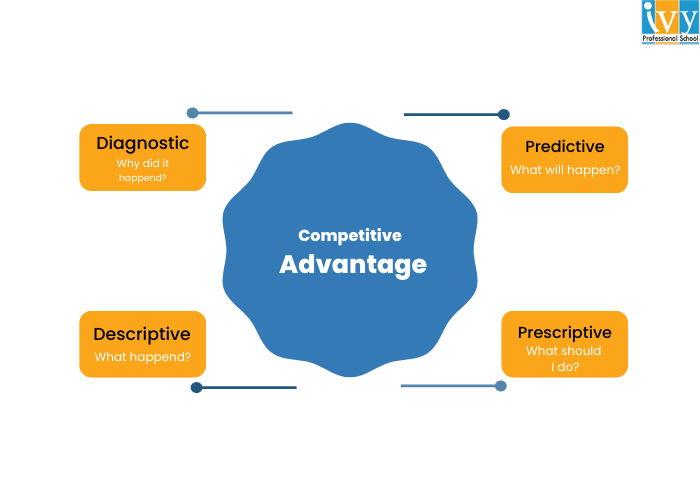
Descriptive analytics is the most basic type of data analytics currently used. It analyzes historical data to find out what has happened in the past or what is happening in the present.
It uses various techniques such as data aggregation, data mining, and reporting to spot patterns and trends over time. It may use arithmetic means to show an average of the values or frequency distribution to show how often a value occurs in the dataset.
Descriptive analytics uses visualization techniques like creating charts and graphs to visually represent complex data, making it easy to identify trends.
Examples of Descriptive Analytics
Let’s say you run an online store, and you want to know how much you sold in the last six months. So, you will use descriptive analytics to analyze monthly sales data and find peak sales periods and underperforming months. You can also identify top-selling products.
Similarly, businesses can use descriptive analytics to analyze:
Diagnostic analytics helps us go further than descriptive analytics. Now that we already know what has happened, diagnostic analytics helps us answer the valuable question, “Why did it happen?” That means we understand the cause of the trends and patterns we just found in the descriptive analytics.
You may use different methods like drill-down analysis, correlation analysis, Pareto analysis, fishbone diagram, hypothesis testing, etc., to effectively understand the cause of an event. This way, businesses can identify areas of improvement and make better strategies.
Examples of Diagnostic Analytics
Let’s say in the above sales report, you found that a particular month had significantly low sales. So, you use diagnostic analysis and find the cause: you had low product stock and couldn’t meet the customer demand effectively.
Similarly, businesses may use diagnostic analytics to find out:
When you know the problem and why it’s happening, you will be able to find effective solutions to make things better. Now, let’s move to our third type of data analytics:
Related: Data Scientist vs. Data Analyst
Now, we are getting into advanced analysis. Predictive analytics uses historical data, statistical models, and machine learning algorithms to figure out what may happen in the future. It can predict future events, trends, outcomes, and behaviors that may affect the business performance.
Techniques used in this type of data analytics can be time series analysis to identify patterns, regression analysis to identify relationships between variables, or decision trees to represent the decision-making process and predict outcomes. The idea is that once you know what will happen, you can better prepare for the challenges and get ready to take advantage of opportunities.
Examples of Predictive Analytics
Coming back to our online store example, let’s say you found that you had low sales because of an inventory shortage. Now you want to fix this problem. So, you may use predictive analytics to forecast the demand for various products. This way, you can have optimal inventory levels to meet the demand, avoiding inventory shortage as well as overstocking.
Predictive analytics can also be used to:
This is the most advanced type of data analysis that combines descriptive, diagnostic, and predictive analytics. It helps us find out what actions we should take to avoid an undesirable outcome or achieve a desirable outcome.
So, the goal of prescriptive analysis is to provide actionable recommendations. It may use techniques like optimization modeling to find the best solution with given constraints, simulation to evaluate different scenarios, or artificial intelligence techniques to automate decision-making processes.
Examples of Prescriptive Analytics
You used predictive analytics to find the demand forecasts. Now, prescriptive analytics goes further by recommending specific actions to achieve the maximum sales. It suggests how to optimize inventory based on predicted demand, supply chain factors, and business goals. You will also know how much inventory to order and when to order it.
You can also use prescriptive analytics to find actionable insights for these questions:
Now you know the four types of data analytics and how they depend on each other. The goal of data analytics is to help businesses identify areas for improvement, increase efficiency, and enhance processes. That’s why data analysts are in demand in the current industry.
If you want to be a data analyst, you can join Ivy Professional School’s Data Analytics Certification course. This is a live online program taught by industry professionals from IIT, IIM, and US universities. You will learn to use tools like Excel, SQL, Python, R, and Tableau with 50+ assignments, 30+ case studies, & 10+ industry projects. Visit this course page to learn more about it.

Eeshani Agrawal holds an MS in Civil Engineering from Texas A&M University (USA) and has over 16 years of experience in data visualization, storytelling, and analytics. She has consulted for top engineering, manufacturing, and consulting firms worldwide and has coached over 9,000 professionals and students from leading institutions like IITs, IIMs, and ISI.
Anubinda Oct 01, 2021 No Comments
In this blog, we will be covering the conversation of Eeshani Agarwal and Ruchika Saha, who bring us the second episode of the Learn to Visualize series where we are going to learn about Dashboard Actions. Eeshani Agarwal (Data Storyteller and Data Visualization Expert (Tableau, PowerBI, VBA, SQL, Excel). Coached 9,000
UsernamE Aug 15, 2021 No Comments
What is Tableau?
Tableau is a visual analytics platform that helps people and organizations to make the most of their data to solve business problems. Tableau was founded in 2003 which aimed at making machine learning, statistics, natural language, and smart data prep more useful to augment human creativity in analysis.
UsernamE Aug 15, 2021 No Comments What is R? R is a programming language that comes long back from 1995. Created by Ross Ihaka and Robert Gentleman at the Auckland University, New Zealand, R is an open-source language that extends its uses for statisticians and data scientists. They are the ones who create and develop applications based on statistics and Is it still worth studying R in 2021?