
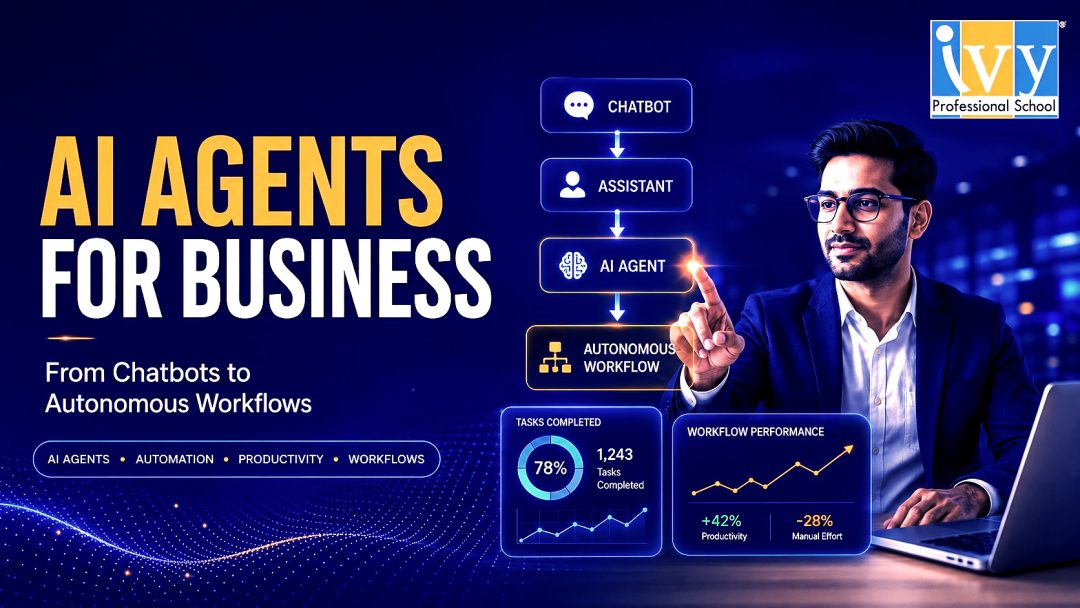
Artificial intelligence is moving from “answering questions” to “getting work done.” That shift is why ai agents for business are becoming one of the most important technology trends for modern companies. Earlier AI tools helped teams write emails, summarize documents, generate ideas, or analyze data when prompted. AI agents go further. They can understand a goal, break it into steps, use tools, interact with data, make decisions within defined limits, and complete tasks with less human effort.
For business leaders, this is not just another software upgrade. ai agents for business represent a new operating model where routine decisions, repetitive workflows, customer interactions, reporting cycles, and internal processes can be handled by intelligent digital workers. A well-designed AI agent does not merely provide information. It acts on information.
The opportunity is large, but the approach must be practical. Businesses should not deploy AI agents just because the technology is fashionable. They should identify high-friction processes, define measurable outcomes, set clear boundaries, and build agents that improve speed, accuracy, customer experience, or revenue. Used properly, ai agents for business can become a serious competitive advantage.
AI agents are software systems that can work toward a goal with a degree of autonomy. Unlike traditional automation, which usually follows fixed rules, AI agents can interpret context, plan the next action, call external tools, learn from feedback, and adapt to changing inputs.
For example, a normal chatbot may answer, “Your order is delayed.” An AI agent can check the order status, identify the delay reason, draft a customer response, create a support ticket, notify the logistics team, and update the CRM. That is the difference between conversation and execution.
This is why ai agents for business are different from basic chatbots or simple automation scripts. They can combine language understanding, reasoning, workflow automation, data access, and tool usage. Depending on how they are designed, they may work independently, assist employees, or collaborate with other agents.
A useful way to understand AI agents is through five capabilities: goal understanding, planning, tool usage, memory, and action. When these capabilities are applied to real workflows, ai agents for business can automate work that previously required human attention at every step.

The main reason businesses are adopting AI agents is simple: traditional automation is too rigid for modern work. Many business processes are semi-structured. They follow a pattern, but not perfectly. A sales lead may need qualification, but the criteria vary. A customer complaint may need routing, but the urgency depends on language, history, and context. A finance report may follow a template, but anomalies require explanation.
Rule-based automation struggles with this kind of work. Humans handle it because they can interpret messy information. AI agents now make it possible to automate parts of these judgment-heavy processes.
There are four strong drivers behind the rise of ai agents for business. First, companies need productivity without constantly adding headcount. Second, customers expect faster response times. Third, business data is scattered across emails, spreadsheets, CRMs, documents, dashboards, and chat platforms. Fourth, leaders want better decision-making, not just more dashboards.
The benefits of ai agents for business are strongest when they are connected to measurable business outcomes. The goal is not to “use AI.” The goal is to improve how work gets done.
AI agents can handle repetitive and time-consuming tasks such as data entry, email drafting, meeting summaries, follow-ups, ticket classification, report generation, invoice matching, and lead research. This frees employees to focus on judgment, relationships, strategy, and creativity.
In customer support, speed directly affects satisfaction. ai agents for business can classify queries, retrieve customer history, suggest solutions, create tickets, escalate urgent cases, and send personalized responses. This reduces waiting time and improves service consistency.
AI agents can monitor business data and alert teams when something requires attention. For example, an inventory agent can detect low stock, identify fast-moving products, forecast reorder requirements, and notify procurement. A finance agent can detect unusual expenses, compare budget variance, and prepare a management summary.
This is where ai agents for business become more valuable than dashboards. Dashboards show what happened. Agents can interpret what happened and recommend what to do next.
Customers increasingly expect personalization. AI agents can analyze customer preferences, purchase history, behavior, and support interactions to deliver more relevant communication. A marketing agent can segment audiences, personalize campaigns, and recommend offers.
When implemented well, ai agents for business can make digital interactions faster, more relevant, and more consistent.
Once a workflow is designed and tested, an agent can handle rising volume without the same linear increase in staffing. This is useful for businesses dealing with seasonal demand, campaign spikes, large customer bases, or rapid expansion.
However, scale should not mean uncontrolled autonomy. The best ai agents for business operate within clear governance, approval workflows, and audit trails.

The most successful AI agent deployments usually start with narrow, high-value use cases. Instead of trying to automate an entire department, businesses should begin with a specific workflow where time, cost, or delay is visible.
Sales teams can use AI agents to research prospects, score leads, draft personalized outreach, summarize calls, update CRM records, schedule follow-ups, and recommend next steps. A sales agent can review a prospect’s website, industry, company size, and previous interactions, then create a customized pitch.
For B2B companies, ai agents for business can improve lead qualification by checking whether a prospect matches the ideal customer profile. This helps teams avoid wasting time on low-intent leads.
Marketing teams can use AI agents for campaign planning, SEO research, content briefs, social media calendars, ad copy variations, customer segmentation, email personalization, and performance analysis. A marketing agent can identify which campaigns are underperforming, suggest changes, and prepare a weekly report.
Support agents can classify tickets, detect urgency, answer common questions, generate response drafts, escalate complex cases, and identify repeated complaints. In many businesses, support teams face the same questions repeatedly. AI agents can reduce this burden while still routing sensitive or complex cases to humans.
The best support use cases for ai agents for business include refund queries, order tracking, onboarding questions, troubleshooting, appointment rescheduling, and service status updates.
HR teams can use AI agents for resume screening, interview scheduling, onboarding checklists, employee query handling, policy explanations, training reminders, and performance review preparation. Finance teams can use AI agents for invoice processing, expense review, budget variance explanation, cash flow summaries, payment reminders, and compliance documentation.
These are practical areas for ai agents for business because HR and finance work often combines structured data with document-heavy processes.
Operations teams can use AI agents for inventory monitoring, vendor follow-ups, workflow coordination, quality checks, demand forecasting, and exception handling. For example, an operations agent can detect that a delivery is delayed, notify the customer service team, update the customer, and alert the logistics manager.
In manufacturing, logistics, education, healthcare, and retail, ai agents for business can reduce manual coordination and improve visibility.
Many people confuse AI agents with chatbots. The difference is important.
A chatbot mainly responds to user queries. It may answer questions, provide information, or guide users through a scripted flow. Traditional automation performs predefined tasks when specific conditions are met. An AI agent can combine understanding, reasoning, planning, and action.
For example:
A chatbot says: “You can find the invoice in your account.”
An automation says: “When invoice status is overdue, send reminder.”
An AI agent says: “This invoice is overdue, the client has a history of delayed payment, the amount is high, and the relationship manager should be notified before sending a strict reminder.”
This is why ai agents for business are more powerful than simple automation. They are better suited for workflows that require context and judgment.

The biggest mistake companies make is starting with technology instead of process. The right question is not “Which AI agent tool should we buy?” The right question is “Which business process is slow, repetitive, costly, or inconsistent?”
Look for workflows where employees repeatedly copy data, write similar messages, check multiple systems, create recurring reports, or make predictable decisions. Good starting points include lead qualification, support ticket handling, invoice review, employee onboarding, campaign reporting, and customer follow-ups.
The best first use case for ai agents for business should be specific, measurable, and low-risk.
Every agent should have a clear metric. Examples include reducing support response time, improving lead follow-up speed, reducing manual reporting hours, improving invoice processing accuracy, or increasing campaign output.
Without metrics, ai agents for business become experiments with no business accountability.
Document the current process. What triggers the task? What information is needed? Which systems are involved? What decisions are made? Where does human approval matter? What can go wrong? This workflow map becomes the blueprint for the AI agent.
Not every agent should act independently. Some agents should only recommend actions. Others can draft outputs but require approval. Some can execute low-risk tasks automatically.
Most companies should start with recommendation, drafting, or approval-based execution. This makes ai agents for business safer and easier to adopt.
AI agents become useful when they can access relevant data and systems. This may include CRM, ERP, helpdesk, email, calendar, spreadsheets, knowledge bases, analytics tools, and document repositories.
Poor data quality will limit results. Before deploying ai agents for business, companies should clean key datasets, standardize naming, improve documentation, and define access permissions.
Governance is not optional. AI agents need boundaries. Businesses should define what data the agent can access, what actions it can take, when approval is required, how outputs are reviewed, and how errors are logged.
For sensitive functions such as finance, HR, legal, healthcare, or customer complaints, ai agents for business must include human oversight.
Start with a pilot. Track performance, errors, adoption, time saved, user satisfaction, and business impact. Improve prompts, workflows, permissions, and escalation rules. Then scale to more processes.
The best approach is not a one-time AI project. It is continuous workflow improvement using AI agents.
The first mistake is automating a broken process. If a workflow is unclear, inconsistent, or politically messy, an AI agent will not magically fix it. Clean the process first.
The second mistake is giving too much autonomy too soon. Businesses should not allow agents to send sensitive emails, approve payments, change records, or make customer commitments without proper controls.
The third mistake is ignoring employees. If teams feel AI agents are being forced on them, adoption will suffer. Employees should be involved in designing workflows because they understand the real exceptions.
The fourth mistake is measuring only cost savings. ai agents for business can also improve speed, quality, customer experience, employee satisfaction, and decision-making.
AI agents create serious value, but they also create risk. Businesses must manage these risks from the beginning.
Data privacy is a major concern. Agents may access customer records, employee information, financial data, or confidential documents. Access should be role-based and limited.
Accuracy is another challenge. AI agents can misunderstand context, make wrong assumptions, or produce incorrect outputs. High-impact decisions need human review.
Security is also important. If agents can take actions in business systems, they need strong identity management, audit logs, and permission controls.
Brand risk matters too. A poorly governed customer-facing agent can send incorrect, insensitive, or legally risky communication.
The conclusion is clear: ai agents for business should be treated as digital team members, not casual tools. They need job descriptions, permissions, performance metrics, supervision, and improvement cycles.
The future of ai agents for business will not be limited to isolated assistants. Companies will move toward agentic workflows, where multiple agents coordinate across departments.
In the next phase, competitive advantage will come from how well a company designs its AI operating system. The winners will not be the companies with the most AI tools. The winners will be the companies that redesign processes around intelligent execution.
Small and mid-sized businesses do not need massive AI budgets to benefit. They should start with practical workflows.
For SMBs, the right way to adopt ai agents for business is to start with one painful process, build a controlled workflow, measure impact, and then expand.
No. Small and mid-sized companies can also use AI agents, especially for lead management, customer support, reporting, recruitment, finance operations, and internal knowledge management. The key is to start with a narrow workflow instead of trying to automate the entire business.
AI agents should not be viewed only as employee replacements. In most practical cases, they work as productivity multipliers. They handle repetitive steps, prepare drafts, retrieve information, and recommend actions. Humans still provide judgment, relationship management, creativity, and final accountability.
The best first use case is a repetitive workflow with clear inputs, clear outputs, measurable time savings, and low business risk. For many companies, this could be customer query handling, sales follow-up, invoice checking, report generation, or employee onboarding.
ai agents for business are not just another AI trend. They are a practical way to redesign how work happens. They can reduce manual effort, improve response time, support decision-making, personalize customer experience, and scale operations. But they must be implemented with discipline.
The best results come when companies treat AI agents as part of business process transformation. Start with a clear workflow. Define the outcome. Set boundaries. Keep humans in the loop where needed. Measure impact. Improve continuously.
Businesses that use AI only for content generation will get limited benefits. Businesses that use AI agents to execute workflows will create deeper operational advantage.
The central question for leaders is no longer “Should we use AI?” The better question is: “Which business workflows should become intelligent, automated, and agent-driven first?”
That is where ai agents for business become powerful. Not as a replacement for human intelligence, but as a force multiplier for teams that want to work faster, serve better, and scale smarter.

Leave a Reply