
Prateek Agrawal Aug 22, 2026 No Comments
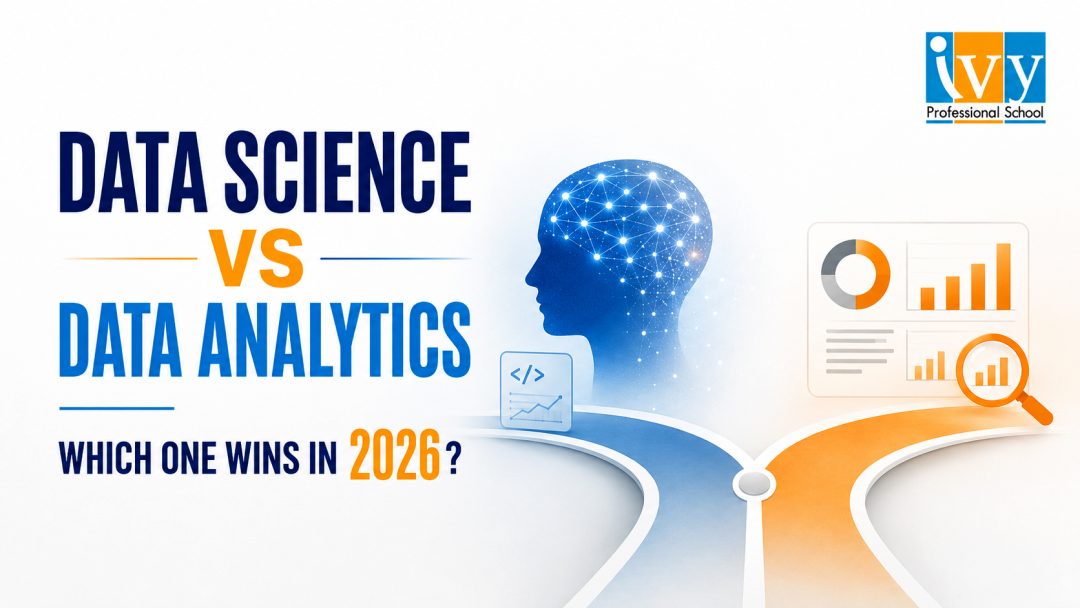
If you’re weighing your next career move, chances are you’ve typed some version of “data science vs data analytics 2026” into a search bar more than once. It’s one of the most common questions among students, working professionals, and career switchers trying to break into the data industry — and for good reason. Both fields are booming, both pay well, and both are often confused with one another. But they are not the same career path, and picking the wrong one for your goals, skills, and personality can cost you months of misdirected effort.
This guide breaks down the real differences between the two fields — the skills, tools, salaries, career trajectories, and day-to-day realities of each role — so you can make a confident, informed decision about which one suits you in the year ahead.
Data analytics is the practice of examining existing data to answer specific business questions. A data analyst looks backward and sideways — what happened, why did it happen, and what does it mean for the business right now? Analysts work heavily with dashboards, spreadsheets, SQL queries, and visualization tools like Power BI and Tableau to turn raw numbers into decisions marketing, sales, and operations teams can act on.
Typical data analyst responsibilities include:
Data analytics is often the more accessible entry point into the data world. The learning curve is gentler, the tools are more business-friendly, and the career transition — especially for commerce, business, or non-engineering graduates — tends to be faster. Many analysts also enjoy a shorter feedback loop: a dashboard built on Monday can influence a marketing decision by Friday, which makes the day-to-day work feel immediately tied to business outcomes rather than abstract experimentation.
Data science goes a step further. Instead of just interpreting what already happened, data scientists build predictive models that estimate what’s likely to happen next. This involves statistics, machine learning, and programming, along with a strong intuition for business context. A data scientist might build a model that predicts customer churn, forecasts demand, or powers a recommendation engine.
Typical data scientist responsibilities include:
Where analytics is about interpreting the past, data science is about predicting and shaping the future. That extra layer of complexity is exactly why so many learners struggle to tell the two roles apart — on the surface they look similar, but underneath they demand very different skill sets, tools, and ways of thinking about problems.

Let’s lay out the head-to-head comparison that defines this landscape heading into the new year.
| Aspect | Data Analytics | Data Science |
| Core focus | Descriptive & diagnostic (“what happened”) | Predictive & prescriptive (“what will happen”) |
| Key tools | SQL, Excel, Power BI, Tableau | Python, R, TensorFlow, Scikit-learn |
| Math depth | Basic statistics | Advanced statistics, probability, linear algebra |
| Coding requirement | Light to moderate | Heavy, production-grade code |
| Typical output | Dashboards, reports | ML models, predictive systems |
| Entry difficulty | Easier for beginners | Steeper learning curve |
| Career ceiling | Analytics Manager, BI Lead | Data Science Lead, ML Engineer, AI Architect |
This table is the fastest way to visualize the decision, but numbers on a page don’t tell you which path actually fits your temperament, background, or long-term ambitions. Let’s go deeper.
To succeed as a data analyst in 2026, you’ll want to build proficiency in:
To succeed as a data scientist in 2026, the bar is higher and more technical:
This is where the data science vs data analytics 2026 gap becomes most obvious: analytics rewards business fluency and tool proficiency, while data science demands genuine engineering and mathematical depth.

Compensation is one of the biggest deciding factors for most career switchers, and it’s a major part of any honest comparison between these two fields. Numbers shift year to year as demand fluctuates, but the general gap between the two roles has held steady for the past several hiring cycles, and 2026 is no exception.
Data Analyst salaries (India, 2026 estimates):
Data Scientist salaries (India, 2026 estimates):
Data science roles generally command a salary premium because of the technical depth and business impact of predictive modeling. That said, experienced analysts who specialize — particularly in domains like fintech, healthcare, or supply chain — can close much of that gap, and senior analysts with strong SQL, dashboarding, and stakeholder-management skills are rarely short of opportunities. Salary isn’t the only factor to weigh here, but it’s a meaningful one, especially for career switchers trying to calculate the return on investment of several months of upskilling before they commit their time and money.
A common misconception among students comparing these two careers is that one path is strictly “better” than the other. In reality, they lead to different destinations, and the “better” choice is entirely a function of what kind of work you actually enjoy doing every day:
Data Analytics career path: Data Analyst → Senior Analyst → Analytics Manager → BI Lead / Head of Analytics. Many analysts also pivot laterally into product management, growth, or operations roles, since the business-facing skills translate well.
Data Science career path: Data Scientist → Senior Data Scientist → ML Engineer / AI Specialist → Data Science Lead → Chief Data Officer. Data scientists with strong engineering chops can also transition into MLOps, AI product development, or research-oriented roles.
Notably, in 2026, the boundary between the two paths is getting blurrier. Many analytics roles now expect basic Python and even light machine learning knowledge, while many data science teams rely on analysts to handle the exploratory groundwork before a model gets built. Understanding this convergence is essential to making a smart decision about which career to pursue — the “pure” versions of either role are becoming rarer, and hybrid skill sets are increasingly the norm across hiring listings, job descriptions, and internal role definitions at both startups and large enterprises.

The industries hiring for these roles overlap heavily, but the specific job titles and day-to-day expectations shift depending on the sector.
Industries that lean heavily on data analysts:
Industries that lean heavily on data scientists:
Almost every industry now employs both roles side by side, often on the same team. A retail company, for instance, might have analysts monitoring daily sales dashboards while data scientists build the demand-forecasting model those dashboards eventually feed into. Rather than competing career tracks, the two roles frequently function as two halves of the same data pipeline — which is worth keeping in mind if you’re choosing based purely on “which field is more in demand,” since the honest answer is: both are, in nearly every sector.
There’s no universal right answer to this question — the right path depends on your background, strengths, and goals. Here’s a practical way to decide.
Choose Data Analytics if you:
Choose Data Science if you:
If you’re still unsure, a good rule of thumb: start with data analytics fundamentals — SQL, Excel, visualization — since these skills are foundational to both paths anyway. Once you have that base, you can decide whether to specialize further into analytics or level up into data science with Python, statistics, and machine learning.
No comparison of these two careers would be complete without addressing generative AI’s impact on both roles. GenAI tools are now assisting analysts with writing SQL queries, generating dashboard summaries, and automating repetitive reporting tasks — effectively raising the productivity bar for entry-level analysts. On the data science side, GenAI is changing how models get built entirely, with teams increasingly fine-tuning large language models, building retrieval-augmented generation (RAG) systems, and integrating AI agents into existing data pipelines.
This means that regardless of which side of the divide you choose, a working understanding of generative AI is quickly becoming a baseline expectation rather than a nice-to-have. Professionals who ignore this shift risk falling behind peers who actively upskill in GenAI alongside their core analytics or data science training.
Making the right call in this career debate is only half the battle — the other half is getting trained by people who actually understand where the industry is heading. Ivy Pro School is an 18-year-old institute with IIT Guwahati E&ICT Academy certification, partnerships with NASSCOM and IBM, and a track record of 37,500+ alumni placed through 500+ hiring partners. With a Pay After Placement model, you don’t pay full fees until you’re actually employed — which keeps the incentive structure aligned with your success, not just enrollment numbers.
Whether you’re leaning toward analytics or data science, Ivy Pro School offers two standout ways to start exploring hands-on, right now:
🎓 FREE Live Gen AI Session — Experience two full classes before you commit. If the GenAI angle of this comparison caught your attention, this is the easiest way to see what building with generative AI actually feels like, with zero upfront cost for the trial classes.
🎓 AI for Entrepreneurs Course with Prateek Agrawal — Built for professionals who want to apply AI and data skills directly to business growth, rather than purely technical roles. If your interest in data science or analytics is really about making smarter business decisions, this course bridges that gap directly.
Both programs are backed by Ivy Pro School’s Pay After Placement model, and a proven placement network — so you’re not just learning in a vacuum, you’re building toward an actual outcome.
Is data science better than data analytics in 2026?
Neither is objectively “better” — data science typically offers a higher salary ceiling and more technical depth, while data analytics offers a faster entry point and strong business-facing career growth. The right choice depends on your skills and goals.
Can I switch from data analytics to data science later?
Yes. Many professionals start as data analysts, build strong SQL and business analysis foundations, and later transition into data science by learning Python, statistics, and machine learning. This is one of the most common — and practical — paths in the industry.
Do I need a coding background for data analytics?
Not necessarily. Data analytics is more accessible to non-technical professionals, since much of the work involves SQL, Excel, and visualization tools rather than heavy programming.
Is data science harder to learn than data analytics?
Generally, yes. Data science requires a stronger foundation in statistics, programming, and machine learning, making the learning curve steeper compared to data analytics.
Which pays more, data science or data analytics, in 2026?
On average, data science roles pay more due to their technical complexity and direct impact on predictive business outcomes. However, experienced, specialized analysts can still command competitive salaries.
How long does it take to become job-ready in either field?
With focused training, most learners can become job-ready in data analytics within 4–6 months, while data science typically requires 6–12 months given its steeper technical requirements.
Do I need a degree in computer science or statistics to enter either field?
No. Both fields are increasingly skills-based rather than degree-based. Bootcamps, certification programs, and portfolio projects are widely accepted by employers as proof of capability, particularly for analytics roles and entry-level data science positions.
The data science vs data analytics 2026 decision ultimately comes down to how you want to work with data — interpreting the past and guiding present-day decisions, or building systems that predict and shape the future. Both careers are in high demand, both are being reshaped by generative AI, and both offer real, well-paying career paths for people willing to put in the work. Start with your strengths, be honest about how much technical depth you’re willing to build, and choose the path that keeps you motivated to keep learning — because in this industry, the learning never really stops.