
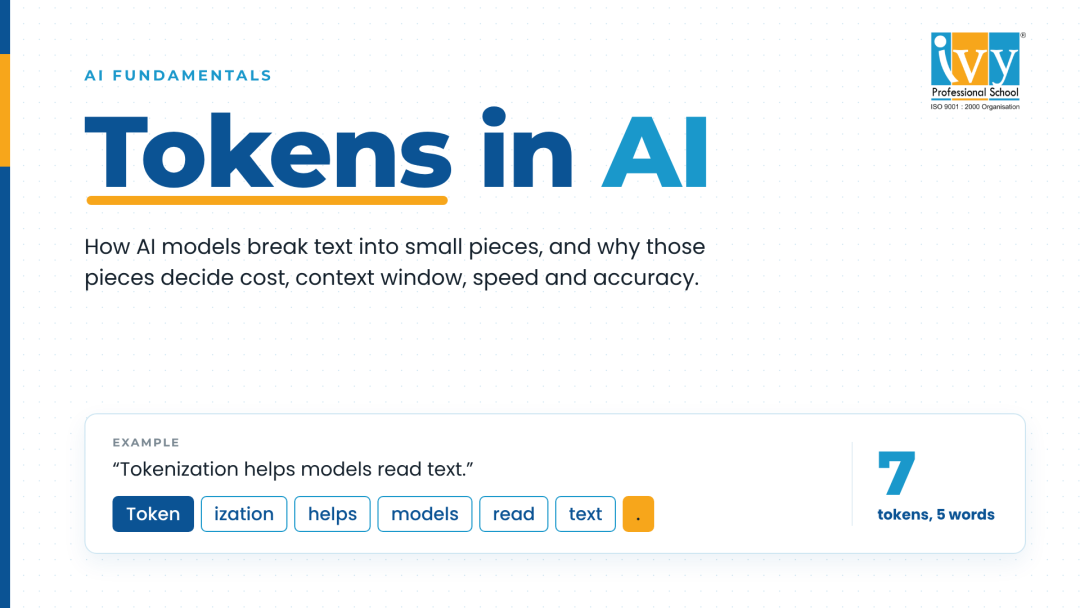
Every time you type a question into an AI chatbot, the model does not read your words the way you do. It first breaks your text into small pieces called tokens. These tokens are the basic units of language that an AI model processes, and they can be whole words, parts of words, or single characters. Understanding tokens in AI is the quickest way to understand how large language models read, write, charge you money, and sometimes make odd mistakes.
If you have used ChatGPT, Claude or Gemini, you have already met tokens, even if you did not notice. Tokens decide how long your prompt can be, how long the answer can run, how much an API call costs, and how fast the reply arrives. Tokenization, the process of splitting text into tokens, is the first step in every language model pipeline. Nothing else in the model works until the tokenizer has done its job.
This guide explains tokens in AI in plain language. You will learn what a token is, how a tokenizer works, how word, sub-word and character tokens differ, why AI tokens affect cost and context, and how tokenization behaves for Indian languages. We also cover practical ways to use fewer tokens. No coding background is needed, though a short Python example is included for those who want to try it.
A token is the smallest unit of text that a language model reads or produces. Computers work with numbers, not letters, so a model cannot process the sentence “Data science is fun” directly. The text is first split into tokens, and each token is then mapped to a number called a token ID. The model works only with those IDs.
A token can be a full word such as “data”, a part of a word such as “ization” in “tokenization”, a single character, or even a space or punctuation mark. The split depends on the tokenizer, which is the program that decides where to cut the text. Different models use different tokenizers, so the same sentence can produce different token counts in different systems.
For English text, a common rule of thumb is that one token is about four characters, or about three quarters of a word. So 100 tokens are roughly 75 English words. This is only an estimate. Code, numbers and non-English languages often behave differently.
Think of tokens as the vocabulary of the model. Each model has a fixed list of tokens it knows, usually from tens of thousands to a few lakh entries. Everything you write is rebuilt from that list, much as any English word can be built from 26 letters, except that the building blocks of AI tokens are larger and carry more meaning than single letters.
It helps to separate three ideas. A token is a piece of text. A token ID is the number assigned to that piece. An embedding is the list of numbers the model learns for each token to capture its meaning. Tokens in AI are therefore the doorway between human language and the mathematics inside the model.
Tokenization is the process of converting raw text into a sequence of tokens and then into token IDs. The usual flow has five steps:
A language model generates its answer one token at a time. When a chatbot reply appears gradually on screen, you are watching it predict token after token. Each new token is added to the sequence, and the model then predicts the one that follows.
Tokenizers broadly follow three approaches. Each one trades vocabulary size against sequence length.
Word-level tokens. Here every word is one token, so “I love data science” becomes four tokens. This is simple and easy to read, but it has a serious weakness. The vocabulary must hold every word the model might meet, including plurals, tenses, names, spelling mistakes and new words. Any word missing from the list becomes an “unknown” token, and its meaning is lost. Word-level tokenization also leads to very large vocabularies.
Character-level tokens. Here every character is a token. The vocabulary is tiny, since it needs only letters, digits and symbols, and no word is ever unknown. The cost is length. A 500-word paragraph turns into thousands of tokens, which makes the model slower and makes it harder to learn relations between distant parts of the text. Character tokens also carry little meaning on their own, since the letter “t” says almost nothing.
Sub-word tokens. Sub-word tokenization sits in the middle and is used by almost all modern large language models. Common words stay whole, while rare words are broken into meaningful pieces. The word “unhappiness” might become “un”, “happi” and “ness”. A new word the model has never seen can still be built from known pieces, so there is no unknown-word problem, and the token sequences stay reasonably short.

Most sub-word tokenizers learn their vocabulary of tokens from a large body of text before the model is trained. Three methods are worth knowing.
Byte Pair Encoding (BPE). BPE starts with single characters and repeatedly merges the pair that appears most often together. If “t” and “h” appear side by side very often, they merge into “th”. Later “th” and “e” may merge into “the”. The process continues until the vocabulary reaches a target size, such as 50,000 tokens. The GPT family of models uses a byte-level form of BPE, which can represent any text, including emoji and rare scripts, without an unknown token.
WordPiece. WordPiece is similar to BPE but chooses merges by which pair most improves the likelihood of the training data, not only by raw frequency. It was popularised by BERT. Pieces that continue a word carry a prefix such as “##”, so “playing” may appear as “play” and “##ing”.
SentencePiece. SentencePiece treats the text as a raw stream of characters, including spaces, and does not need the text to be split into words first. This makes it useful for languages that do not separate words with spaces. It supports BPE and another approach called the Unigram model, and many multilingual models use it.
The main point for a practitioner is simple. All these methods produce a fixed vocabulary of tokens that is frozen before training. The model can never use a token that is not in its vocabulary, so the choice of tokenizer affects what the model handles well. Changing the tokenizer later normally means retraining the model, which is why the tokenizer is chosen carefully at the start.
Tokens are not just a technical detail. They affect four things every user and business cares about.
Cost. Most AI providers charge by the token through their API, with separate rates for input tokens (your prompt) and output tokens (the model’s reply). A longer prompt or a longer answer costs more. For a company running thousands of requests a day, a small saving in tokens per request adds up to a large difference in the monthly bill. When you plan an AI project, estimating tokens per request is a basic part of the budget.
Context window. Every model has a context window, which is the maximum number of tokens it can consider at one time. This limit covers your prompt, any documents you paste, the conversation history and the reply. If the total goes beyond the limit, older content is dropped or the request fails. This is why a model can seem to forget the start of a very long chat. A large context window simply means the model can hold more tokens in view at once.
Speed. The model produces output one token at a time, so a longer reply takes longer. Long inputs also take more time to process. Keeping token counts sensible makes an application feel faster.
Accuracy. Tokenization explains some strange model mistakes. Models see tokens, not letters. Asking a model to count the letters in a word, reverse a string or do careful arithmetic can go wrong because the text was split into pieces that hide the individual characters. A number such as 12345 may be cut at an arbitrary point, which makes digit-level arithmetic harder. These are limits of tokens in AI, not signs that the model is careless.

For learners and companies in India, tokenization has a practical side that is often missed. Most popular tokenizers were built mainly on English text, so they split English efficiently. Text in Hindi, Bengali, Tamil, Telugu and other Indian languages is often broken into many more tokens for the same meaning. A Hindi sentence can need noticeably more tokens than its English translation, and in some cases several times more, depending on the tokenizer.
There are two reasons. First, the text used to build these tokenizers contained far less Indian language content, so fewer common word pieces from these scripts entered the vocabulary. Second, scripts such as Devanagari use combined characters and marks, and when the vocabulary lacks these pieces, the tokenizer falls back to byte-level tokens, which are very small.
The result is higher cost, because you pay per token, and a smaller effective context window, because the same document uses up more of the limit. It can also mean slower responses.
This matters when you build chatbots or document tools for Indian users. Before choosing a model, test your own sample text in Hindi or your target language and compare token counts across tokenizers. Some newer models have improved their vocabularies for Indian languages, so the gap is narrowing, but measure rather than assume. A simple test with a hundred real customer messages will give you a reliable estimate of tokens per request and therefore of cost.
You do not need to be an engineer to save tokens. These habits help whether you use a chatbot or build with an API.
Saving tokens should never cost you clarity. If a shorter prompt gives a vague answer, you will spend more tokens on follow-up questions. The aim is a prompt that is as short as it can be while still complete.
“One token equals one word.” Not true. In English, a token is often shorter than a word, and some words use several tokens. The rule of about three quarters of a word per token is only an average.
“Tokens are the same in every model.” No. Each model family has its own tokenizer and vocabulary, so token counts for the same text differ across models. A count from one tool may not apply to another.
“Spaces and punctuation are free.” They are not. Spaces, commas, line breaks and symbols usually become part of tokens, and they count towards your limit and your bill.
“Tokenization is the same as understanding.” Tokenization only prepares the text. Meaning is learned later, when the model turns each token into an embedding and processes it through its layers.
Tokens in AI are the basic units that connect human language to machine learning. A tokenizer splits your text into words, sub-words or characters, converts them into token IDs, and the model reads and writes one token at a time. Sub-word tokenization, using methods such as BPE, WordPiece and SentencePiece, is the standard because it balances vocabulary size, sequence length and meaning.
For anyone working with generative AI, tokens decide cost, context length and speed. They also explain why models sometimes fail at letter counting or arithmetic, and why Indian language text can cost more to process. Learning to estimate and control AI tokens is a small skill that pays off in every project.
If you are building a career in AI, understanding tokenization is a good foundation before you move on to embeddings, transformers and retrieval-augmented generation. Ivy Professional School has trained learners in data science and AI since 2008, and the same step-by-step approach to fundamentals runs through our programs. Explore our generative AI course to go deeper into how large language models work.


Leave a Reply