
Table of Contents
Add a header to begin generating the table of contents
Data engineer or data scientist? It is one of the most common questions beginners ask before entering data careers, and the answer decides which skills you learn, which jobs you apply for and how your first few years unfold. This guide compares both roles in plain language and then shows you how to choose the best data engineering course with placement if you decide the engineering path suits you. By the end, you will know what each professional does, how the careers differ and what to check before you enrol.
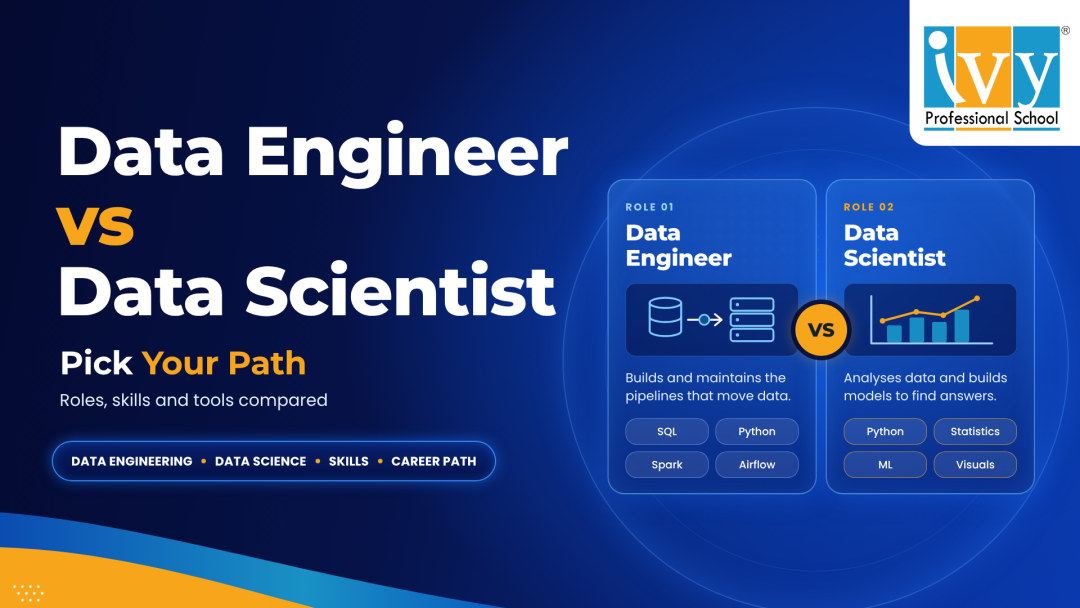
A data engineer builds the systems that collect, move, clean and store data. A data scientist uses that data to find patterns, build models and answer business questions. Think of a restaurant. The data engineer runs the supply chain and the kitchen so that fresh, organised ingredients arrive on time. The data scientist is the chef who creates new dishes from them. Neither can work well without the other.
In practice, the difference shows in the output. A data engineer delivers reliable pipelines, warehouses and datasets that other people can trust. A data scientist delivers insights, predictions and models, such as a customer churn predictor or a recommendation engine. Many learners compare the two roles before searching for the best data engineering course with placement, so it helps to understand each job properly first.
Data engineers design, build and maintain the infrastructure that makes data usable. Their typical responsibilities include:
A typical day involves writing Python and SQL, debugging a failed job, optimising a slow query or reviewing a teammate’s code. The role suits people who enjoy building systems, solving reliability problems and seeing their work run quietly in the background of a business.
The core toolkit includes Python, SQL, Spark, Airflow, Kafka, cloud platforms such as AWS, Azure or Google Cloud, warehouses such as Snowflake or BigQuery, and Git. Anyone choosing this path should look for the best data engineering course with placement that teaches these tools through hands-on projects, not just slides.

Data scientists analyse data to support decisions and build predictive models. Their typical responsibilities include:
Their toolkit includes Python, SQL, Pandas, scikit-learn, statistics, visualisation tools such as Tableau, Power BI or Matplotlib, and notebooks. Advanced roles add deep learning frameworks.
The role suits people who are curious, comfortable with mathematics and enjoy telling stories with data. Choosing between the two careers does not mean ignoring the other side, though. Even the best data engineering course with placement should expose you to machine learning basics so that you understand what your downstream users need.
| Aspect | Data Engineer | Data Scientist |
| Primary goal | Reliable, scalable data systems | Insights and predictive models |
| Main output | Pipelines, warehouses, clean datasets | Models, analyses, reports |
| Core skills | Python, SQL, Spark, Airflow, cloud | Python, statistics, ML, visualisation |
| Mindset | Engineering, reliability, scale | Analytical, experimental, exploratory |
| Works closest with | Software engineers, analysts, scientists | Business teams, product managers, engineers |
| Common starting point | IT, software, SQL or analytics background | Statistics, maths or analytics background |
| Typical tools | Spark, Airflow, Kafka, Snowflake | scikit-learn, Pandas, Jupyter, TensorFlow |
The table shows two complementary careers, not rival ones. If the left column describes the work you would enjoy, the best data engineering course with placement is a logical next step. If the right column excites you more, a data science programme fits better.
Both roles share a foundation: Python, SQL, cloud basics, Git and clear communication. Past that point, they diverge. Data engineers go deeper into data modelling, distributed processing, orchestration and system design. Data scientists go deeper into statistics, machine learning, experiment design and storytelling.
Knowing a little about the other side makes you a stronger teammate. A data engineer who understands what a model needs builds better feature pipelines. A data scientist who understands pipelines writes code that survives in production instead of staying stuck in a notebook. That is why the best data engineering course with placement often includes a short module on machine learning workflows, and why good data science courses include SQL and deployment basics.

Every analytics and AI project depends on dependable data. Companies have learned, often painfully, that a clever model built on messy data fails in production. As a result, demand for people who can build and maintain data foundations keeps growing. The rise of generative AI adds to this, because applications that use retrieval-augmented generation need ingestion pipelines, embeddings and vector databases, all of which are data engineering work.
Data science remains a respected path, but entry-level competition is intense because so many learners choose it. Employers increasingly look for candidates who can show production-ready skills, not only notebook experience. This is one reason many professionals now search for the best data engineering course with placement instead of a general data science programme.
Growth paths look like this:
Pay and progression depend on skills, company, city and experience, not on the job title alone, so be wary of anyone promising a particular salary.
Use these pointers to decide:
There is no wrong answer, only a better fit for your temperament and goals.

Once you lean towards engineering, judge every programme on five factors.
Placement is the most misused word in education marketing. When you compare options for the best data engineering course with placement, ask these questions directly:
No institute can guarantee a job. Even the best data engineering course with placement can only prepare you thoroughly, open doors and support you until you convert an opportunity. Your effort on projects and interview practice remains the biggest variable.
Enrolling is only the beginning. Use a structure like this to get the most from any strong programme.
Months 1-2: Foundations. Master Python and SQL. Practise daily on real datasets and learn data modelling basics such as star schemas and normalisation.
Months 3-4: Core engineering. Learn Spark, Airflow and one major cloud platform. Build at least two end-to-end pipelines and document them on GitHub with a clear README.
Month 5: Specialise. Add streaming with Kafka or explore generative AI basics such as embeddings and retrieval-augmented generation. Extend one pipeline so it feeds a simple AI application.
Month 6: Job preparation. Polish your resume and LinkedIn profile, practise mock interviews and revise SQL and system design questions. Apply consistently instead of waiting to feel perfectly ready.
Learners who follow a plan like this walk into interviews with stronger stories to tell. The best data engineering course with placement gives you the framework, but your consistency decides the result.
Ivy Professional School in Kolkata has been training learners for 18 years and runs programmes in Data Science, Data Analytics, Data Engineering, Generative AI and AI, with a presence in Bangalore and Delhi as well. For learners looking for the best data engineering course with placement, a few facts are worth checking against the criteria above:
Treat these as claims to verify, like any others. Visit ivyproschool.com, review the current syllabus and placement terms, speak to counsellors and ask to connect with alumni. That is how you test whether Ivy is the best data engineering course with placement for your goals instead of relying on an article.
Ivy also offers a Data Science programme, so you can compare both career paths under one roof and ask counsellors which one matches your background. The best data engineering course with placement for one learner may differ from another’s, depending on experience and ambition.
Myth: Data scientists always earn more. Pay depends on skills, employer, city and experience. Strong data engineers are valued highly because their work keeps every data project running.
Myth: Data engineering is just plumbing. It involves system design, performance tuning, cost control and, increasingly, supporting AI applications at scale.
Myth: You need a mathematics degree for either path. Data science needs comfort with statistics, and data engineering needs strong logic and coding, but both can be learned step by step.
Myth: You must already be a software engineer. The best data engineering course with placement starts from fundamentals and builds your skills through guided projects.
Myth: Data science is dying. It is evolving. Routine tasks are getting automated, while problem framing, experimentation and communication stay valuable.
Is a data engineer better than a data scientist? Neither is better. They solve different problems. For learners who want a job-focused path with strong demand, the best data engineering course with placement is an excellent starting point, while those drawn to statistics and modelling may prefer data science.
What is the best data engineering course with placement? The best data engineering course with placement combines a deep, project-based curriculum, live mentorship, a recognised certification and transparent placement support. Compare syllabus, projects, alumni outcomes and fee terms before you decide.
Can a data scientist become a data engineer? Yes. Data scientists already know Python and SQL, so they mainly need to learn pipelines, orchestration, distributed processing and cloud platforms. A structured programme speeds this transition.
Do data engineers need machine learning? Not deeply, but understanding machine learning workflows helps you build better pipelines and collaborate with data scientists.
How long does it take to become job-ready? Most learners need around six to nine months of consistent effort, depending on prior experience and time available. Projects and interview practice matter as much as finishing lectures.
Does Pay After Placement mean the course is free until I get a job? Not necessarily. Terms differ between institutes, so confirm what you pay upfront, what you pay later and under which conditions.
How do I know if the best data engineering course with placement claims are genuine? Ask for named hiring partners, speak to alumni, read the placement terms in writing and check whether the institute explains what happens if you are not placed. Genuine providers answer these questions openly.
The data engineer vs data scientist debate has no universal winner. Data scientists turn data into insight, and data engineers make that data available, trustworthy and ready to use. If you enjoy building systems and want a career that sits at the centre of analytics and AI, data engineering deserves serious attention.
That is why choosing the best data engineering course with placement is one of the smartest decisions you can make this year. Look for depth, projects, mentorship, credible certification and placement you can verify, then pair that with consistent practice.
If you are ready to explore, visit ivyproschool.com, compare the Data Engineering and Data Science courses, and book a counselling session to find the best data engineering course with placement for your career stage. Your first pipeline is closer than you think.


Leave a Reply