
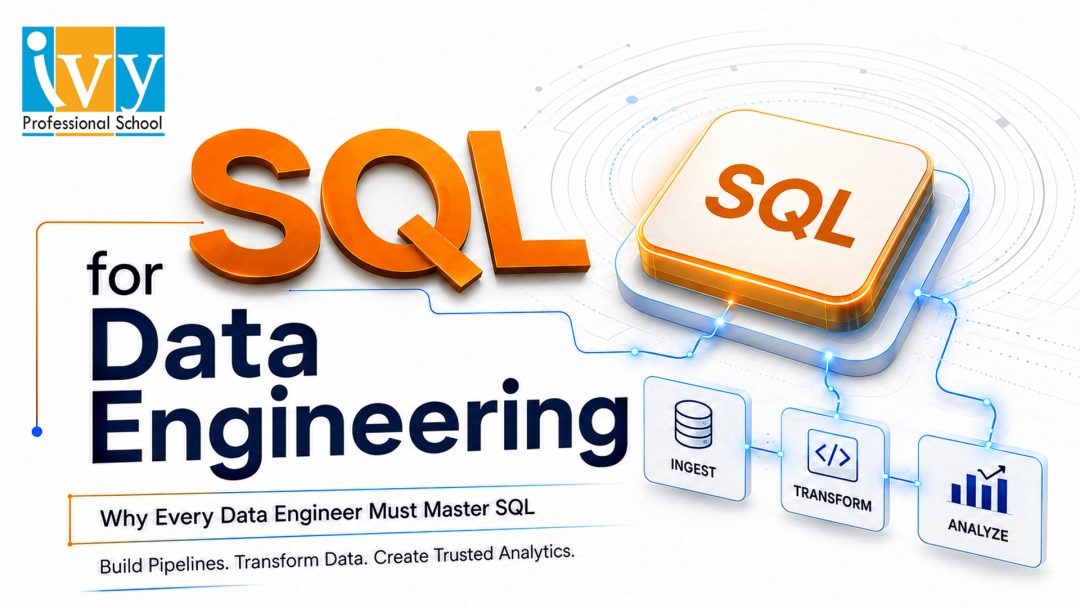
Data engineering has become one of the most important career paths in the modern data economy. Every organization now depends on data from applications, websites, CRMs, ERPs, payment platforms, marketing systems, IoT devices, and customer touchpoints. But raw data is rarely ready for business use. It must be extracted, cleaned, transformed, validated, modeled, and delivered in a reliable form. This is where SQL becomes essential.
SQL for Data Engineering is not just about writing basic queries. It is about building the logic that powers data pipelines, data warehouses, analytics dashboards, reporting systems, and machine learning datasets. While tools such as Python, Spark, Airflow, dbt, Snowflake, BigQuery, Redshift, and Databricks are widely used in the data ecosystem, SQL remains the common language across most platforms.
For any aspiring data engineer, SQL for Data Engineering should be treated as a foundation skill. It helps professionals understand source systems, transform data at scale, test data quality, and create trusted datasets for decision-making. A data engineer who is strong in SQL can debug faster, collaborate better, and build pipelines that are easier to maintain.
This is why professional learning institutes such as Ivy Professional School emphasize practical SQL training as part of data analytics, data science, AI, and data engineering learning paths. For students and working professionals, SQL for Data Engineering creates a clear bridge between classroom learning and production data work. Tools may change, but the ability to reason with structured data remains central.
For beginners, SQL often means selecting rows from a table. For data engineers, SQL has a much larger role.
SQL for Data Engineering means using SQL to move data from raw systems to business-ready datasets. It includes extracting records, joining tables, cleaning fields, standardizing formats, creating derived columns, aggregating data, validating outputs, and preparing tables for downstream users.
A data engineer does not only ask, “Can I get the answer?” The real question is, “Can this logic run every day, at scale, without breaking and without producing incorrect numbers?” This mindset is what makes SQL an engineering skill.
For example, a reporting query may calculate last month’s revenue once. A data engineering query may build a reusable revenue table that updates daily, handles refunds, excludes test transactions, adjusts for time zones, and supports dashboards across the company. That is the practical difference. SQL for Data Engineering is therefore about repeatable, governed, and business-aligned transformation logic.
Some professionals assume SQL may become less important because data engineering now includes Python, Spark, APIs, orchestration tools, and AI-assisted development. In reality, SQL has become more important because modern platforms have adopted SQL deeply.
SQL for Data Engineering works across relational databases, cloud data warehouses, and lakehouse platforms. Analysts use SQL. BI tools generate SQL. Data scientists use SQL to prepare datasets. Transformation frameworks often rely on SQL. Even distributed processing engines support SQL-style logic.
This matters because SQL is readable and declarative. Instead of writing every processing step manually, engineers can describe the result they want, and the database or processing engine decides how to execute it. That makes SQL ideal for transformations, metric definitions, and audit-friendly logic.
In production environments, readability is not cosmetic. Data pipelines are business infrastructure. Multiple people need to understand them, review them, modify them, and trust them.

ETL stands for Extract, Transform, Load. ELT stands for Extract, Load, Transform. Both are central to data engineering, and both depend heavily on SQL.
SQL for Data Engineering is used to clean raw tables, standardize data formats, join multiple sources, create staging layers, build intermediate tables, and publish final analytics-ready datasets. In modern cloud environments, ELT has become especially common because warehouses and lakehouses can handle large-scale transformations after data is loaded.
Consider a simple sales pipeline. Raw orders may arrive from an application database. Payment records may come from a payment gateway. Customer details may come from a CRM. Product details may come from an ERP. SQL can connect these datasets, remove invalid rows, calculate net revenue, map product categories, and produce a clean sales table.
This transformation logic runs repeatedly. It must be stable, accurate, and efficient. That is why SQL for Data Engineering requires more than syntax. It requires pipeline thinking.
At Ivy Professional School, learners are often trained to work with practical datasets because real-world data is rarely clean. It contains missing values, duplicate records, inconsistent formats, and changing business rules.
Every reliable data pipeline begins with source system understanding. Before building a pipeline, a data engineer must know where the data comes from, what each table represents, and how business processes are captured.
SQL for Data Engineering allows engineers to inspect source systems directly. They can check row counts, primary keys, foreign key relationships, date ranges, null values, duplicate records, and unusual category values. This prevents wrong assumptions from entering the pipeline.
For example, in an e-commerce system, one order may have multiple payment attempts, multiple shipments, partial refunds, cancelled items, and discount adjustments. If the engineer assumes one order equals one payment, revenue calculations may become incorrect.
SQL helps the engineer ask better questions. Are cancelled orders included? Are timestamps stored in UTC? Are prices captured at order time or pulled from the latest product catalog? Are refunds recorded as negative transactions or separate events? These details directly affect pipeline design.
Data modeling is one of the most valuable responsibilities in data engineering. A good data model makes analytics faster, cleaner, and more reliable. A poor model creates inconsistent metrics, slow dashboards, and repeated manual work.
SQL for Data Engineering is essential for creating data models. Engineers use SQL to build staging tables, intermediate tables, fact tables, dimension tables, snapshots, aggregate tables, and reporting marts.
For example, a retail business may need fact tables for sales, returns, inventory movement, and payments. It may need dimension tables for customers, products, stores, locations, and dates. A professional education company may need models for leads, courses, batches, enrollments, payments, learner progress, and placements.
Good modeling reduces confusion. Instead of every analyst writing complex joins from raw tables, the data engineering team creates trusted tables that are easier to use. This improves consistency across dashboards and reports.
SQL for Data Engineering turns raw operational records into structured analytical assets. This is where business logic becomes reusable data infrastructure.

Data quality is one of the biggest reasons data engineering exists. A dashboard may look polished, but if the underlying data is wrong, the business decision will also be wrong.
SQL for Data Engineering allows engineers to test whether data is complete, consistent, unique, accurate, and valid. They can identify missing values, duplicate keys, broken relationships, invalid categories, negative amounts, unusual dates, and mismatched totals.
For example, after loading order data into a warehouse, the engineer may compare source and target record counts. They may check whether total revenue matches within a defined tolerance. They may verify that every order has a customer ID and every order item has a valid product ID.
These checks can be automated. If a data quality rule fails, the pipeline can alert the team before incorrect data reaches business users.
This is how SQL protects trust. It helps organizations move from “we have data” to “we trust this data.”
Data pipelines fail for many reasons. A source schema may change. A new data type may appear. A job may run with partial data. A join may multiply records. A dashboard metric may suddenly shift without explanation.
SQL for Data Engineering gives engineers a direct way to investigate these failures. A skilled engineer can trace a number from the final dashboard back to the reporting table, intermediate layer, staging table, raw table, and source system.
For example, if a revenue dashboard suddenly increases by 40 percent, the engineer can use SQL to check whether the increase is real or caused by duplicate payment rows, incorrect joins, late-arriving data, or a change in logic.
Tools can show that a job failed. SQL helps explain why it failed. This debugging ability is one of the strongest practical advantages a data engineer can have.
Correct data is essential, but performance also matters. In cloud environments, inefficient queries can increase compute costs, delay dashboards, and slow down downstream pipelines.
SQL for Data Engineering includes the ability to write efficient logic. Engineers must understand how to apply filters early, reduce unnecessary joins, avoid repeated calculations, use partitions correctly, and materialize important tables when needed.
For example, a query that scans five years of transaction data every morning may be replaced with an incremental process that scans only new or changed records. This can improve runtime and reduce cost.
Performance also depends on understanding how the platform works. Indexing, partitioning, clustering, query plans, and storage formats may differ across systems, but the core principle remains the same: process only what is necessary and structure the data intelligently.
Real-world data does not remain static. New records are added, old records are updated, statuses change, and late-arriving data appears. A strong pipeline must handle these changes correctly.
SQL for Data Engineering is used for incremental loading patterns such as inserts, updates, upserts, merges, and change tracking. Engineers use timestamps, batch IDs, high-water marks, and change data capture fields to identify what must be processed.
For example, if a customer updates their address, should the old value be overwritten or preserved as history? If an order changes from pending to completed, should the warehouse table update immediately? If a refund arrives after three days, should past revenue numbers be adjusted?
These are business logic questions as much as technical questions. SQL helps implement the answer accurately.
Python is important in data engineering. It is used for APIs, automation, scripting, file movement, and workflow control. Spark is used for distributed processing. Airflow and similar tools are used for orchestration. But these tools do not replace SQL.
SQL for Data Engineering complements them. A data engineer may use Python to pull data from an API, Airflow to schedule jobs, Spark to process large files, and SQL to define transformation logic.
In many teams, SQL is preferred for business transformations because it is easier to read and review. Python is often better for procedural tasks, while SQL is clearer for joins, aggregations, and table-based transformations.
The best data engineers do not choose between SQL and Python. They use both intelligently.

Basic SQL is not enough for production data engineering. A data engineer must go deeper.
SQL for Data Engineering requires mastery of joins, aggregations, CTEs, subqueries, window functions, date functions, conditional logic, merge statements, data type conversion, JSON handling, deduplication patterns, and query optimization.
Window functions are especially important. They help with ranking, latest-record selection, running totals, moving averages, cohort analysis, sessionization, and duplicate removal.
Join logic is equally important. Many data errors happen because engineers do not check whether a relationship is one-to-one, one-to-many, or many-to-many. A technically valid join can still produce a wrong business result.
SQL for Data Engineering also requires clean formatting and maintainable structure. Production queries should be readable, testable, and easy for another engineer to review.
Organizations are investing heavily in analytics, automation, and AI. But advanced AI initiatives depend on strong data foundations. If the data is incomplete, inconsistent, or poorly modeled, AI outputs will also be unreliable.
SQL for Data Engineering helps create curated datasets, feature tables, historical snapshots, governed metrics, and business-ready data marts. These assets support dashboards, predictive models, personalization systems, customer segmentation, forecasting, and decision intelligence.
For example, a machine learning model may need customer-level features such as total purchases, average order value, last transaction date, refund rate, engagement frequency, and product category preference. SQL can create these features from raw transactional tables.
This is why SQL is not becoming less relevant in the AI era. It is becoming more strategic. Before organizations can use AI effectively, they must prepare high-quality data.
The best way to learn SQL is through projects. Syntax practice is useful, but it is not enough. Learners must solve realistic problems using messy datasets and business rules.
SQL for Data Engineering should be learned through tasks such as cleaning raw data, creating staging tables, building fact and dimension tables, validating source-to-target loads, handling duplicates, and designing incremental pipelines.
Learners should also practice business metric creation. Revenue, churn, retention, conversion rate, active users, average order value, and customer lifetime value all require careful definitions. SQL is the tool that converts those definitions into repeatable logic.
This is where structured training helps. Ivy Professional School provides career-focused learning in data analytics, data science, AI, and related data skills, with a strong emphasis on practical projects and industry-style problem solving. For learners who want to move into data engineering, mastering SQL is one of the most practical starting points.
Many learners treat SQL as a basic topic and move too quickly to advanced tools. This is a mistake. Weak SQL leads to weak data engineering.
Common mistakes include using SELECT DISTINCT to hide duplicate problems, joining tables without checking the level of detail, ignoring null values, writing unreadable queries, and failing to validate results against source data.
SQL for Data Engineering requires discipline. Queries should be structured, tested, documented, and reviewed. Engineers must think about correctness, performance, maintainability, and business meaning.
Another mistake is practicing only on small sample tables. Real data is larger and messier. It contains missing values, late updates, inconsistent formats, changing definitions, and unexpected exceptions. Practice must reflect this reality.
For career growth, SQL remains one of the highest-value skills in the data field. Data engineering interviews frequently test SQL because it reveals how a candidate thinks about data relationships, logic, edge cases, and business rules.
SQL for Data Engineering is also valuable on the job. A professional who can investigate data issues, optimize queries, explain metrics, build models, and validate pipelines becomes useful across teams.
This skill is relevant for data engineers, analytics engineers, BI developers, data analysts moving into engineering, and data scientists who work with production data. Even managers and consultants benefit from understanding SQL because it helps them evaluate data quality and pipeline feasibility.
Ivy Professional School can support learners in building this career foundation by connecting SQL with analytics, AI, visualization, and real business use cases. The goal is not only to learn commands, but to learn how data moves through an organization. SQL for Data Engineering helps learners develop that end-to-end view.
SQL for Data Engineering is not optional. It is a core professional skill for anyone who wants to build, maintain, and scale reliable data systems.
A strong data engineer uses SQL to understand source systems, design pipelines, transform raw data, create data models, validate quality, debug failures, optimize performance, and support analytics and AI initiatives. SQL remains relevant because it is practical, powerful, readable, and widely supported across modern data platforms.
The data ecosystem will continue to evolve. New tools will emerge. Cloud platforms will change. AI assistants will become more capable. But organizations will still need professionals who can turn raw data into trusted, structured, business-ready information.
That is why every data engineer must master SQL. In practical terms, SQL for Data Engineering remains one of the safest skills to invest in for a long-term data career.
For anyone serious about building a career in this field, SQL for Data Engineering should be one of the first and deepest skills to develop. With the right training, real-world projects, and consistent practice, learners can move from basic querying to production-ready data engineering. Ivy Professional School can be a practical learning partner in that journey by helping learners connect SQL, analytics, data science, AI, and business problem-solving into one career-focused path.

Leave a Reply