Prateek Agrawal May 02, 2026 No Comments
Data science has become one of the most attractive career paths today. It combines problem-solving, business thinking, statistics, programming, and artificial intelligence to help companies make better decisions.
But one question comes up again and again:
Can I become a data scientist without a degree?
The answer is yes.
You do not necessarily need a formal degree in computer science, statistics, mathematics, or engineering to become a data scientist. What you do need is the right skill set, practical project experience, business understanding, and the ability to prove your capabilities through a strong portfolio.
In today’s job market, companies are increasingly interested in what you can do, not only what degree you hold. A candidate who can clean data, build machine learning models, explain insights clearly, and solve real business problems can stand out even without a traditional degree.
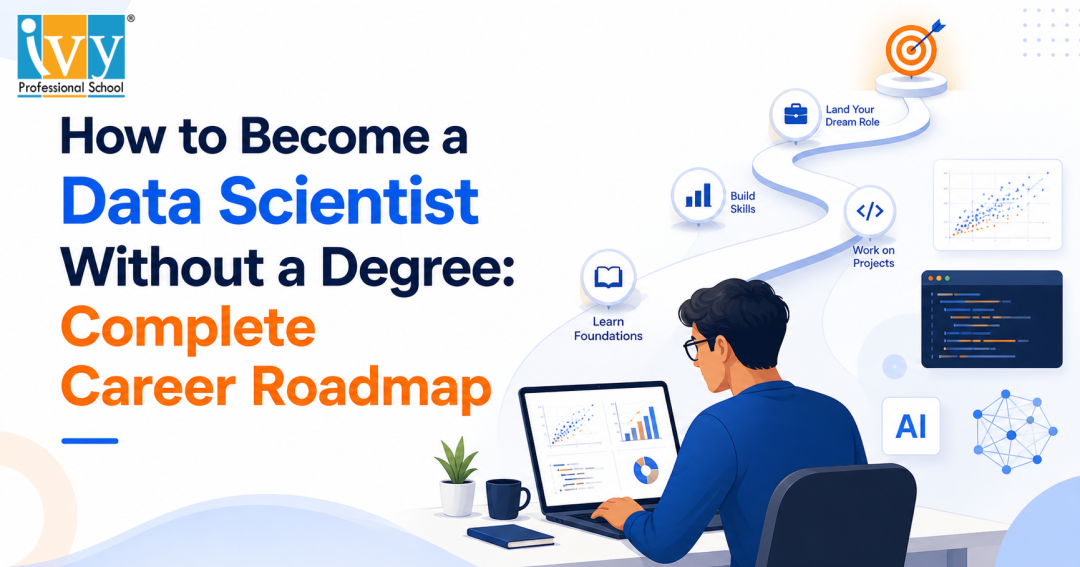
This blog will give you a practical, step-by-step roadmap on how to become a data scientist without a degree.
Before learning how to become a data scientist without a degree, it is important to understand the role clearly.
A data scientist works with data to solve business problems. Their job is not just to write code or build machine learning models. They need to understand the problem, collect and clean data, analyze patterns, create predictive models, and communicate the results to decision-makers.
For example, a data scientist may help a company answer questions like:
Which customers are likely to leave?
Which products should we recommend to users?
How can we predict sales for the next quarter?
Which factors are affecting employee performance?
How can we detect fraud or unusual activity?
A data scientist usually works with tools and techniques such as Python, SQL, statistics, machine learning, data visualization, business analytics, and sometimes generative AI.
This is why data science is not just a technical career. It is a business problem-solving career powered by data.
Yes, you can become a data scientist without a degree, but you cannot become one without skills.
This is the most important difference.
A degree may help you get shortlisted in some companies, especially large enterprises with strict hiring filters. However, many startups, product companies, analytics firms, consulting firms, and modern enterprises are open to candidates who can demonstrate real ability.
Your challenge is to replace the missing degree with proof.
That proof can come from:
A degree gives credibility. But practical work can also give credibility if it is presented well.
So, if you are wondering how to become a data scientist without a degree, the answer is simple: build skills, apply them on real projects, and show evidence of your work.
Many people make the mistake of directly jumping into machine learning. But data science starts with data analysis.
Before you build predictive models, you must know how to understand data.
Start with the following concepts:
You can begin with Excel because it is simple, widely used, and excellent for understanding data logic. Learn formulas, pivot tables, charts, lookup functions, filters, and basic dashboards.
After that, move to SQL and Python.
Your goal in this stage is to become comfortable with data. You should be able to look at a dataset and answer questions like:
If you want to become a data scientist without a degree, SQL is one of the most important skills to learn.
Most companies store their data in databases. SQL helps you extract, filter, join, and analyze that data.
You should learn:
SQL is not only for data engineers or analysts. Data scientists also use SQL regularly to collect and prepare data before modeling.
For example, if you are building a customer churn model, you may first need to pull customer purchase history, subscription details, support tickets, and payment records from different tables. SQL helps you bring all this data together.
A good SQL foundation can make you much more employable, even without a degree.
Python is one of the most popular programming languages for data science. It is beginner-friendly, powerful, and widely used in the industry.
You should focus on Python specifically for data science, not general software development.
Start with:
Once your basics are clear, move to data science libraries:
You do not need to become an expert programmer at the beginning. You need to become comfortable enough to work with data.
For example, you should be able to read a CSV file, clean missing values, create new columns, group data, visualize trends, and prepare the dataset for machine learning.
Python is where your data science journey becomes practical.
Many learners fear statistics, but you do not need to become a mathematician to become a data scientist.
You need applied statistics.
Start with concepts like:
Statistics helps you understand data properly. It also helps you avoid wrong conclusions.
For example, if sales increased after a marketing campaign, statistics can help you check whether the increase was meaningful or just random variation.
If two variables are correlated, statistics helps you understand whether that relationship is strong, weak, or misleading.
Without statistics, data science becomes blind model-building. With statistics, you learn how to reason with data.
Once you are comfortable with data analysis, SQL, Python, and statistics, you can start learning machine learning.
Machine learning is the process of teaching computers to learn patterns from data and make predictions or decisions.
Start with basic supervised learning techniques:
Do not just learn algorithms theoretically. Learn when to use them.
For example:
If you do not have a degree, your projects become your strongest proof.
Do not create only basic projects like “Iris flower classification” or “Titanic survival prediction.” These are okay for practice, but they are too common for your portfolio.
Instead, build projects that look like real business problems.
Some strong project ideas include:
A good project should answer:
This is how you show recruiters that you are not just learning tools. You are solving problems.
A portfolio is extremely important when learning how to become a data scientist without a degree.
Your portfolio should include 4 to 6 strong projects. Each project should be properly documented.
You can host your portfolio on:
For each project, include:
Final recommendation
For example, instead of writing:
“Built a machine learning model for churn prediction.”
Write:
“Built a customer churn prediction model to identify high-risk customers and help the business design retention campaigns. The model achieved strong recall, making it useful for identifying customers likely to leave.”
This sounds more business-oriented and professional.
A data scientist must be able to explain insights clearly.
Many candidates can build models, but they fail to communicate results. This is a major weakness.
You should learn tools like:
But tools are only one part. You must also learn data storytelling.
Data storytelling means presenting insights in a way that helps people make decisions.
For example, instead of saying:
“The churn rate is 23%.”
Say:
“Nearly one in four customers is leaving, and the highest churn is among customers with low usage and frequent support complaints. The company should focus retention offers on this segment first.”
This is much more useful.
Data science is not complete until the result is understood and acted upon.
Modern data scientists are increasingly using generative AI tools to speed up their work.
Tools like ChatGPT, Claude, Gemini, and GitHub Copilot can help with:
However, you should not depend blindly on AI. You must understand the logic behind what the tool gives you.
Generative AI can make you faster, but it cannot replace your thinking.
For someone learning how to become a data scientist without a degree, AI tools can be a huge advantage. They can act like a personal tutor, coding assistant, and project guide.
Use them wisely.
Certifications are not a replacement for skills, but they can help build credibility.
If you do not have a formal degree, certifications can show that you have taken structured learning seriously.
You can consider certifications in:
Choose certifications that require practical work, not only multiple-choice exams.
A good certification should help you build projects, practice problem-solving, and understand real business use cases.
When applying for jobs, certifications work best when combined with a strong portfolio.
Certification alone is weak. Certification plus projects is powerful.
You may not directly get a data scientist role at the beginning, especially without a degree. That is okay.
You can enter the field through related roles such as:
These roles help you gain practical data experience. Once you work with data in a company, it becomes easier to transition into data science.
Many successful data scientists started as data analysts.
So, do not wait for the perfect job title. Start where you can use data.
Your first goal should be to enter the data ecosystem. Your second goal should be to grow into a data scientist role.
Interview preparation is a key part of becoming a data scientist without a degree.
You should prepare for:
Recruiters may ask:
Your project explanation is especially important. Since you may not have a degree, your ability to explain your practical work becomes your biggest strength.
Practice explaining each project in a simple structure:
This makes your answers clear and professional.
LinkedIn can help you get noticed, especially if you are trying to become a data scientist without a degree.
Start posting about your learning journey.
You can share:
Do not wait until you become an expert. Share what you are learning in a professional way.
For example:
“This week, I built a customer churn prediction project using Python and logistic regression. I learned how recall is more important than accuracy when the business goal is to identify customers likely to leave.”
This shows practical thinking.
Over time, your LinkedIn profile becomes proof of your consistency, skills, and communication ability.
Many learners waste time because they follow the wrong approach.
Avoid these mistakes:
Learn a concept, apply it in a small project, document it, and move forward.
The timeline depends on your background, effort, and consistency.
If you are starting from zero, it may take 8 to 12 months of serious learning and practice to become job-ready for entry-level data roles.
A practical timeline can look like this:
First 2 months: Excel, data analysis basics, and SQL
Next 2 months: Python, Pandas, NumPy, and visualization
Next 2 months: Statistics and machine learning basics
Next 2 months: Real-world projects and portfolio
Next 1 to 2 months: Interview preparation and job applications
If you already know Excel, programming, or analytics, your journey may be faster.
But do not measure progress only by time. Measure it by output.
How many projects have you completed?
Can you write SQL queries confidently?
Can you clean data in Python?
Can you explain machine learning models?
Can you solve a business problem using data?
These are better indicators of readiness.
Here is a simple roadmap you can follow:
This roadmap is practical because it builds your skills in the same order used in real jobs.
You first learn to understand data, then analyze it, then model it, then communicate the result.
Becoming a data scientist without a degree is possible, but it requires discipline, consistency, and proof of skill.
You do not need to wait for permission from a university or a formal program to start your data science journey. Today, you can learn the tools, build projects, publish your work, and apply for opportunities with a strong portfolio.
The key is to focus on practical learning.
Do not just learn Python. Use Python to solve problems.
Do not just learn machine learning. Build models for real use cases.
Do not just complete courses. Create proof of work.
If you can show that you understand data, solve business problems, and communicate insights clearly, you can build a successful career in data science even without a degree.
The path may not be easy, but it is very much possible.
Start small. Stay consistent. Build projects. Share your work. Apply early.
That is how to become a data scientist without a degree.
You have not enough Humanizer words left. Upgrade your Surfer plan.
Prateek Agrawal is the founder and director of Ivy Professional School. He is ranked among the top 20 analytics and data science academicians in India. With over 16 years of experience in consulting and analytics, Prateek has advised more than 50 leading companies worldwide and taught over 7,000 students from top universities like IIT Kharagpur, IIM Kolkata, IIT Delhi, and others.