


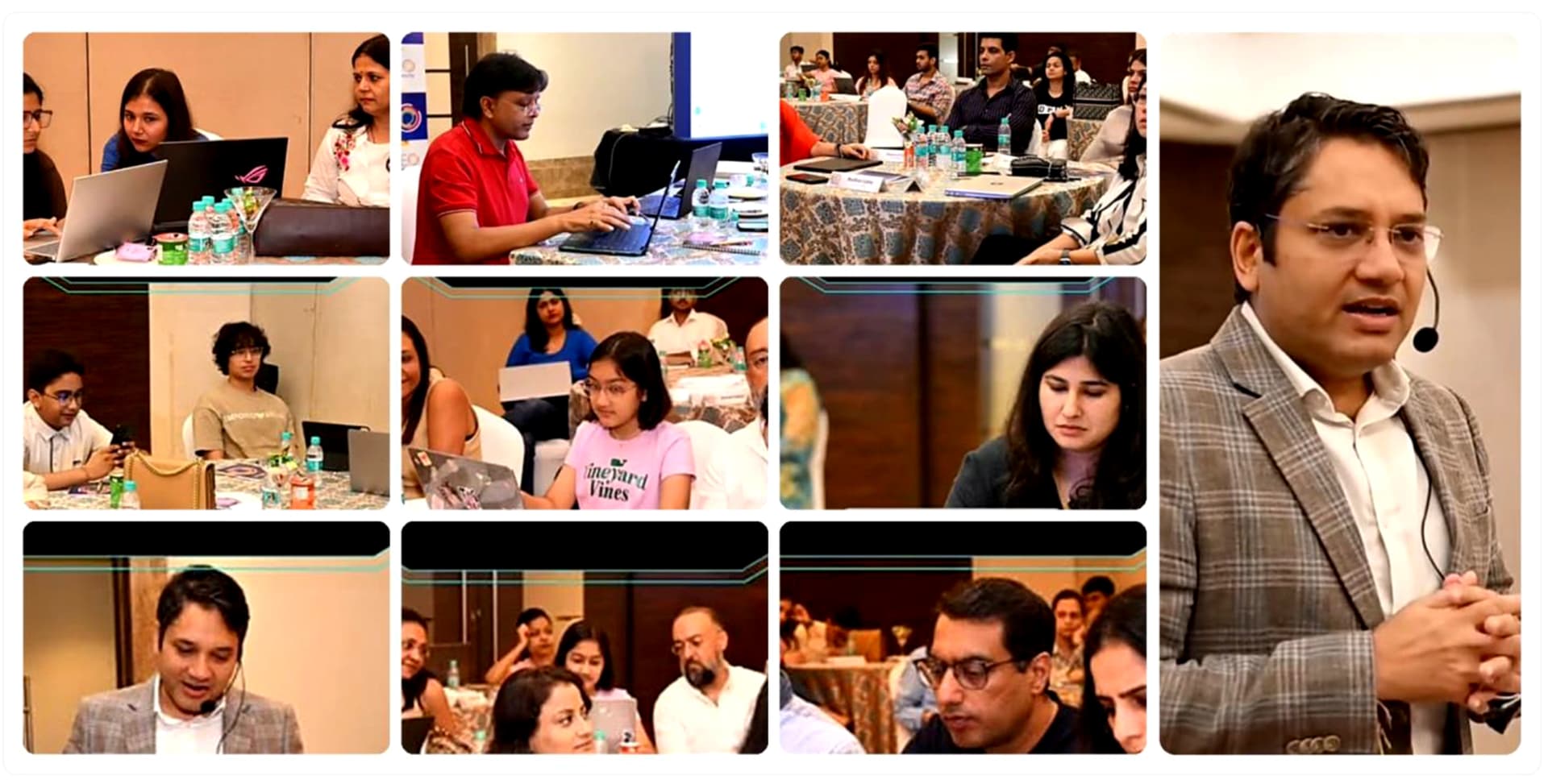
AI WORKSHOP FOR ENTREPRENEURS / BUSINESS TRANSFORMATION / CASE STUDY
AI Workshop for Entrepreneurs: From Chatbots to Predictive AI
How Ivy Professional School helped 50 business owners, founders and CXOs convert AI experimentation into 86 business use cases, 18 prototypes, 14 pilots and a six-month implementation roadmap.
50
ENTREPRENEURS
business owners, founders and CXOs
6 hrs
HANDS-ON AI TRAINING
one-day, in-person intensive
86
AI USE CASES
identified across five business areas
14
PILOTS INITIATED
with owners and 30-day actions
14
PILOTS INITIATED
with owners and 30-day actions
A hands-on AI training programme that turned business problems into implementation-ready AI assistants, data insights, predictive use cases and automation workflows.
Why entrepreneurs struggle to implement AI in their businesses
Most participants had tried ChatGPT, Gemini or similar generative AI tools. The challenge was moving beyond isolated prompts to repeatable AI workflows, owned projects and measurable returns.
BUSINESS CONTEXT
Entrepreneurs wanted to improve sales speed, customer response and cost efficiency without building large technology teams or investing in complex AI infrastructure.
- ●Fragmented AI use - Tools were used for writing or research, not embedded into sales, service, finance or operations.
- ●No use-case prioritisation - Teams lacked a framework to rank opportunities by impact, effort, data readiness and risk.
- ●Low implementation confidence - Founders were unsure how to move from a promising AI idea to a working prototype and pilot.
- ●Unclear AI ROI - Benefits were qualitative, with few quantified time-saving, revenue or payback hypotheses.
THE CORE QUESTION
“Which AI use cases should we implement first - and how will we measure business value?”
The workshop answered this through hands-on AI training, rapid prototyping and use-case business cases.
Four barriers to successful AI adoption
Tool-first AI experimentation
Participants started with a platform rather than a business problem, process owner and success metric.
Prototype-to-pilot gap
Chatbots, websites and automations remained demos because no rapid build and validation path existed.
Business data-to-action gap
Sales and financial data was available, but turning it into insights and predictions remained slow.
No AI implementation roadmap
Initiatives lacked sequencing, governance, ownership and a realistic 30/60/180-day plan.
The shift created by the AI workshop
BEFORE
Scattered AI prompts, generic demos and vendor dependence
AFTER
Prioritised AI use cases, working prototypes, owners, timelines and ROI hypotheses
How Ivy’s hands-on AI workshop moved ideas into implementation
Ivy Professional School structured the six-hour AI training programme as a series of short concept inputs, guided builds and business decisions. Each module produced an asset or next step for the participant’s six-month AI roadmap.
A six-stage build-to-implementation journey
Discover
Find high-value AI opportunities
›Prompt
Create reliable business instructions
›Build
Develop web, app and assistant assets
›Analyse
Turn sales and financial data into actions
›Predict
Test purchase likelihood and ML use cases
›Automate
Connect forms, messages and workflows
Design principles of the AI training programme
Start with a measurable business problem
Every exercise began with a sales, service, operations or decision challenge - not a tool demonstration.
Build a working AI asset
Participants created prompts, assistants, web assets, analyses, predictive examples and automation flows.
Assign ownership and milestones
Each priority use case gained an owner, success metric and 30/60/180-day implementation horizon.
What participants built during the AI workshop
AI assistants and prompt systems
Role-specific assistants for market research, marketing, customer response, proposal drafting and operating decisions.
AI websites and app prototypes
Rapid landing pages, simple applications and customer-facing assets built with no-code and low-code AI tools.
AI-powered data and predictive insights
Sales-data analysis, growth recommendations and a practical customer purchase-likelihood model.
AI automation workflows
Workflows connecting forms, WhatsApp or email, spreadsheets and follow-up actions.
AI workshop results: 86 use cases, 14 pilots and 8 implementations
The programme created a measurable AI implementation pipeline. Participants converted business problems into prioritised opportunities, working prototypes, pilot commitments and implemented use cases.
86
AI USE CASES IDENTIFIED
across five business areas
31
AI USE CASES PRIORITISED
through impact-effort screening
18
WORKING AI PROTOTYPES
created during or immediately after
14
AI PILOTS INITIATED
with owners and 30-day actions
8
AI USE CASES IMPLEMENTED
within the 60-day draft follow-up
360
HOURS / MONTH
estimated capacity released
₹6.8 Cr
ANNUAL VALUE OPPORTUNITY
estimated from time and growth cases
88%
ROADMAP COMPLETION
participants with a 6-month plan
From ideas to implemented business value
Implementation conversion: 9% of ideas reached live use within 60 days
Business impact of the AI training programme
Faster AI time to value
Assistants, reporting workflows and customer-response automations moved from concept to pilot in days rather than months.
Lower cost of AI experimentation
Existing SaaS, no-code and low-code tools let participants test ideas before custom development.
Stronger AI governance and execution
A quantified use-case backlog helped leaders fund, sequence and govern AI initiatives against business outcomes.
High-value AI use cases identified by entrepreneurs
The use-case portfolio spanned sales and marketing, customer service, operations, finance and new digital products - areas where AI could improve revenue velocity, employee capacity, customer response and management visibility.
Where entrepreneurs found the highest-value opportunities
Share of prioritised use cases by business area
Representative AI use cases from the implementation pipeline
AI SALES FOLLOW-UP
AI-assisted lead qualification and follow-up
Faster response; reduced enquiry leakage
AI SALES ANALYTICS
Automated analysis of sales and customer data
Shorter reporting cycle; clearer actions
AI CONTENT AUTOMATION
Repeatable campaign and proposal drafting workflow
Lower first-draft time; brand consistency
AI OPERATIONS AUTOMATION
Form-to-message-to-sheet automation
Less manual entry; better process visibility
Why this AI training model works for enterprise teams
- ●Custom corporate AI training - Examples, datasets and activities can be aligned to functions, processes and strategic priorities.
- ●Applied learning with workplace outputs - Every module produces an observable asset, reducing the distance between training and implementation.
- ●ROI-focused AI use-case selection - Projects are evaluated on value, feasibility, ownership, data readiness and measurable success criteria.
- ●Scalable enterprise AI adoption - The workshop can feed into pilot clinics, project mentoring, functional cohorts and enterprise programmes.
FROM AI TRAINING TO BUSINESS TRANSFORMATION
The core deliverable is not tool familiarity.
It is a governed pipeline of AI use cases with evidence, ownership and momentum.
Custom AI workshops for leaders, functional teams and cross-functional cohorts
Build a custom AI training programme around your organisation’s use cases.
Generative AI, analytics, predictive AI and automation training
SEO PUBLISHING SPECIFICATION
Recommended on-page SEO setup
Use this internal handoff when publishing the case study on ivyproschool.com. The first five pages contain the public-facing copy; this page provides the CMS fields and implementation requirements.
Core SEO fields
Keyword and internal-link map
- • AI training for business owners
- • Generative AI workshop
- • AI automation training
- • Predictive AI training
- • Business AI use cases
- • Corporate AI training in India
Website implementation checklist
Semantic headings
Use one H1. Publish the problem, solution, impact and business-value titles as descriptive H2/H3 headings.
Visible metric text
Keep the 86, 31, 18, 14 and 8 impact figures as HTML text, not only as labels inside chart images.
Optimised images
Use descriptive filenames and alt text. Compress photographs and charts to WebP without reducing legibility.
Structured data
Implement Article or BlogPosting, Organization and BreadcrumbList JSON-LD with accurate author, publisher and dates.
Crawl and index
Add a canonical URL, include the page in the XML sitemap and confirm that robots directives allow indexing.
Measurement
Track organic sessions, search queries, CTA clicks and qualified enquiries in Search Console and analytics.